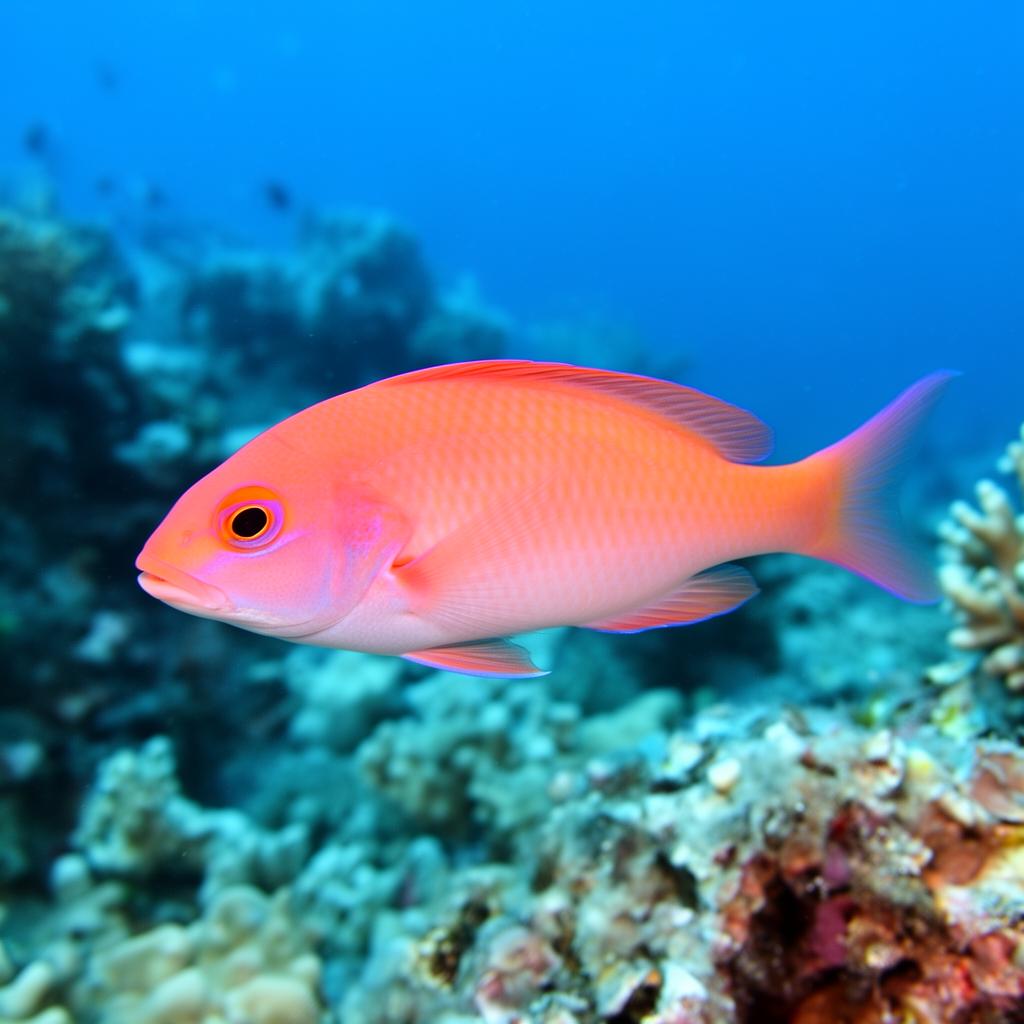
Anthias
Pseudanthias spp.
About Anthias
Vibrant schooling fairy fish that dance above coral heads
Quick Facts
- Habitat: Anthias, members of the genus *Pseudanthias*, are a ubiquitous sight on healthy coral reefs throughout the **Indo-Pacific and Red Sea**, typically inhabiting depths ranging from a few meters down to over 100 meters. Divers commonly encounter them in the vibrant reef systems of the **Philippines (e.g., Tubbataha Reefs Natural Park)**, **Indonesia (e.g., Raja Ampat, Komodo National Park)**, **Australia's Great Barrier Reef**, and the **Maldives atolls**. These small, brightly colored fish prefer areas with strong currents that deliver their planktonic food source, often congregating in massive schools around **coral bommies, reef edges, and steep drop-offs**. They are a vital component of the reef ecosystem, often found near cleaning stations and serving as a food source for larger predators. While primarily day-active, they retreat into the reef's crevices for protection during the night. Their consistent presence makes them a reliable sighting on most dives in their range, forming a dynamic, shimmering backdrop to the reef. They exhibit strong site fidelity, remaining in their preferred reef sections year-round as long as conditions remain stable.
- Diet: Anthias are **obligate planktivores**, meaning their diet consists almost exclusively of zooplankton. They are **active daylight feeders**, positioning themselves above the reef in the water column to filter out microscopic organisms drifting by in the currents. Their feeding strategy involves a constant, almost rhythmic gulping motion, as they individually pick out copepods, ostracods, and other small crustaceans from the water. These fish do not actively hunt in the traditional sense; instead, they rely on the **currents to deliver their food**. Their bright coloration and schooling behavior serve as a form of **safety in numbers** against predators while they are exposed during feeding. The abundance of suitable food dictates their population density, often leading to **dense aggregations** in nutrient-rich waters. Their feeding is a continuous activity throughout the day, essential for sustaining their high metabolic rates and vibrant energy.
- Best season: Anthias are a **year-round spectacle** across their range, with their consistent presence being a hallmark of healthy reef systems. However, specific regions might offer enhanced viewing experiences due to seasonal variations in water clarity, current strength, and overall reef activity. In the **Philippines**, particularly areas like **Palawan and Visayas**, the **dry season from November to May** often brings calmer seas and exceptional visibility, allowing for clearer observations of their massive schools. Similarly, **Indonesia's Raja Ampat** is superb **October to April**, coinciding with the region's main dive season, offering the best conditions for vast schools along current-swept reefs. The **Red Sea** provides excellent viewing opportunities almost **all year**, though the **warmer months of May to October** can lead to increased plankton blooms, sometimes reducing visibility but potentially boosting the anthias' food supply. Generally, any time is a good time to see Anthias, but aiming for **peak dive seasons** in specific locations will provide the most comfortable and rewarding overall diving conditions to appreciate their abundance.
Fun Facts
Anthias are all born female—the dominant fish transforms into a male,If the male dies, the largest female changes sex within days,Schools of anthias can number in the thousands on healthy reefs
Diving Tips
Encountering Anthias is almost a given on any healthy Indo-Pacific or Red Sea reef dive, but observing them effectively requires **calm and deliberate diver behavior**. Approach aggregations slowly and avoid sudden movements, as this can startle them. Rather than focusing on a single fish, observe the **dynamic behavior of the entire school**, especially their synchronized movements as they feed or react to a passing predator. Look for them congregating on **exposed reef edges, bommies, and steep walls**, particularly where **currents are moderate to strong**, as these are their preferred feeding grounds. Pay attention to the **coloration disparities** within schools; males of many species are typically larger and more vibrantly colored than females, sometimes displaying distinct sexual dimorphism. For photography, use a **wide-angle lens** to capture the vastness of the school. Always maintain **excellent buoyancy control** to avoid contact with the reef, which can damage their habitat. Remember, these are wild animals; **do not attempt to touch or feed them**. Enjoy their beauty from a respectful distance, appreciating their crucial role in the reef ecosystem. Ethical diving practices dictate minimal impact, so simply observe and admire their natural behavior without interference. Note that larger predatory fish, like trevally or tuna, often patrol the edges of anthias schools, providing an additional photographic or observational opportunity.