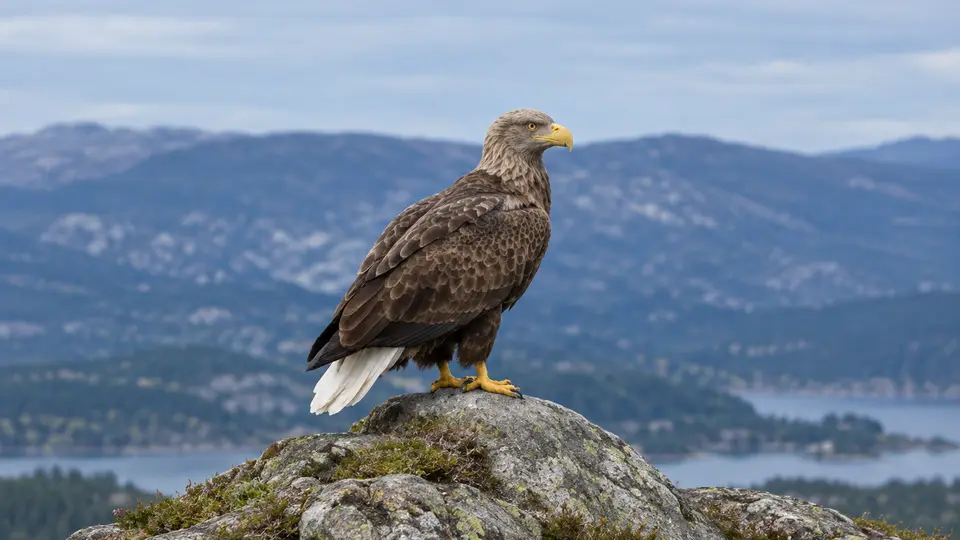
White-tailed Eagle in its natural habitat, AI illustration

White-tailed Eagle: where and when to see them

Haliaeetus albicilla

White-tailed Eagle at a glance

The white-tailed eagle is one of Eurasia's largest raptors, with broad wings, a heavy bill and a short, wedge-shaped tail. Adults develop the white tail that gives the species its name, while younger birds remain darker and more mottled. Norway supports a substantial population, and reintroduction restored the species to Scotland after historical persecution. Coastal territories can offer impressive distant views, but nest disturbance and illegal killing remain important regional concerns.

Behaviour & reproduction

Size
69-95 cm long; wingspan 180-245 cm
Weight
3.5-7 kg
Lifespan
Not reliably established
Status
Least Concern

White-tailed eagles spend long periods perched near productive feeding areas, alternating patient watching with powerful flights and soaring patrols. They catch prey, scavenge and sometimes steal food from other birds. Established pairs can reuse large stick nests over many years, adding fresh material each season. Young eagles wander more widely before settling, while adults often remain associated with territories, making local patterns different from a simple seasonal migration. Courtship displays involve spectacular aerial maneuvers, including talon grappling and synchronized dives. Their strong pair bonds can last for life, with both parents sharing incubation and chick-rearing duties.

Top wildlife locations

Norway wildlife habitat

Norway

Fjord shores, outer-coast viewpoints and island coastlines offer plausible distant observation. Some territories lie on remote or protected islands, so use public shore access or decks without assuming nesting areas permit landings.

Adventure cruises in Norway
Scotland wildlife habitat

Scotland

West-coast sea lochs and island shore viewpoints provide plausible habitat, although distribution remains uneven. Some viewing requires travel to remote coastal districts, and nest protection zones or private land can restrict access.

Adventure cruises in Scotland

Destinations describe the species' habitat, not guaranteed cruise stops. Some animals require an optional inland excursion or are found in restricted reserves.

Fun facts about the White-tailed Eagle

  • Females are typically larger than males.
  • The white adult tail develops gradually as immature plumage is replaced.
  • Scottish reintroduction efforts used birds originating from Norway.
  • Repeated additions can turn a long-used nest into a very large structure.

Best time to see the White-tailed Eagle

In Norway and Scotland, spring through early autumn offers long daylight for coastal observation, while resident adults can be seen year-round. Winter sometimes concentrates birds near dependable food, but weather reduces viewing opportunities. Breeding begins well before midsummer, so nest sensitivity is not confined to peak tourism. Prime viewing in Norway and Scotland is from May to September when young birds are active and adults are provisioning. During this period, the warmer weather also makes deck observations more comfortable.

White-tailed Eagle: season matrix by destination

Travel and observation windows vary by region. Highlighted months are an orientation for planning, not confirmed sightings or a guarantee of access.

Norway

Longer daylight favors coastal watching; many adults are resident year-round, and this window is not a guarantee or a complete breeding calendar.

JanFebMarAprMayJunJulAugSepOctNovDec
Cruise ships in Norway

Scotland

These months provide useful daylight for shore observation; resident birds also occur in winter, and local breeding restrictions must be checked.

JanFebMarAprMayJunJulAugSepOctNovDec
Cruise ships in Scotland

Where the White-tailed Eagle lives

Coasts, sea lochs, fjords, large lakes and broad river systems provide suitable feeding habitat. Nesting requires relatively secure trees or cliffs with limited disturbance. Exposed shorelines can be productive, but sheltered bays and inland waters are also used when prey is available. They typically build their massive stick nests in tall trees or on inaccessible cliff ledges. These large territories ensure adequate prey resources and minimal human disturbance.

What the White-tailed Eagle eats

Fish, waterbirds and carrion are major foods, with mammals and other available prey taken opportunistically. Fish may be seized near the surface or scavenged after washing ashore. Seasonal changes in food supply can shift feeding activity between coastlines, wetlands and nearby terrestrial habitats. They are skilled at kleptoparasitism, often stealing fish from ospreys or other seabirds. While primarily piscivorous, they can also prey on small mammals like rabbits and hares.

Species at a glance

Common name
White-tailed Eagle
Scientific name
Haliaeetus albicilla
Animal group
Birds
Size
69-95 cm long; wingspan 180-245 cm
Weight
3.5-7 kg
Lifespan
Not reliably established
Status
Least Concern
Identification
Compared with the golden eagle, adults have a white wedge-shaped tail, a much heavier yellow bill and broader, more rectangular wings. Juveniles are generally darker brown with a less distinct tail and a dark bill, gradually acquiring adult plumage over several years. Their immense wingspan, often exceeding 2 meters, is a key identification feature even at great distances.

White-tailed Eagle: frequently asked questions

Where can I see the White-tailed Eagle?
Norway, Scotland. Scan shorelines and distant slopes from public viewpoints without approaching nests. Keep clear of cliff edges, and avoid baiting or lingering where adults repeatedly alarm; a telescope allows useful views without disrupting feeding or breeding. From the cruise ship, look for their distinctive silhouette soaring high over coastal areas or perched prominently on clifftops. Guided shore excursions often visit known nesting or feeding territories, providing opportunities for distant scope viewing.
When is the best time to see the White-tailed Eagle?
In Norway and Scotland, spring through early autumn offers long daylight for coastal observation, while resident adults can be seen year-round. Winter sometimes concentrates birds near dependable food, but weather reduces viewing opportunities. Breeding begins well before midsummer, so nest sensitivity is not confined to peak tourism. Prime viewing in Norway and Scotland is from May to September when young birds are active and adults are provisioning. During this period, the warmer weather also makes deck observations more comfortable.
How big does the White-tailed Eagle get?
69-95 cm long; wingspan 180-245 cm. Adult weight: 3.5-7 kg. Size varies with age, sex and population.
How should I behave around the White-tailed Eagle?
Scan shorelines and distant slopes from public viewpoints without approaching nests. Keep clear of cliff edges, and avoid baiting or lingering where adults repeatedly alarm; a telescope allows useful views without disrupting feeding or breeding. From the cruise ship, look for their distinctive silhouette soaring high over coastal areas or perched prominently on clifftops. Guided shore excursions often visit known nesting or feeding territories, providing opportunities for distant scope viewing.
What does the White-tailed Eagle eat?
Fish, waterbirds and carrion are major foods, with mammals and other available prey taken opportunistically. Fish may be seized near the surface or scavenged after washing ashore. Seasonal changes in food supply can shift feeding activity between coastlines, wetlands and nearby terrestrial habitats. They are skilled at kleptoparasitism, often stealing fish from ospreys or other seabirds. While primarily piscivorous, they can also prey on small mammals like rabbits and hares.
Are wildlife sightings guaranteed on an adventure cruise?
No. Animals move freely and routes, weather, access restrictions and local conditions influence every outing. Confirm the actual itinerary and shore program before booking.

Compare wildlife in the same destinations

Explore other birds recorded in these destinations. Similar surroundings do not mean the animals share the same habits or viewing season.

Species comparison by animal group and destination
White-tailed EagleWhite-tailed EagleArctic TernArctic TernAtlantic PuffinAtlantic Puffin
Animal groupBirdsAnimal groupBirdsAnimal groupBirds
DestinationsNorway, ScotlandDestinationsAlaska, Norway, ArcticDestinationsNew England, Norway, Scotland, Arctic
All wildlife destinations
Plan your trip

Find your next wildlife adventure

Compare destinations, shore programs and dates with the animals and habitats you would love to see.

  • Naturalist-led shore excursions
  • Responsible wildlife watching
  • Small expedition ships

Newsletter

Take Blue Rides with you

Adventure cruise offers, last-minute deals and trip inspiration.

Free, unsubscribe anytime. Details: Privacy Policy

Partner with Blue Rides

Affiliate Program

Recommend adventure cruises and earn commission on every confirmed booking.

Share. Track. Earn.
