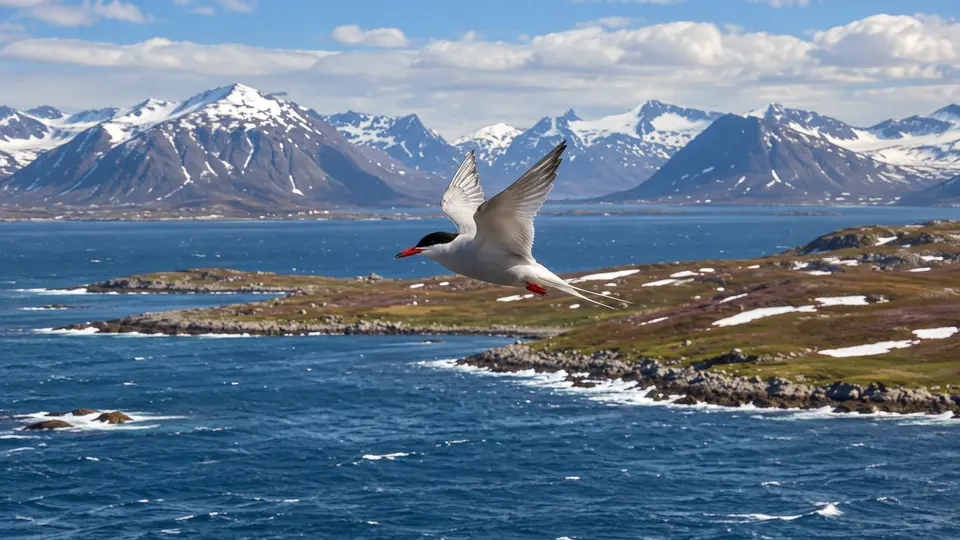
Arctic Tern in its natural habitat, AI illustration
Size33-39 cm body lengthLifespanNot reliably establishedStatusLeast Concern

Arctic Tern: where and when to see them

Sterna paradisaea

Arctic Tern at a glance

The Arctic tern is a slender seabird famous for linking northern breeding grounds with the Southern Ocean through exceptionally long migrations. Its narrow wings, deeply forked tail and buoyant flight suit a life spent following marine productivity. Breeding adults have a black cap and red bill, but identification requires care where related terns occur. Despite its name, the species also breeds in temperate northern regions, including inland freshwater sites.

Behaviour & reproduction

Size
33-39 cm body length
Weight
90-120 g
Lifespan
Not reliably established
Status
Least Concern

Arctic terns breed in colonies or scattered pairs and defend eggs and chicks with loud calls and repeated aerial attacks on intruders. Both parents incubate and deliver small prey to their young. After breeding, birds disperse along complex oceanic migration routes rather than flying directly between poles. They often hover before taking food from the surface, and communal feeding can develop where small fish or crustaceans concentrate near shore. Courtship involves aerial displays where the male presents a fish to the female, a behavior known as 'fish flights.' They are known for their aggressive defense of nests, often striking the heads of perceived threats, including humans. Post-breeding, they undergo a complete molt before embarking on their epic southward migration.

Top wildlife locations

Alaska wildlife habitat

Alaska

Coastal gravel, low islands and nearby tundra wetlands provide suitable breeding habitat. Some colonies require remote access, while others are visible from established paths; nesting closures and defensive birds must be respected.

Adventure cruises in Alaska
Norway wildlife habitat

Norway

Norwegian coastal islands and Svalbard's gravel shores can support breeding terns. View from established coastal routes where permitted; many small islands have seasonal access restrictions, and colonies should not be entered.

Adventure cruises in Norway
Arctic wildlife habitat

Arctic

Low coastal tundra, gravel spits and small islands offer plausible breeding habitat across much of the Arctic. Remote shores may be inaccessible, and local permissions determine whether land-based observation is appropriate.

Adventure cruises in Arctic

Destinations describe the species' habitat, not guaranteed cruise stops. Some animals require an optional inland excursion or are found in restricted reserves.

Fun facts about the Arctic Tern

  • Tracked migrations can exceed 70,000 km in a year.
  • Its annual travels expose it to unusually long periods of daylight.
  • Both parents incubate the eggs and provision chicks.
  • Some individuals have survived for more than three decades.

Best time to see the Arctic Tern

June and July usually offer the strongest overlap of northern colony activity and accessible coastal travel, with May or August useful in some regions. Arrival, nesting and departure vary with latitude and weather. These northern opportunities are separate from its Southern Ocean nonbreeding period. In the Arctic, early summer offers the best chance to observe courtship rituals and early nesting activity. Observing them from ship decks during June and July provides excellent opportunities to witness their aerial foraging and colony life. The timing of their arrival and departure is highly synchronized with the peak availability of their marine prey.

Arctic Tern: season matrix by destination

Travel and observation windows vary by region. Highlighted months are an orientation for planning, not confirmed sightings or a guarantee of access.

Alaska

June and July are generally most relevant for breeding-area observation; August opportunities vary as birds disperse and migrate.

JanFebMarAprMayJunJulAugSepOctNovDec
Cruise ships in Alaska

Norway

Timing shifts northward: mainland arrivals can precede those in Svalbard, and late-summer departures vary with breeding progress.

JanFebMarAprMayJunJulAugSepOctNovDec
Cruise ships in Norway

Arctic

This broad summer window reflects coastal access and northern breeding presence, with substantial variation by latitude and local ice conditions.

JanFebMarAprMayJunJulAugSepOctNovDec
Cruise ships in Arctic

Where the Arctic Tern lives

Breeding habitat includes gravel beaches, low islands, rocky shorelines and sparsely vegetated tundra near water. Some pairs nest beside inland lakes and rivers. Outside breeding, Arctic terns range widely over marine waters and spend much of the northern winter in the Southern Ocean. Arctic terns undertake the longest migratory journey of any bird, traveling annually between Arctic breeding grounds and Antarctic nonbreeding areas. They prefer low-lying, often remote islands or coastal areas, making them less frequently seen on mainland shores during breeding. During their nonbreeding season, they are pelagic, spending most of their time far out at sea.

What the Arctic Tern eats

Small fish and marine crustaceans are principal foods, supplemented by insects and other invertebrates, particularly around freshwater breeding sites. Birds capture prey near the water surface. Food delivered to chicks varies locally, and shortages of suitable fish can sharply reduce breeding success. They employ a 'dip-feeding' technique, snatching prey from the water's surface while in flight or hovering. Their diet also includes small invertebrates, especially insects, which are crucial for adults and chicks in freshwater-influenced breeding areas. Local food availability and quality directly impact their reproductive success and chick survival.

Species at a glance

Common name
Arctic Tern
Scientific name
Sterna paradisaea
Animal group
Birds
Size
33-39 cm body length
Weight
90-120 g
Lifespan
Not reliably established
Status
Least Concern
Identification
Breeding adults usually have a short all-red bill, very short red legs and longer tail streamers than common terns, though nonbreeding birds are harder to separate. Their translucent primary flight feathers, visible when backlit, are a key identification feature distinguishing them from other terns. In flight, their graceful, buoyant wingbeats and slender profile are characteristic. The long, deeply forked tail streamers extend well beyond the wingtips, especially prominent in breeding adults.

Arctic Tern: frequently asked questions

Where can I see the Arctic Tern?
Alaska, Norway, Arctic. Keep outside marked nesting areas and turn back when repeated alarm calls or swoops indicate disturbance. Use an existing path, protect your head without striking birds, and never step toward camouflaged eggs. When viewing from a vessel, scanning small, rocky islands and low-lying coastlines can reveal active colonies. Binoculars are essential for observing details of their plumage and behavior from a respectful distance. Their constant activity and distinctive calls make them noticeable, even from afar.
When is the best time to see the Arctic Tern?
June and July usually offer the strongest overlap of northern colony activity and accessible coastal travel, with May or August useful in some regions. Arrival, nesting and departure vary with latitude and weather. These northern opportunities are separate from its Southern Ocean nonbreeding period. In the Arctic, early summer offers the best chance to observe courtship rituals and early nesting activity. Observing them from ship decks during June and July provides excellent opportunities to witness their aerial foraging and colony life. The timing of their arrival and departure is highly synchronized with the peak availability of their marine prey.
How big does the Arctic Tern get?
33-39 cm body length. Adult weight: 90-120 g. Size varies with age, sex and population.
How should I behave around the Arctic Tern?
Keep outside marked nesting areas and turn back when repeated alarm calls or swoops indicate disturbance. Use an existing path, protect your head without striking birds, and never step toward camouflaged eggs. When viewing from a vessel, scanning small, rocky islands and low-lying coastlines can reveal active colonies. Binoculars are essential for observing details of their plumage and behavior from a respectful distance. Their constant activity and distinctive calls make them noticeable, even from afar.
What does the Arctic Tern eat?
Small fish and marine crustaceans are principal foods, supplemented by insects and other invertebrates, particularly around freshwater breeding sites. Birds capture prey near the water surface. Food delivered to chicks varies locally, and shortages of suitable fish can sharply reduce breeding success. They employ a 'dip-feeding' technique, snatching prey from the water's surface while in flight or hovering. Their diet also includes small invertebrates, especially insects, which are crucial for adults and chicks in freshwater-influenced breeding areas. Local food availability and quality directly impact their reproductive success and chick survival.
Are wildlife sightings guaranteed on an adventure cruise?
No. Animals move freely and routes, weather, access restrictions and local conditions influence every outing. Confirm the actual itinerary and shore programme before booking.

Compare wildlife in the same destinations

Explore other birds recorded in these destinations. Similar surroundings do not mean the animals share the same habits or viewing season.

Species comparison by animal group and destination
Arctic TernArctic TernAtlantic PuffinAtlantic PuffinBald EagleBald Eagle
Animal groupBirdsAnimal groupBirdsAnimal groupBirds
DestinationsAlaska, Norway, ArcticDestinationsNew England, Norway, Scotland, ArcticDestinationsAlaska, Florida, New England
All wildlife destinations
Plan your trip

Find your next wildlife adventure

Compare destinations, shore programmes and dates with the animals and habitats you would love to see.

  • Naturalist-led shore excursions
  • Responsible wildlife watching
  • Small expedition ships

Newsletter

Take Blue Rides with you

Adventure cruise offers, last-minute deals and trip inspiration.

Free, unsubscribe anytime. Details: Privacy Policy

Partner with Blue Rides

Affiliate Program

Recommend adventure cruises and earn commission on every confirmed booking.

Share. Track. Earn.