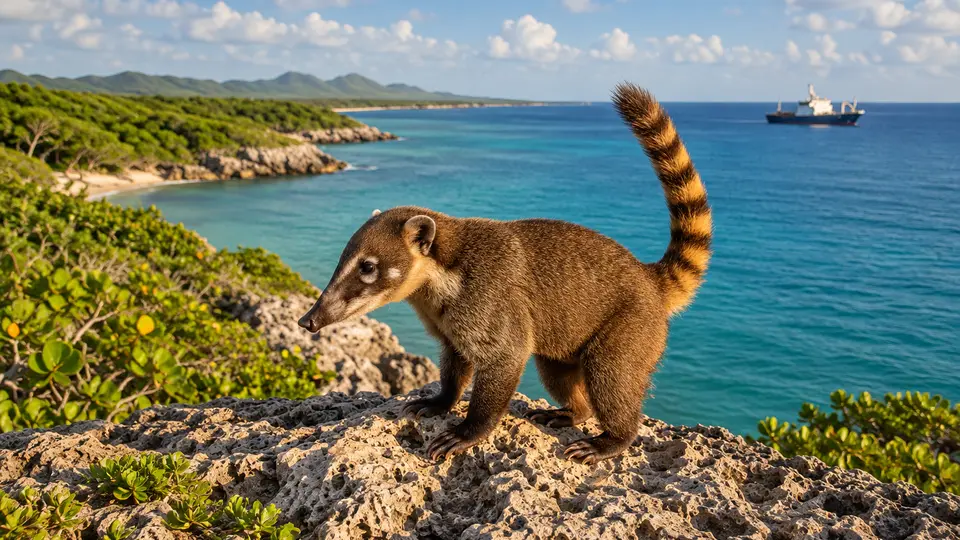
White-nosed Coati in its natural habitatAI-modified

White-nosed CoatiNasua naricaWhere and when to see them

White-nosed Coati at a glance

The white-nosed coati is a long-snouted member of the raccoon family found from the southwestern United States through Central America into northwestern South America. It combines a flexible nose, strong digging claws and a long, often ringed tail. In Mexico and Costa Rica, it occurs in forests and some coastal protected landscapes. Familiarity around visitor facilities can disguise its wild nature, and food-conditioned animals can become assertive or vulnerable to unsuitable diets.

Behaviour & reproduction

Size
40-65 cm (16-26 in) head-body; tail 40-65 cm (16-26 in)
Weight
3-6 kg (6.6-13.2 lb)
Lifespan
Not reliably established
Status
Least Concern

Females and younger animals commonly travel in bands, while adult males are often solitary outside the breeding period. Coatis spend much of the day searching leaf litter, probing crevices and digging for hidden food. They climb readily to feed, rest or escape danger, and often carry the tail upright when moving on the ground. Group members communicate through calls and body postures, maintaining contact while spreading out across a feeding area. Bands of coatis exhibit a coordinated foraging strategy, often spreading out but remaining in vocal contact to exploit food resources efficiently. When startled or threatened, they may freeze, then scatter into trees or dense undergrowth for safety.

Top wildlife locations

Costa Rica wildlife habitatAI-modified

Costa Rica

Coastal dry forest and protected woodland trails offer plausible viewing, sometimes requiring a short terrestrial excursion from the shore. Animals near visitor facilities may be food-conditioned, so avoid feeding sites and maintain distance.

Mexico wildlife habitatAI-modified

Mexico

Wooded coastal reserves and forest-edge trails in suitable parts of Mexico provide plausible habitat. Open beaches alone are unpromising, and reaching natural populations may require an inland excursion rather than remaining at waterfront facilities.

Destinations describe the species' habitat, not guaranteed cruise stops. Some animals require an optional inland excursion or are found in restricted reserves.

Fun facts about the White-nosed Coati

  • Its flexible snout can probe narrow spaces while searching for food.
  • Female-led bands contrast with the more solitary lives of many adult males.
  • It can descend trees headfirst using highly mobile ankle joints.
  • The long tail helps balance climbing movements but is not prehensile.

Best time to see the White-nosed Coati

Coatis are active year-round in Costa Rica and Mexico. Dry-season months often make forest paths easier to use, particularly on Pacific slopes, but do not mark a universal peak in animal activity. Regional rainfall, fruit availability and local protection affect viewing opportunities more directly. Breeding typically occurs between January and March, with births following in April to May, which might influence band size and visibility. While dry season offers easier access, lush wet season foliage can provide more cover and food for these animals.

White-nosed Coati: season matrix by destination

Travel and observation windows vary by region. Highlighted months are an orientation for planning, not confirmed sightings or a guarantee of access.

Costa Rica

These months generally favor Pacific-side trail access; coatis are resident, and Caribbean rainfall follows a different pattern.

JanFebMarAprMayJunJulAugSepOctNovDec
Cruise ships in Costa Rica

Mexico

A broadly useful dry-season travel window for many tropical regions, not a national breeding season or assurance of local coati presence.

JanFebMarAprMayJunJulAugSepOctNovDec
Cruise ships in Mexico

Where the White-nosed Coati lives

White-nosed coatis occupy tropical and subtropical forests, woodland, scrub and forest edges, from lowlands into mountains. Coastal dry forest and mangrove-adjacent woodland can be suitable. They need terrestrial cover and food resources, rather than beaches alone, and frequently move away from accessible trails. Coatis can be found from sea level up to elevations of 3,500 meters (11,500 feet), showcasing a remarkable adaptability to varied altitudes. They often prefer areas near permanent water sources, such as streams and rivers, which support richer vegetation and food availability.

What the White-nosed Coati eats

Their omnivorous diet includes fruit, beetles, other insects, spiders and small vertebrates, with eggs and carrion taken opportunistically. The sensitive, mobile snout helps locate concealed food. Seasonal fruit crops can influence movements, while scraps at tourist sites create unnatural feeding concentrations. Insects like beetle larvae, scorpions, and tarantulas form a significant part of their invertebrate diet. Their foraging activities, especially digging, play an ecological role in soil aeration and seed dispersal.

Species at a glance

Common name
White-nosed Coati
Scientific name
Nasua narica
Animal group
Mammals
Size
40-65 cm (16-26 in) head-body; tail 40-65 cm (16-26 in)
Weight
3-6 kg (6.6-13.2 lb)
Lifespan
Not reliably established
Status
Least Concern
Identification
Its elongated white-marked snout and usually upright long tail distinguish it from raccoons, which have broader faces and a stronger dark facial mask. The long, slender snout, often a lighter color than the rest of the face, is highly flexible and constantly twitching as they sniff the ground. Their coat color can vary from reddish-brown to dark brown or grayish, sometimes with lighter underparts.

White-nosed Coati: frequently asked questions

Where can I see the White-nosed Coati?
Costa Rica, Mexico. Keep snacks sealed and never feed or corner a coati. Strong claws and teeth can cause injury if it is grabbed or crowded; give bands space to cross paths and secure bags at visitor facilities. When viewing coatis from a distance, notice their characteristic sniffing and rootling behavior as they probe the forest floor. Flash photography can startle them, so it is best avoided to minimize disturbance.
When is the best time to see the White-nosed Coati?
Coatis are active year-round in Costa Rica and Mexico. Dry-season months often make forest paths easier to use, particularly on Pacific slopes, but do not mark a universal peak in animal activity. Regional rainfall, fruit availability and local protection affect viewing opportunities more directly. Breeding typically occurs between January and March, with births following in April to May, which might influence band size and visibility. While dry season offers easier access, lush wet season foliage can provide more cover and food for these animals.
How big does the White-nosed Coati get?
40-65 cm (16-26 in) head-body; tail 40-65 cm (16-26 in). Adult weight: 3-6 kg (6.6-13.2 lb). Size varies with age, sex and population.
How should I behave around the White-nosed Coati?
Keep snacks sealed and never feed or corner a coati. Strong claws and teeth can cause injury if it is grabbed or crowded; give bands space to cross paths and secure bags at visitor facilities. When viewing coatis from a distance, notice their characteristic sniffing and rootling behavior as they probe the forest floor. Flash photography can startle them, so it is best avoided to minimize disturbance.
What does the White-nosed Coati eat?
Their omnivorous diet includes fruit, beetles, other insects, spiders and small vertebrates, with eggs and carrion taken opportunistically. The sensitive, mobile snout helps locate concealed food. Seasonal fruit crops can influence movements, while scraps at tourist sites create unnatural feeding concentrations. Insects like beetle larvae, scorpions, and tarantulas form a significant part of their invertebrate diet. Their foraging activities, especially digging, play an ecological role in soil aeration and seed dispersal.
Are wildlife sightings guaranteed on an adventure cruise?
No. Animals move freely and routes, weather, access restrictions and local conditions influence every outing. Confirm the actual itinerary and shore program before booking.

Compare wildlife in the same destinations

Explore other mammals recorded in these destinations. Similar surroundings do not mean the animals share the same habits or viewing season.

Species comparison by animal group and destination
White-nosed CoatiAI-modifiedWhite-nosed CoatiBaja California Rock SquirrelAI-modifiedBaja California Rock SquirrelBlue WhaleAI-modifiedBlue Whale
Animal groupMammalsAnimal groupMammalsAnimal groupMammals
DestinationsCosta Rica, MexicoDestinationsMexicoDestinationsMexico, Norway, Portugal, Antarctica, Arctic, Maldives, New Zealand
Scientific nameNasua naricaScientific nameScientific name
All wildlife destinations
AI-modified
Plan your trip

Find your next wildlife adventure

Compare destinations, shore programs and dates with the animals and habitats you would love to see.

  • Naturalist-led shore excursions
  • Responsible wildlife watching
  • Small expedition ships