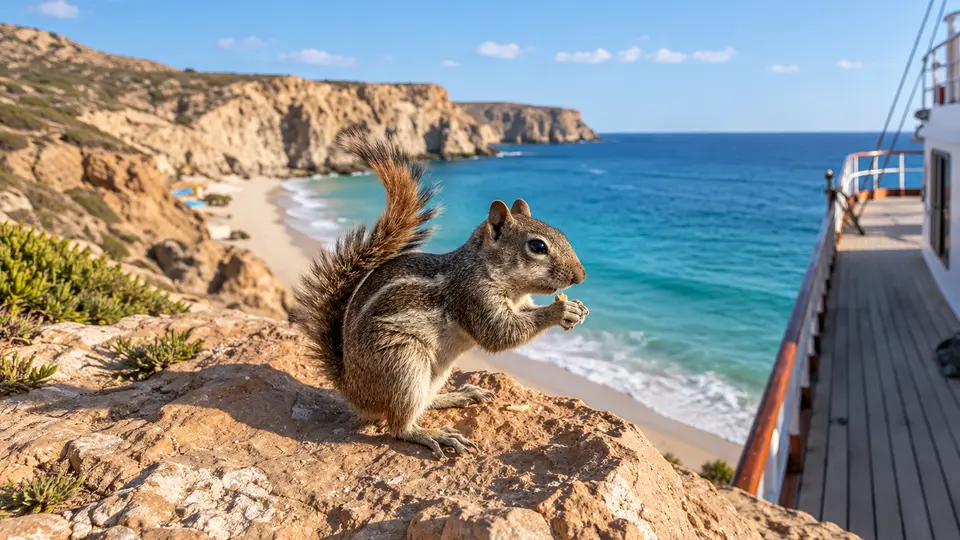
Baja California Rock Squirrel in its natural habitatAI-modified

Baja California Rock SquirrelOtospermophilus atricapillusWhere and when to see them

Baja California Rock Squirrel at a glance

The Baja California rock squirrel is a localized ground squirrel of the southern Baja California peninsula. It is especially associated with rocky landscapes in the Cape region, where boulders provide lookout points and shelter. Its dark head contrasts with a mottled body and bushy tail. Despite the common name, it is not a tree squirrel, and its restricted distribution should not be extended to every rocky island or shoreline in Baja.

Behaviour & reproduction

Size
40–50 cm (15.7–19.7 in) total length
Weight
280–738 g (9.9–26.0 oz) (related species)
Lifespan
Up to 6 years in the wild, up to 10 years in captivity (related species)
Status
Check current assessment

Active by day, this squirrel alternates between feeding on the ground and watching from elevated rocks. A quick retreat into a crevice or burrow is a typical response to disturbance. Individuals use the broken terrain to move between shade, cover and feeding patches. Activity can become less conspicuous during intense midday heat, making cooler hours more promising for observation without implying that squirrels will appear at every suitable outcrop. They are diurnal and highly alert, constantly scanning their surroundings for danger while foraging. Social structures are relatively loose, but individuals may share burrows or rocky territories, especially among related females.

Top wildlife locations

Mexico wildlife habitatAI-modified

Mexico

Search suitable rocky scrub and canyon margins in southern Baja California, using established land trails. An inland excursion may be needed; ordinary beach visits and offshore island stops are not reliable opportunities.


Destinations describe the species' habitat, not guaranteed cruise stops. Some animals require an optional inland excursion or are found in restricted reserves.

Fun facts about the Baja California Rock Squirrel

  • Its scientific epithet atricapillus refers to its dark head.
  • A bushy tail does not make this ground-dwelling animal a tree squirrel.
  • Boulders serve both as observation posts and rapid escape cover.
  • Its natural distribution is confined to the Baja California peninsula.

Best time to see the Baja California Rock Squirrel

The cooler months generally make walking and watching rocky southern Baja landscapes more comfortable. Early morning remains useful in warmer weather. This is a practical observation window rather than a documented seasonal concentration, and local heat and drought influence visible activity. Activity levels can decrease during the hottest summer months, especially during the midday sun, making cooler parts of the day more reliable for sightings. Rainfall patterns influence food availability, which in turn can affect activity and visibility across the year.

Baja California Rock Squirrel: season matrix by destination

Travel and observation windows vary by region. Highlighted months are an orientation for planning, not confirmed sightings or a guarantee of access.

Mexico

These are generally comfortable months for land-based walking in southern Baja, not evidence of a seasonal gathering or confirmed sightings.

JanFebMarAprMayJunJulAugSepOctNovDec
Cruise ships in Mexico

Where the Baja California Rock Squirrel lives

Rocky hillsides, canyon slopes and boulder-strewn scrub in southern Baja provide suitable habitat. Vegetation ranges from dry scrub to more wooded upland settings. Rocks and secure ground refuges are more important indicators than proximity to the sea itself. They often occupy areas with rock piles, rocky outcrops, and boulder fields which provide essential shelter and escape routes. Burrows are typically dug under rocks or in hard soil, providing protection from predators and extreme temperatures.

What the Baja California Rock Squirrel eats

Its diet includes seeds, fruits and other plant material, with insects and other small animal foods taken opportunistically. Food availability varies with rainfall and vegetation growth. Human snacks are unsuitable and can encourage risky approaches to paths and vehicles. Cacheing behavior is observed, where individuals store seeds and other food items in scattered larders for later consumption, especially during periods of scarcity. Its diet contributes to seed dispersal, playing a role in the desert ecosystem's plant regeneration.

Species at a glance

Common name
Baja California Rock Squirrel
Scientific name
Otospermophilus atricapillus
Animal group
Mammals
Size
40–50 cm (15.7–19.7 in) total length
Weight
280–738 g (9.9–26.0 oz) (related species)
Lifespan
Up to 6 years in the wild, up to 10 years in captivity (related species)
Status
Check current assessment
Identification
A distinctly dark head and mottled body help distinguish it from nearby ground squirrels, but separation from the closely related rock squirrel also depends strongly on geographic range. The species typically measures around 43-48 cm (17-19 inches) in total length, with a long, bushy tail accounting for about half its length. Unique fur patterns and the dark cap are consistent features across its range, aiding in positive identification.

Baja California Rock Squirrel: frequently asked questions

Where can I see the Baja California Rock Squirrel?
Mexico. Scan boulders quietly from stable paths, keeping hands away from occupied crevices. Do not feed or corner squirrels, and watch footing on loose slopes; a dark head alone is insufficient for identification outside the correct range. Listen for their high-pitched alarm calls, which are given when a predator is spotted, often indicating their presence even if not immediately visible. Patience is key, as squirrels may initially be wary but often resume activity once they perceive no threat.
When is the best time to see the Baja California Rock Squirrel?
The cooler months generally make walking and watching rocky southern Baja landscapes more comfortable. Early morning remains useful in warmer weather. This is a practical observation window rather than a documented seasonal concentration, and local heat and drought influence visible activity. Activity levels can decrease during the hottest summer months, especially during the midday sun, making cooler parts of the day more reliable for sightings. Rainfall patterns influence food availability, which in turn can affect activity and visibility across the year.
How big does the Baja California Rock Squirrel get?
40–50 cm (15.7–19.7 in) total length. Adult weight: 280–738 g (9.9–26.0 oz) (related species). Size varies with age, sex and population.
How should I behave around the Baja California Rock Squirrel?
Scan boulders quietly from stable paths, keeping hands away from occupied crevices. Do not feed or corner squirrels, and watch footing on loose slopes; a dark head alone is insufficient for identification outside the correct range. Listen for their high-pitched alarm calls, which are given when a predator is spotted, often indicating their presence even if not immediately visible. Patience is key, as squirrels may initially be wary but often resume activity once they perceive no threat.
What does the Baja California Rock Squirrel eat?
Its diet includes seeds, fruits and other plant material, with insects and other small animal foods taken opportunistically. Food availability varies with rainfall and vegetation growth. Human snacks are unsuitable and can encourage risky approaches to paths and vehicles. Cacheing behavior is observed, where individuals store seeds and other food items in scattered larders for later consumption, especially during periods of scarcity. Its diet contributes to seed dispersal, playing a role in the desert ecosystem's plant regeneration.
Are wildlife sightings guaranteed on an adventure cruise?
No. Animals move freely and routes, weather, access restrictions and local conditions influence every outing. Confirm the actual itinerary and shore program before booking.

Compare wildlife in the same destinations

Explore other mammals recorded in these destinations. Similar surroundings do not mean the animals share the same habits or viewing season.

Species comparison by animal group and destination
Baja California Rock SquirrelAI-modifiedBaja California Rock SquirrelBlue WhaleAI-modifiedBlue WhaleBryde's WhaleAI-modifiedBryde's Whale
Animal groupMammalsAnimal groupMammalsAnimal groupMammals
DestinationsMexicoDestinationsMexico, Norway, Portugal, Antarctica, Arctic, Maldives, New ZealandDestinationsGalapagos, Mexico, Egypt, Thailand, Vietnam
Scientific nameOtospermophilus atricapillusScientific nameScientific name
All wildlife destinations
AI-modified
Plan your trip

Find your next wildlife adventure

Compare destinations, shore programs and dates with the animals and habitats you would love to see.

  • Naturalist-led shore excursions
  • Responsible wildlife watching
  • Small expedition ships