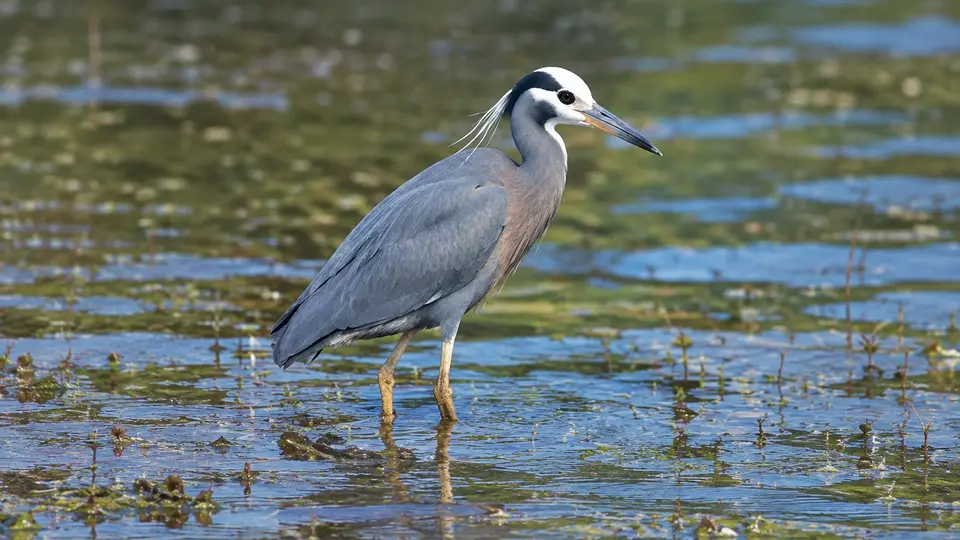
White-faced heron in its natural habitat, AI illustration

White-faced heron: where and when to see them

Egretta novaehollandiae

White-faced heron at a glance

The white-faced heron is a slim, blue-gray heron native to Australasia and parts of the southwest Pacific. White facial markings, a fine dark bill and yellowish legs give adults an understated but recognizable appearance. It uses both fresh and saltwater habitats and readily feeds in open human-modified landscapes. Fiji is peripheral to its usual distribution, where it should be treated as an unusual visitor rather than a dependable resident attraction.

Behaviour & reproduction

Size
60-70 cm long
Weight
500-700 g
Lifespan
Not reliably established
Status
Least Concern

Usually solitary or loosely spaced while feeding, this heron alternates slow stalking with sudden lunges at small prey. It may stir shallow water with a foot or pause motionless before striking. Birds sometimes gather where temporary conditions concentrate food, but they are less densely colonial than many other herons. Nesting pairs build a stick platform in a tree, and both adults participate in incubation and care of the young. Courtship displays often involve mutual preening and twig offerings between partners. Both parents share the duties of incubating the 2-5 pale blue-green eggs and feeding the young. The fledglings typically leave the nest after about 40 days, becoming independent shortly thereafter.

Top wildlife locations

Fiji wildlife habitat

Fiji

Estuary edges, tidal shallows and coastal wet grassland are plausible habitat, but this heron is an unusual visitor in Fiji. Accessible shore habitat alone does not imply presence, and recent verified records are essential.

Adventure cruises in Fiji
Destinations describe the species' habitat, not guaranteed cruise stops. Some animals require an optional inland excursion or are found in restricted reserves.

Fun facts about the White-faced heron

  • Despite its genus placement among egrets, its usual plumage is predominantly gray.
  • It sometimes uses foot movements to disturb concealed aquatic prey.
  • It expanded naturally into New Zealand and became widespread there.
  • Feeding birds can use wet pasture as well as tidal shorelines.

Best time to see the White-faced heron

No reliable species-specific observation season can be assigned for Fiji because occurrence is unusual and poorly predictable. Regional dry-season travel may improve comfort on coastal paths, but it should not be presented as increasing the probability of seeing this particular heron. Globally, nesting typically occurs between September and January, though this can vary regionally and depends on local conditions. Outside of Fiji, peak breeding activity often correlates with periods of abundant food resources following rains. While not reliable for Fiji, understanding global breeding seasons can offer context for potential sightings elsewhere.

White-faced heron: season matrix by destination

Travel and observation windows vary by region. Highlighted months are an orientation for planning, not confirmed sightings or a guarantee of access.

Fiji

No defensible seasonal occurrence window is established for Fiji; general travel weather cannot substitute for evidence of this rare visitor.

JanFebMarAprMayJunJulAugSepOctNovDec
Cruise ships in Fiji

Where the White-faced heron lives

It uses estuaries, tidal flats, rocky shores, freshwater marshes, ponds and damp pasture. Shallow feeding water and nearby resting or nesting trees are useful features. In Fiji, suitable coastal habitat does not establish regular occurrence, and records require careful regional verification. This heron is native to Australasia, including New Zealand, and has recently expanded its range to some Pacific islands. Its adaptability to both freshwater and saltwater environments contributes to its widespread distribution across various wetland types. Despite its preference for coastal areas, it can also be found in agricultural lands and suburban parks with suitable water sources.

What the White-faced heron eats

Food includes small fish, crustaceans, aquatic insects, frogs and other small animals. On land it can take insects and worms from damp grass. Its broad diet allows it to exploit changing water levels and temporary feeding opportunities in wetland margins. Its opportunistic feeding strategy allows it to consume a wide variety of prey, adapting to local availability. This includes aquatic invertebrates like crabs and shrimps, as well as terrestrial insects such as grasshoppers. Occasionally, it may also prey on small reptiles or amphibians when foraging in damp areas.

Species at a glance

Common name
White-faced heron
Scientific name
Egretta novaehollandiae
Animal group
Birds
Size
60-70 cm long
Weight
500-700 g
Lifespan
Not reliably established
Status
Least Concern
Identification
Compared with a dark-morph Pacific reef heron, it is slimmer and paler gray, with a more extensive white face and a finer bill. Key distinguishing features include its pale grey plumage, which contrasts with its almost entirely white face and foreneck. The bill is dark, relatively long, and pointed, while its legs are greenish-yellow. In flight, the underwings are pale, and it displays a slow, deliberate wingbeat.

White-faced heron: frequently asked questions

Where can I see the White-faced heron?
Fiji. Scan shallow estuary margins without entering soft mud or disturbing feeding birds. In Fiji, photograph unusual gray herons from a distance for identification, since Pacific reef herons are more expected and can cause confusion. When spotting, look for its distinctive long neck and legs, which are typical heron features, even at a distance. From a vessel, scan mudflats and mangrove edges during low tide, as these are prime feeding locations for herons. Using binoculars is essential to confirm subtle identification features and minimize disturbance.
When is the best time to see the White-faced heron?
No reliable species-specific observation season can be assigned for Fiji because occurrence is unusual and poorly predictable. Regional dry-season travel may improve comfort on coastal paths, but it should not be presented as increasing the probability of seeing this particular heron. Globally, nesting typically occurs between September and January, though this can vary regionally and depends on local conditions. Outside of Fiji, peak breeding activity often correlates with periods of abundant food resources following rains. While not reliable for Fiji, understanding global breeding seasons can offer context for potential sightings elsewhere.
How big does the White-faced heron get?
60-70 cm long. Adult weight: 500-700 g. Size varies with age, sex and population.
How should I behave around the White-faced heron?
Scan shallow estuary margins without entering soft mud or disturbing feeding birds. In Fiji, photograph unusual gray herons from a distance for identification, since Pacific reef herons are more expected and can cause confusion. When spotting, look for its distinctive long neck and legs, which are typical heron features, even at a distance. From a vessel, scan mudflats and mangrove edges during low tide, as these are prime feeding locations for herons. Using binoculars is essential to confirm subtle identification features and minimize disturbance.
What does the White-faced heron eat?
Food includes small fish, crustaceans, aquatic insects, frogs and other small animals. On land it can take insects and worms from damp grass. Its broad diet allows it to exploit changing water levels and temporary feeding opportunities in wetland margins. Its opportunistic feeding strategy allows it to consume a wide variety of prey, adapting to local availability. This includes aquatic invertebrates like crabs and shrimps, as well as terrestrial insects such as grasshoppers. Occasionally, it may also prey on small reptiles or amphibians when foraging in damp areas.
Are wildlife sightings guaranteed on an adventure cruise?
No. Animals move freely and routes, weather, access restrictions and local conditions influence every outing. Confirm the actual itinerary and shore program before booking.

Compare wildlife in the same destinations

Explore other birds recorded in these destinations. Similar surroundings do not mean the animals share the same habits or viewing season.

Species comparison by animal group and destination
White-faced heronWhite-faced heronBarking imperial pigeonBarking imperial pigeonBrown BoobyBrown Booby
Animal groupBirdsAnimal groupBirdsAnimal groupBirds
DestinationsFijiDestinationsFijiDestinationsCosta Rica, Cape Verde, Egypt, Fiji, Polynesia
All wildlife destinations
Plan your trip

Find your next wildlife adventure

Compare destinations, shore programs and dates with the animals and habitats you would love to see.

  • Naturalist-led shore excursions
  • Responsible wildlife watching
  • Small expedition ships

Newsletter

Take Blue Rides with you

Adventure cruise offers, last-minute deals and trip inspiration.

Free, unsubscribe anytime. Details: Privacy Policy

Partner with Blue Rides

Affiliate Program

Recommend adventure cruises and earn commission on every confirmed booking.

Share. Track. Earn.