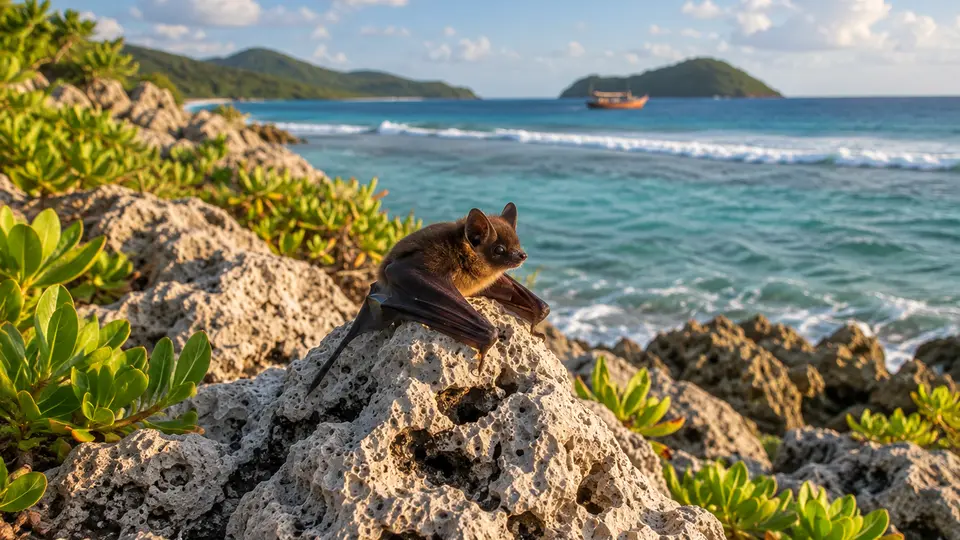
Seychelles Sheath-tailed Bat in its natural habitat, AI illustration

Seychelles Sheath-tailed Bat: where and when to see them

Coleura seychellensis

Seychelles Sheath-tailed Bat at a glance

The Seychelles sheath-tailed bat is one of the archipelago's most threatened mammals. This small insect-eating bat survives in a few colonies associated with sheltered rock cavities and suitable surrounding feeding habitat. It is quite different from the large fruit bats commonly seen over the islands. Historical declines have left it exceptionally vulnerable to roost disturbance and environmental change, so protecting occupied shelters is more important than obtaining close views.

Behaviour & reproduction

Size
About 5–6 cm head-and-body length
Weight
About 10–15 g
Lifespan
Not reliably established
Status
Critically Endangered

By day, individuals shelter in communal roosts within protected rock spaces. Around dusk they emerge to pursue flying insects, using echolocation to navigate and locate prey. Their movements link secure roosts with nearby feeding areas, making both parts of the landscape important. Colony attendance and emergence patterns can vary. Sensitive roosts should never be entered or illuminated by visitors, even when bats appear inactive or the entrance seems accessible. Emergence times can vary based on local weather conditions and insect availability, but generally occur shortly after sunset. These bats exhibit high site fidelity, often returning to the same roosts for many years, provided they remain undisturbed. Their social structure involves colonial living, with groups ranging from a few individuals to hundreds sharing a single roost.

Top wildlife locations

Seychelles wildlife habitat

Seychelles

Rare surviving colonies are associated with granite shelters near lowland feeding habitat on Mahé and Silhouette. Roosts may be restricted or inaccessible; coastal dusk watching cannot reliably identify this species without specialist support.

Adventure cruises in Seychelles
Destinations describe the species' habitat, not guaranteed cruise stops. Some animals require an optional inland excursion or are found in restricted reserves.

Fun facts about the Seychelles Sheath-tailed Bat

  • It is the Seychelles' only surviving native insect-eating bat.
  • Its common name refers to the arrangement of the tail within the tail membrane.
  • A small number of occupied roosts hold much of the remaining population.
  • It hunts using echolocation rather than the fruit-finding strategy of flying foxes.

Best time to see the Seychelles Sheath-tailed Bat

No reliable public viewing season is established for this extremely rare bat. Responsible observation depends on conservation advice and whether a nonsensitive public vantage is available. General island travel conditions should not be interpreted as evidence of seasonal bat abundance or permission to visit roosts. Conservation efforts prioritize minimal disturbance to these critically endangered bats, making any form of public viewing highly restricted. Any potential for observation would be entirely incidental to other activities and subject to strict no-disturbance policies. The focus remains on protecting the species rather than promoting tourism.

Seychelles Sheath-tailed Bat: season matrix by destination

Travel and observation windows vary by region. Highlighted months are an orientation for planning, not confirmed sightings or a guarantee of access.

Seychelles

No supported public shore-observation window is established; conservation restrictions and the availability of an approved vantage take precedence over travel season.

JanFebMarAprMayJunJulAugSepOctNovDec
Cruise ships in Seychelles

Where the Seychelles Sheath-tailed Bat lives

Sheltered granite cavities and boulder formations provide roosts, while nearby lowland woodland, clearings and coastal vegetation can support feeding. Suitable airflow and shelter make individual roosts difficult to replace. Loss of feeding habitat or disturbance at a single occupied cavity can affect a substantial colony. These bats are highly particular about their roost sites, often preferring deep, narrow crevices or small caves that offer stable microclimates. The integrity of these specific granite formations is crucial, as they provide necessary protection from predators and environmental extremes. Roost sites are typically found within a few kilometers of foraging grounds, highlighting the importance of conserving the interconnected landscape.

What the Seychelles Sheath-tailed Bat eats

This is an aerial insectivore, catching small flying insects rather than eating fruit or nectar. Available evidence indicates that several insect groups are used. Maintaining healthy insect populations around occupied roosts matters, and broad pesticide use can undermine the feeding environment. They forage in open areas and along forest edges, often making repeated passes to catch insects. Studies suggest their diet includes moths, beetles, and other small dipterans, reflecting the insect diversity of the Seychelles ecosystem. This reliance on a variety of insect prey underscores the need for diverse and healthy invertebrate populations.

Species at a glance

Common name
Seychelles Sheath-tailed Bat
Scientific name
Coleura seychellensis
Animal group
Mammals
Size
About 5–6 cm head-and-body length
Weight
About 10–15 g
Lifespan
Not reliably established
Status
Critically Endangered
Identification
It is a small, rapidly flying insectivorous bat with a tail projecting through its tail membrane, unlike the much larger, broad-winged Seychelles flying fox. Its small size and dark coloration make it difficult to distinguish from other small bats in flight, especially in low light. The free-tail characteristic is a key feature when close observation is possible, setting it apart from other local bat species. It is significantly smaller and more agile in flight compared to the fruit bats found in the Seychelles.

Seychelles Sheath-tailed Bat: frequently asked questions

Where can I see the Seychelles Sheath-tailed Bat?
Seychelles. Observe only from a conservation-approved public vantage, if one is available. Never enter roosts, shine lights at entrances or handle bats. Identification in flight is difficult, and routine coastal visits are unlikely to produce a confirmed sighting. Local conservation authorities are the sole source for information on potential, highly limited, and strictly regulated viewing opportunities, if any exist. Approaching or lingering near known or suspected roost sites is strictly prohibited to prevent stress and abandonment by the bats. Respecting signage and local guidelines is paramount for the survival of this species.
When is the best time to see the Seychelles Sheath-tailed Bat?
No reliable public viewing season is established for this extremely rare bat. Responsible observation depends on conservation advice and whether a nonsensitive public vantage is available. General island travel conditions should not be interpreted as evidence of seasonal bat abundance or permission to visit roosts. Conservation efforts prioritize minimal disturbance to these critically endangered bats, making any form of public viewing highly restricted. Any potential for observation would be entirely incidental to other activities and subject to strict no-disturbance policies. The focus remains on protecting the species rather than promoting tourism.
How big does the Seychelles Sheath-tailed Bat get?
About 5–6 cm head-and-body length. Adult weight: About 10–15 g. Size varies with age, sex and population.
How should I behave around the Seychelles Sheath-tailed Bat?
Observe only from a conservation-approved public vantage, if one is available. Never enter roosts, shine lights at entrances or handle bats. Identification in flight is difficult, and routine coastal visits are unlikely to produce a confirmed sighting. Local conservation authorities are the sole source for information on potential, highly limited, and strictly regulated viewing opportunities, if any exist. Approaching or lingering near known or suspected roost sites is strictly prohibited to prevent stress and abandonment by the bats. Respecting signage and local guidelines is paramount for the survival of this species.
What does the Seychelles Sheath-tailed Bat eat?
This is an aerial insectivore, catching small flying insects rather than eating fruit or nectar. Available evidence indicates that several insect groups are used. Maintaining healthy insect populations around occupied roosts matters, and broad pesticide use can undermine the feeding environment. They forage in open areas and along forest edges, often making repeated passes to catch insects. Studies suggest their diet includes moths, beetles, and other small dipterans, reflecting the insect diversity of the Seychelles ecosystem. This reliance on a variety of insect prey underscores the need for diverse and healthy invertebrate populations.
Are wildlife sightings guaranteed on an adventure cruise?
No. Animals move freely and routes, weather, access restrictions and local conditions influence every outing. Confirm the actual itinerary and shore program before booking.

Compare wildlife in the same destinations

Explore other mammals recorded in these destinations. Similar surroundings do not mean the animals share the same habits or viewing season.

Species comparison by animal group and destination
Seychelles Sheath-tailed BatSeychelles Sheath-tailed BatCommon Bottlenose DolphinCommon Bottlenose DolphinHumpback WhaleHumpback Whale
Animal groupMammalsAnimal groupMammalsAnimal groupMammals
DestinationsSeychellesDestinationsCosta Rica, Florida, Galapagos, Mexico, Cape Verde, Croatia, Greece, Portugal, Scotland, Seychelles, Turkey, Maldives, Australia, New ZealandDestinationsAlaska, Costa Rica, Mexico, New England, Cape Verde, Norway, Portugal, Scotland, Seychelles, Antarctica, Arctic, Australia, Fiji, New Zealand, Polynesia
All wildlife destinations
Plan your trip

Find your next wildlife adventure

Compare destinations, shore programs and dates with the animals and habitats you would love to see.

  • Naturalist-led shore excursions
  • Responsible wildlife watching
  • Small expedition ships

Newsletter

Take Blue Rides with you

Adventure cruise offers, last-minute deals and trip inspiration.

Free, unsubscribe anytime. Details: Privacy Policy

Partner with Blue Rides

Affiliate Program

Recommend adventure cruises and earn commission on every confirmed booking.

Share. Track. Earn.

Your footage, our stage

Send us your videos or pictures.

Captured beautiful landscapes or wildlife? Share your videos and pictures with us, we may feature them on Blue Rides.
