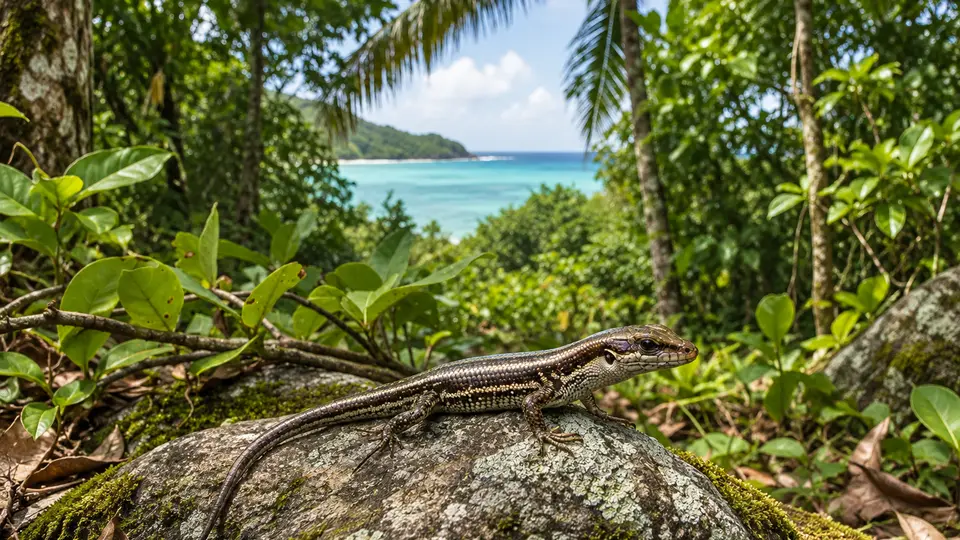
Seychelles Skink in its natural habitat, AI illustration

Seychelles SkinkTrachylepis sechellensisWhere and when to see them

Seychelles Skink at a glance

The Seychelles skink is an endemic lizard of the Seychelles, especially associated with the granitic islands. Its glossy scales, sturdy body and quick movements make it a familiar reptile in suitable lowland habitats. It often adapts to gardens and visitor areas, but that visibility should not obscure its restricted global range. The species is part of an island reptile community that includes several other skinks, so careful identification remains worthwhile.

Behaviour & reproduction

Size
Approximately 8–12 cm snout-to-vent length
Weight
Not reliably established
Lifespan
Not reliably established
Status
Least Concern

Active mainly by day, Seychelles skinks move between sunlit patches and shade to regulate body temperature. They search leaf litter and low vegetation for food and retreat quickly into cover when alarmed. Some become conspicuous around buildings, although apparent boldness does not justify feeding or handling. A seized animal can shed part of its tail, sacrificing stored resources and altering its appearance. Quiet observation usually reveals more natural activity than following a retreating lizard. They are excellent at camouflage, blending seamlessly with leaf litter and bark, and can be surprisingly quick when darting for prey or cover. Individuals often establish small territories, especially around preferred basking spots or feeding areas.

Top wildlife locations

Seychelles wildlife habitat

Seychelles

Coastal gardens, leaf-littered paths and rocky vegetation on occupied granitic islands offer plausible viewing without an inland expedition. Occurrence is island-specific, and remote coral islands should not be assumed to support this skink.
Destinations describe the species' habitat, not guaranteed cruise stops. Some animals require an optional inland excursion or are found in restricted reserves.

Fun facts about the Seychelles Skink

  • It is native only to the Seychelles.
  • Older references often place it in the genus Mabuya.
  • Its scientific name directly refers to its island home.
  • A regenerated tail can differ in color and shape from the original.

Best time to see the Seychelles Skink

Observation is possible throughout the year in suitable habitat. Dry, bright intervals often make active lizards easier to see, but intense midday heat can send them into shade. Local rainfall and exposure matter more than any well-established archipelago-wide breeding or viewing season. While generally observable year-round, their activity peaks during warmer parts of the day, making mid-morning to late afternoon optimal viewing times. Avoid looking for them during heavy rain as they tend to seek shelter.

Seychelles Skink: season matrix by destination

Travel and observation windows vary by region. Highlighted months are an orientation for planning, not confirmed sightings or a guarantee of access.

Seychelles

Year-round warmth allows activity in all months; rain, shade and local island distribution control actual observation opportunities.

JanFebMarAprMayJunJulAugSepOctNovDec
Cruise ships in Seychelles

Where the Seychelles Skink lives

Coastal vegetation, woodland edges, gardens and rocky ground provide shelter and feeding opportunities. Leaf litter, roots and crevices are useful refuges. Distribution is island-specific, and the species should not automatically be expected on every distant coral island within the Seychelles. They are often found in relatively dry areas, preferring sun-drenched clearings and rock faces for basking. Their prevalence in human-modified landscapes reflects their adaptability to disturbed environments, as long as food and cover are available.

What the Seychelles Skink eats

Small invertebrates, including insects and other arthropods, form much of its food. The species is opportunistic and can also consume fruit and other edible material. Human snacks are inappropriate substitutes and can change behavior or draw lizards into hazardous visitor areas. Their diet primarily consists of small arthropods such as ants, termites, and small beetles, which they actively hunt. They play an important role in the local ecosystem by helping to control insect populations.

Species at a glance

Common name
Seychelles Skink
Scientific name
Trachylepis sechellensis
Animal group
Reptiles
Size
Approximately 8–12 cm snout-to-vent length
Weight
Not reliably established
Lifespan
Not reliably established
Status
Least Concern
Identification
Compared with the usually smaller Seychelles bronze gecko, it has glossy overlapping scales, movable eyelids and ordinary clawed toes rather than adhesive toe pads. This skink species typically exhibits a bronze-brown to greyish-brown coloration, often with lighter lateral stripes or flecks that can vary individually. Juveniles frequently display a more striking pattern, including a blue tail that fades with age.

Seychelles Skink: frequently asked questions

Where can I see the Seychelles Skink?
Seychelles. Watch sunlit path margins without blocking access to cover. Do not feed, catch or grasp skinks by the tail, and place feet carefully where small lizards forage around steps and vegetation. Focus on areas with good sun exposure but also nearby cover, like fallen logs or rock piles, where they might quickly retreat. Look closely at the base of trees and along pathways for their rapid movements.
When is the best time to see the Seychelles Skink?
Observation is possible throughout the year in suitable habitat. Dry, bright intervals often make active lizards easier to see, but intense midday heat can send them into shade. Local rainfall and exposure matter more than any well-established archipelago-wide breeding or viewing season. While generally observable year-round, their activity peaks during warmer parts of the day, making mid-morning to late afternoon optimal viewing times. Avoid looking for them during heavy rain as they tend to seek shelter.
How big does the Seychelles Skink get?
Approximately 8–12 cm snout-to-vent length. Adult weight: Not reliably established. Size varies with age, sex and population.
How should I behave around the Seychelles Skink?
Watch sunlit path margins without blocking access to cover. Do not feed, catch or grasp skinks by the tail, and place feet carefully where small lizards forage around steps and vegetation. Focus on areas with good sun exposure but also nearby cover, like fallen logs or rock piles, where they might quickly retreat. Look closely at the base of trees and along pathways for their rapid movements.
What does the Seychelles Skink eat?
Small invertebrates, including insects and other arthropods, form much of its food. The species is opportunistic and can also consume fruit and other edible material. Human snacks are inappropriate substitutes and can change behavior or draw lizards into hazardous visitor areas. Their diet primarily consists of small arthropods such as ants, termites, and small beetles, which they actively hunt. They play an important role in the local ecosystem by helping to control insect populations.
Are wildlife sightings guaranteed on an adventure cruise?
No. Animals move freely and routes, weather, access restrictions and local conditions influence every outing. Confirm the actual itinerary and shore program before booking.

Compare wildlife in the same destinations

Explore other reptiles recorded in these destinations. Similar surroundings do not mean the animals share the same habits or viewing season.

Species comparison by animal group and destination
Seychelles SkinkSeychelles SkinkAldabra Giant TortoiseAldabra Giant TortoiseGreen Sea TurtleGreen Sea Turtle
Animal groupReptilesAnimal groupReptilesAnimal groupReptiles
DestinationsSeychellesDestinationsSeychellesDestinationsCosta Rica, Florida, Galapagos, Mexico, Cape Verde, Egypt, Greece, Seychelles, Turkey, Indonesia, Maldives, Thailand, Vietnam, Australia, Fiji, Polynesia
All wildlife destinations
Plan your trip

Find your next wildlife adventure

Compare destinations, shore programs and dates with the animals and habitats you would love to see.

  • Naturalist-led shore excursions
  • Responsible wildlife watching
  • Small expedition ships

Newsletter

Take Blue Rides with you

Adventure cruise offers, last-minute deals and trip inspiration.

Free, unsubscribe anytime. Details: Privacy Policy

Partner with Blue Rides

Affiliate Program

Recommend adventure cruises and earn commission on every confirmed booking.

Share. Track. Earn.

Your footage, our stage

Send us your videos or pictures.

Captured remarkable nature or wildlife on your journey? Share it with us, we may feature it on Blue Rides.