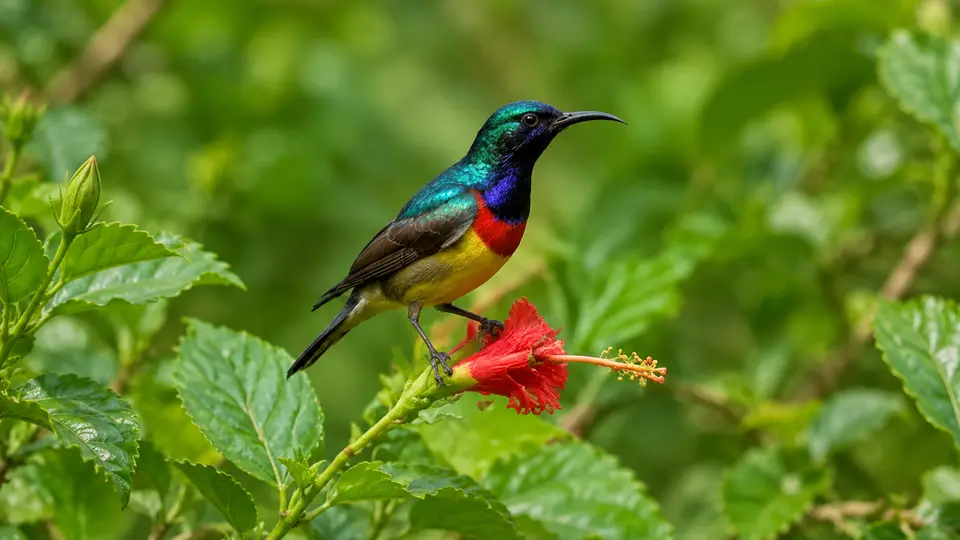
Seychelles Sunbird in its natural habitat, AI illustration

Seychelles Sunbird: where and when to see them

Cinnyris dussumieri

Seychelles Sunbird at a glance

The Seychelles sunbird is a small endemic bird with a slender, downcurved bill adapted to feeding at flowers. It is widespread across the granitic islands and occurs in gardens as well as native vegetation. Males show an iridescent throat and small colored pectoral tufts, while females are plainer. Its frequent use of flowering shrubs makes it one of the more accessible endemic birds for patient observation from established paths.

Behaviour & reproduction

Size
11–12 cm long
Weight
Not reliably established
Lifespan
Not reliably established
Status
Least Concern

Sunbirds move briskly between blossoms, usually perching to feed but sometimes hovering briefly. They supplement nectar with small arthropods gathered from leaves, twigs and flowers. Males sing from exposed positions and may defend productive feeding patches. The nest is a suspended pouch with a side entrance, attached to vegetation or occasionally a sheltered structure. Birds readily use modified landscapes where flowering plants and safe nesting cover remain available. Courtship displays often involve the male singing and posturing to attract a mate. The intricate suspended nest, often decorated with lichen or plant material, is built predominantly by the female, taking several days to complete.

Top wildlife locations

Seychelles wildlife habitat

Seychelles

Flowering coastal gardens and woodland edges on Mahé, Praslin and La Digue offer plausible shore-based habitat. No remote island access is normally necessary, although activity depends on flowers and local vegetation.

Adventure cruises in Seychelles
Destinations describe the species' habitat, not guaranteed cruise stops. Some animals require an optional inland excursion or are found in restricted reserves.

Fun facts about the Seychelles Sunbird

  • Its local Creole name is kolibri, although it is not a hummingbird.
  • Males have small pectoral feather tufts that are not always visible.
  • Its nest hangs like a pouch and has a side entrance.
  • It feeds mainly while perched rather than hovering continuously.

Best time to see the Seychelles Sunbird

Observation is possible throughout the year because this sunbird is resident and widespread. Local flowering cycles often influence where it feeds more strongly than the calendar. Calmer intermonsoon months can make coastal walks comfortable, while early mornings usually offer better activity than hot midday periods. Early mornings are particularly productive for observing sunbirds as they actively forage in cooler temperatures. Observing from a boat is not common as they are typically found on land; shore excursions offer the best opportunities.

Seychelles Sunbird: season matrix by destination

Travel and observation windows vary by region. Highlighted months are an orientation for planning, not confirmed sightings or a guarantee of access.

Seychelles

Year-round access and resident occurrence support observation attempts in any month; flowering and daily weather affect opportunities rather than a fixed breeding season.

JanFebMarAprMayJunJulAugSepOctNovDec
Cruise ships in Seychelles

Where the Seychelles Sunbird lives

Coastal scrub, woodland edges, gardens and upland vegetation all provide habitat when flowers and small arthropods are available. It tolerates settlement better than many Seychelles endemics. Native flowering plants and layered vegetation are particularly useful, while bare beaches offer little feeding or nesting habitat. They are found across all the granitic islands of the Seychelles, thriving in a variety of disturbed and undisturbed habitats. Their adaptability allows them to persist in areas with human activity, including hotel grounds and plantations, as long as food and nesting sites are present.

What the Seychelles Sunbird eats

Nectar supplies readily available energy, but insects and spiders provide important nutrients, especially for growing chicks. Birds probe blossoms with their curved bills and also glean prey from vegetation. Their use of flowers can assist pollination, although the outcome depends on flower structure and feeding technique. Insects such as small flies, beetles, and caterpillars are important protein sources, especially during breeding. They show a preference for certain flower species, contributing to their pollination by transferring pollen as they feed on nectar.

Species at a glance

Common name
Seychelles Sunbird
Scientific name
Cinnyris dussumieri
Animal group
Birds
Size
11–12 cm long
Weight
Not reliably established
Lifespan
Not reliably established
Status
Least Concern
Identification
Its slim, strongly downcurved bill separates it from the Seychelles white-eye and warbler, while males also show an iridescent throat. Females and juveniles have duller olive-green plumage above and yellowish underparts, lacking the male's iridescent throat. The overall small size, active movements, and long, decurved bill are key characteristics even without the male's metallic coloration.

Seychelles Sunbird: frequently asked questions

Where can I see the Seychelles Sunbird?
Seychelles. Watch flowering shrubs from a path and allow birds to resume feeding between photographs. Do not handle hanging nests or provide sugar mixtures. Avoid trampling coastal vegetation, and use binoculars rather than approaching territorial males repeatedly. Be patient and look for movement among flowering bushes; their bright colors can catch the eye. A good field guide can help confirm identification before or after your sighting.
When is the best time to see the Seychelles Sunbird?
Observation is possible throughout the year because this sunbird is resident and widespread. Local flowering cycles often influence where it feeds more strongly than the calendar. Calmer intermonsoon months can make coastal walks comfortable, while early mornings usually offer better activity than hot midday periods. Early mornings are particularly productive for observing sunbirds as they actively forage in cooler temperatures. Observing from a boat is not common as they are typically found on land; shore excursions offer the best opportunities.
How big does the Seychelles Sunbird get?
11–12 cm long. Adult weight: Not reliably established. Size varies with age, sex and population.
How should I behave around the Seychelles Sunbird?
Watch flowering shrubs from a path and allow birds to resume feeding between photographs. Do not handle hanging nests or provide sugar mixtures. Avoid trampling coastal vegetation, and use binoculars rather than approaching territorial males repeatedly. Be patient and look for movement among flowering bushes; their bright colors can catch the eye. A good field guide can help confirm identification before or after your sighting.
What does the Seychelles Sunbird eat?
Nectar supplies readily available energy, but insects and spiders provide important nutrients, especially for growing chicks. Birds probe blossoms with their curved bills and also glean prey from vegetation. Their use of flowers can assist pollination, although the outcome depends on flower structure and feeding technique. Insects such as small flies, beetles, and caterpillars are important protein sources, especially during breeding. They show a preference for certain flower species, contributing to their pollination by transferring pollen as they feed on nectar.
Are wildlife sightings guaranteed on an adventure cruise?
No. Animals move freely and routes, weather, access restrictions and local conditions influence every outing. Confirm the actual itinerary and shore program before booking.

Compare wildlife in the same destinations

Explore other birds recorded in these destinations. Similar surroundings do not mean the animals share the same habits or viewing season.

Species comparison by animal group and destination
Seychelles SunbirdSeychelles SunbirdBridled TernBridled TernBrown NoddyBrown Noddy
Animal groupBirdsAnimal groupBirdsAnimal groupBirds
DestinationsSeychellesDestinationsSeychellesDestinationsSeychelles, Maldives, Fiji
All wildlife destinations
Plan your trip

Find your next wildlife adventure

Compare destinations, shore programs and dates with the animals and habitats you would love to see.

  • Naturalist-led shore excursions
  • Responsible wildlife watching
  • Small expedition ships

Newsletter

Take Blue Rides with you

Adventure cruise offers, last-minute deals and trip inspiration.

Free, unsubscribe anytime. Details: Privacy Policy

Partner with Blue Rides

Affiliate Program

Recommend adventure cruises and earn commission on every confirmed booking.

Share. Track. Earn.

Your footage, our stage

Send us your videos or pictures.

Captured beautiful landscapes or wildlife? Share your videos and pictures with us, we may feature them on Blue Rides.