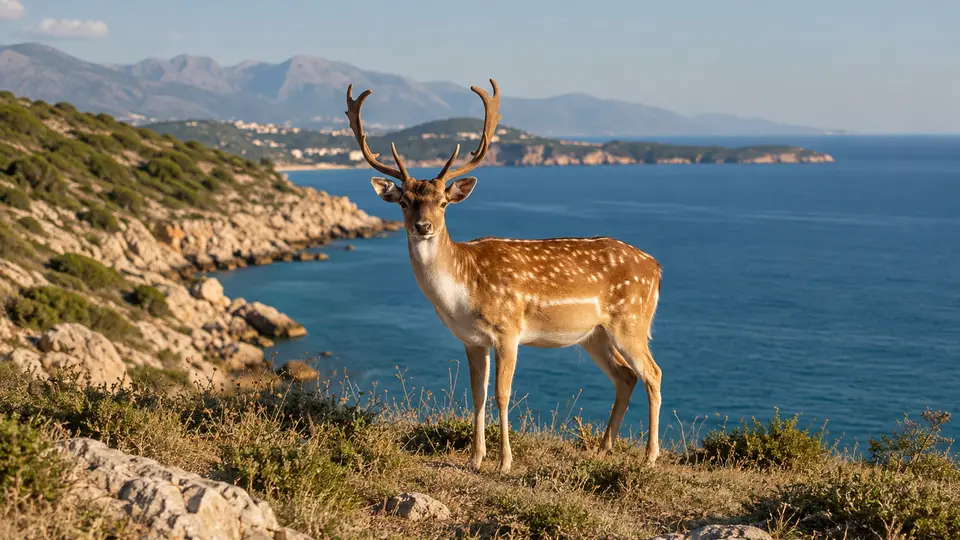
Persian Fallow Deer in its natural habitat, AI illustration

Persian Fallow Deer: where and when to see them

Dama mesopotamica

Persian Fallow Deer at a glance

The Persian fallow deer is a threatened deer of southwestern Asia, surviving through a combination of remnant populations, captive breeding and reintroductions. Its spotted coat and the males' antlers recall the European fallow deer, but it is generally larger and its antlers are less extensively flattened. Historical range descriptions include parts of the eastern Mediterranean region. They should not be mistaken for evidence of a present-day, publicly viewable population in Turkey.

Behaviour & reproduction

Size
1.3–1.9 m body length
Weight
40–100 kg
Lifespan
Not reliably established
Status
Endangered

These deer combine browsing and grazing with long periods of resting and ruminating in cover. Activity often increases around dawn and dusk, particularly where daytime heat or disturbance is substantial. Females and young may associate in groups, while mature males become more competitive during the rut. Stags shed and regrow their antlers annually. Much modern knowledge comes from managed populations, so behaviour observed in enclosures may not represent every free-ranging setting. The rut, typically occurring in autumn, is characterized by competitive male displays involving vocalizations, parallel walking, and occasional fighting. Females give birth to one or occasionally two fawns, which are initially hidden in dense vegetation. They exhibit crepuscular activity patterns, being most active during dawn and dusk, especially in areas with human disturbance.

Top wildlife locations

Turkey wildlife habitat

Turkey

Historical occurrence does not establish a current wild population. Coastal woodland cannot be recommended for sightings; any verified conservation collection would require a separately arranged excursion and confirmation of public access.

Adventure cruises in Turkey
Destinations describe the species' habitat, not guaranteed cruise stops. Some animals require an optional inland excursion or are found in restricted reserves.

Fun facts about the Persian Fallow Deer

  • The species was once feared extinct before surviving deer were documented in Iran in the 1950s.
  • Conservation breeding has been central to its survival.
  • Only males normally develop antlers.
  • Some older classifications treated it as a subspecies of the European fallow deer.

Best time to see the Persian Fallow Deer

There is no defensible general wildlife-viewing season for this species in Turkey without identifying a verified, legally accessible population. Seasonal travel advice cannot substitute for occurrence records. Any visit to a conservation facility should follow its current access rules rather than presumed rutting or calving dates. The annual antler cycle of males typically involves shedding old antlers in spring and regrowing them through summer, culminating in hardening by late summer or early autumn. Births usually occur in late spring or early summer, following a gestation period of approximately eight months. These biological rhythms are consistent across their species, but legal viewing access remains the primary hurdle.

Persian Fallow Deer: season matrix by destination

Travel and observation windows vary by region. Highlighted months are an orientation for planning, not confirmed sightings or a guarantee of access.

Turkey

No supported contemporary shore-viewing population or seasonal observation window is established here; verify any proposed facility and its animals independently.

JanFebMarAprMayJunJulAugSepOctNovDec
Cruise ships in Turkey

Where the Persian Fallow Deer lives

Historically associated with riverine woodland, scrub and wooded landscapes, Persian fallow deer require feeding areas near protective cover. Remaining and restored populations occupy only a small fraction of their former range. Turkey should not be presented as an established contemporary wild-viewing destination. Historical populations were often found in lowland alluvial forests, favoring areas with dense undergrowth for concealment. Their reliance on specific forest types makes habitat fragmentation a significant conservation challenge. Remaining wild populations are highly localized and often depend on carefully managed reserves.

What the Persian Fallow Deer eats

The diet includes leaves, shoots, grasses, herbs and seasonally available fruits. Deer select among these foods according to plant growth, habitat and availability. As ruminants, they ferment fibrous vegetation in a specialized stomach and later rechew regurgitated material while resting. In their natural range, they demonstrate dietary plasticity, adapting to available forage throughout the year. Forage selection can vary significantly with seasonal availability of succulent new growth. They are hindgut fermenters, processing food efficiently through a multi-chambered stomach.

Species at a glance

Common name
Persian Fallow Deer
Scientific name
Dama mesopotamica
Animal group
Mammals
Size
1.3–1.9 m body length
Weight
40–100 kg
Lifespan
Not reliably established
Status
Endangered
Identification
Compared with European fallow deer, Persian fallow deer are generally larger and males have less broadly palmated antlers, although reliable identification also requires verified provenance. Key distinguishing features include their overall larger size and often a less distinct spotting pattern compared to European fallow deer. Males possess prominent antlers that are generally less palmate and more branched, especially in older individuals. The presence of a black or dark tail stripe, and a relatively long tail are also characteristic.

Persian Fallow Deer: frequently asked questions

Where can I see the Persian Fallow Deer?
Turkey. Verify both species identity and legal access before planning a visit. At authorized facilities, remain behind barriers, never feed deer, and give antlered males extra space during reproductive displays. Quiet observation from a distance is crucial to avoid disturbing these naturally wary animals, especially where they are not habituated to human presence. During the rut, males are particularly sensitive to disturbance, and their displays can be intense. Always maintain a respectful distance to ensure both your safety and the well-being of the deer.
When is the best time to see the Persian Fallow Deer?
There is no defensible general wildlife-viewing season for this species in Turkey without identifying a verified, legally accessible population. Seasonal travel advice cannot substitute for occurrence records. Any visit to a conservation facility should follow its current access rules rather than presumed rutting or calving dates. The annual antler cycle of males typically involves shedding old antlers in spring and regrowing them through summer, culminating in hardening by late summer or early autumn. Births usually occur in late spring or early summer, following a gestation period of approximately eight months. These biological rhythms are consistent across their species, but legal viewing access remains the primary hurdle.
How big does the Persian Fallow Deer get?
1.3–1.9 m body length. Adult weight: 40–100 kg. Size varies with age, sex and population.
How should I behave around the Persian Fallow Deer?
Verify both species identity and legal access before planning a visit. At authorized facilities, remain behind barriers, never feed deer, and give antlered males extra space during reproductive displays. Quiet observation from a distance is crucial to avoid disturbing these naturally wary animals, especially where they are not habituated to human presence. During the rut, males are particularly sensitive to disturbance, and their displays can be intense. Always maintain a respectful distance to ensure both your safety and the well-being of the deer.
What does the Persian Fallow Deer eat?
The diet includes leaves, shoots, grasses, herbs and seasonally available fruits. Deer select among these foods according to plant growth, habitat and availability. As ruminants, they ferment fibrous vegetation in a specialized stomach and later rechew regurgitated material while resting. In their natural range, they demonstrate dietary plasticity, adapting to available forage throughout the year. Forage selection can vary significantly with seasonal availability of succulent new growth. They are hindgut fermenters, processing food efficiently through a multi-chambered stomach.
Are wildlife sightings guaranteed on an adventure cruise?
No. Animals move freely and routes, weather, access restrictions and local conditions influence every outing. Confirm the actual itinerary and shore programme before booking.

Compare wildlife in the same destinations

Explore other mammals recorded in these destinations. Similar surroundings do not mean the animals share the same habits or viewing season.

Species comparison by animal group and destination
Persian Fallow DeerPersian Fallow DeerBrown BearBrown BearCaracalCaracal
Animal groupMammalsAnimal groupMammalsAnimal groupMammals
DestinationsTurkeyDestinationsTurkeyDestinationsTurkey
All wildlife destinations
Plan your trip

Find your next wildlife adventure

Compare destinations, shore programmes and dates with the animals and habitats you would love to see.

  • Naturalist-led shore excursions
  • Responsible wildlife watching
  • Small expedition ships

Newsletter

Take Blue Rides with you

Adventure cruise offers, last-minute deals and trip inspiration.

Free, unsubscribe anytime. Details: Privacy Policy

Partner with Blue Rides

Affiliate Program

Recommend adventure cruises and earn commission on every confirmed booking.

Share. Track. Earn.