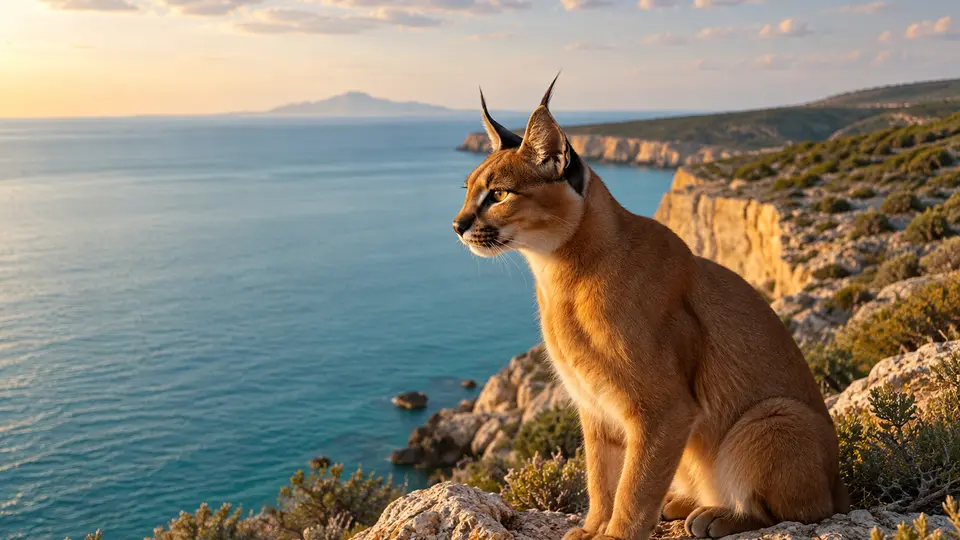
Caracal in its natural habitat, AI illustration
Size60-105 cm head-body lengthLifespan10-12 years in the wildStatusLeast Concern

Caracal: where and when to see them

Caracal caracal

Caracal at a glance

The caracal is a long-legged wild cat with a short tail, sandy coat and conspicuous black ear tufts. Its range extends across much of Africa and parts of southwestern and central Asia, but populations are very unevenly distributed. In Turkey it is scarce and associated mainly with suitable habitats in the south and southwest. A globally widespread distribution should not obscure the vulnerability of small, fragmented populations at the edges of its range.

Behaviour & reproduction

Size
60-105 cm head-body length
Weight
6-20 kg
Lifespan
10-12 years in the wild
Status
Least Concern

Usually solitary, caracals communicate through scent marks, scrapes and vocalisations rather than regular social gatherings. They often hunt at night or around twilight, although activity changes with temperature and disturbance. A patient stalk ends in a rapid rush or leap, and their powerful hindquarters help them catch birds taking flight. Females raise kittens in concealed shelters. Adults use substantial home ranges, so even occupied habitat can produce very few sightings. Caracals are primarily solitary, establishing and defending territories through scent marking and occasional vocalizations like growls, hisses, and purrs. They are exceptionally athletic, known for their powerful leaps reaching up to 3 meters (10 feet) to catch birds. Females typically give birth to litters of one to six kittens in secluded dens, which can include abandoned burrows, rock crevices, or dense bush thickets.

Top wildlife locations

Turkey wildlife habitat

Turkey

Mediterranean scrub and wooded hills in southern and southwestern Turkey provide plausible habitat, but sightings are exceptionally uncommon. A specialist inland excursion is normally required; ordinary coastal stops are not dependable viewing opportunities.

Adventure cruises in Turkey
Destinations describe the species' habitat, not guaranteed cruise stops. Some animals require an optional inland excursion or are found in restricted reserves.

Fun facts about the Caracal

  • Its name derives from a Turkish expression meaning black ear.
  • Despite the ear tufts, it is not a member of the lynx genus.
  • Its closest living relatives include the African golden cat and serval.
  • Caracals can conceal larger kills and return to feed later.

Best time to see the Caracal

There is no dependable public viewing season for caracals in Turkey. Cooler spring and autumn conditions can suit guided terrestrial wildlife excursions, but the animal remains elusive throughout the year. Seasonal travel convenience must not be interpreted as a predictable sighting window. While no specific season guarantees caracal sightings, understanding their crepuscular and nocturnal habits can slightly improve chances during guided tours. Optimal viewing conditions often involve clear, moonlit nights or early mornings in less disturbed areas. Patience and a knowledgeable local guide are more critical than the season itself.

Caracal: season matrix by destination

Travel and observation windows vary by region. Highlighted months are an orientation for planning, not confirmed sightings or a guarantee of access.

Turkey

No well-supported seasonal shore-observation window exists; spring and autumn travel conditions do not establish caracal detectability.

JanFebMarAprMayJunJulAugSepOctNovDec
Cruise ships in Turkey

Where the Caracal lives

Caracals inhabit scrub, open woodland, rocky hills and dry grassland where cover and prey are available. In Turkey, Mediterranean woodland and scrub mosaics are important. They generally avoid extensive open desert and dense rainforest, and need connected cover within human-modified landscapes. Caracals are well-adapted to arid and semi-arid environments, favoring landscapes with good cover for hunting and resting. In Turkey, their presence is often associated with the foothills of mountain ranges and coastal areas, particularly in the Mediterranean and Aegean regions.

What the Caracal eats

Prey includes rodents, hares, birds and other small to medium-sized vertebrates. Caracals can kill animals larger than themselves, but local prey availability shapes their diet. Livestock losses sometimes occur, creating conflict that can threaten already sparse populations. They are highly agile predators, capable of catching prey such as gazelles and antelopes where available. Caracals primarily target smaller prey items, with rodents like gerbils and hares forming a significant part of their diet. They exhibit remarkable hunting skills, including high jumps to snatch birds from the air.

Species at a glance

Common name
Caracal
Scientific name
Caracal caracal
Animal group
Mammals
Size
60-105 cm head-body length
Weight
6-20 kg
Lifespan
10-12 years in the wild
Status
Least Concern
Identification
Long black ear tufts, an unspotted sandy coat and a relatively short unringed tail distinguish the caracal from Turkey's Eurasian lynx and jungle cat. The caracal's striking black ear tufts, which can be up to 5 cm long, are a key distinguishing feature, acting as a potential communication signal. Their reddish-tan to brick-red coat lacks any spots or stripes, making them visually distinct from other regional wild cats. The relatively short, unringed tail, about a third of their body length, further aids in differentiating them.

Caracal: frequently asked questions

Where can I see the Caracal?
Turkey. Use a lawful, locally guided terrestrial excursion and observe only from a distance. Never bait, pursue or approach a den; keep children close and give any encountered cat an unobstructed escape route. Always maintain a respectful distance to avoid disturbing these naturally shy animals, using binoculars or a spotting scope for observation. Disturbing caracals can disrupt their hunting or denning activities, potentially impacting their survival. Never attempt to feed wildlife, as this habituates them to humans and can lead to dangerous situations for both parties.
When is the best time to see the Caracal?
There is no dependable public viewing season for caracals in Turkey. Cooler spring and autumn conditions can suit guided terrestrial wildlife excursions, but the animal remains elusive throughout the year. Seasonal travel convenience must not be interpreted as a predictable sighting window. While no specific season guarantees caracal sightings, understanding their crepuscular and nocturnal habits can slightly improve chances during guided tours. Optimal viewing conditions often involve clear, moonlit nights or early mornings in less disturbed areas. Patience and a knowledgeable local guide are more critical than the season itself.
How big does the Caracal get?
60-105 cm head-body length. Adult weight: 6-20 kg. Size varies with age, sex and population.
How should I behave around the Caracal?
Use a lawful, locally guided terrestrial excursion and observe only from a distance. Never bait, pursue or approach a den; keep children close and give any encountered cat an unobstructed escape route. Always maintain a respectful distance to avoid disturbing these naturally shy animals, using binoculars or a spotting scope for observation. Disturbing caracals can disrupt their hunting or denning activities, potentially impacting their survival. Never attempt to feed wildlife, as this habituates them to humans and can lead to dangerous situations for both parties.
What does the Caracal eat?
Prey includes rodents, hares, birds and other small to medium-sized vertebrates. Caracals can kill animals larger than themselves, but local prey availability shapes their diet. Livestock losses sometimes occur, creating conflict that can threaten already sparse populations. They are highly agile predators, capable of catching prey such as gazelles and antelopes where available. Caracals primarily target smaller prey items, with rodents like gerbils and hares forming a significant part of their diet. They exhibit remarkable hunting skills, including high jumps to snatch birds from the air.
Are wildlife sightings guaranteed on an adventure cruise?
No. Animals move freely and routes, weather, access restrictions and local conditions influence every outing. Confirm the actual itinerary and shore programme before booking.

Compare wildlife in the same destinations

Explore other mammals recorded in these destinations. Similar surroundings do not mean the animals share the same habits or viewing season.

Species comparison by animal group and destination
CaracalCaracalBrown BearBrown BearCommon Bottlenose DolphinCommon Bottlenose Dolphin
Animal groupMammalsAnimal groupMammalsAnimal groupMammals
DestinationsTurkeyDestinationsTurkeyDestinationsCosta Rica, Florida, Galapagos, Mexico, Cape Verde, Croatia, Greece, Portugal, Scotland, Seychelles, Turkey, Maldives, Australia, New Zealand
All wildlife destinations
Plan your trip

Find your next wildlife adventure

Compare destinations, shore programmes and dates with the animals and habitats you would love to see.

  • Naturalist-led shore excursions
  • Responsible wildlife watching
  • Small expedition ships

Newsletter

Take Blue Rides with you

Adventure cruise offers, last-minute deals and trip inspiration.

Free, unsubscribe anytime. Details: Privacy Policy

Partner with Blue Rides

Affiliate Program

Recommend adventure cruises and earn commission on every confirmed booking.

Share. Track. Earn.