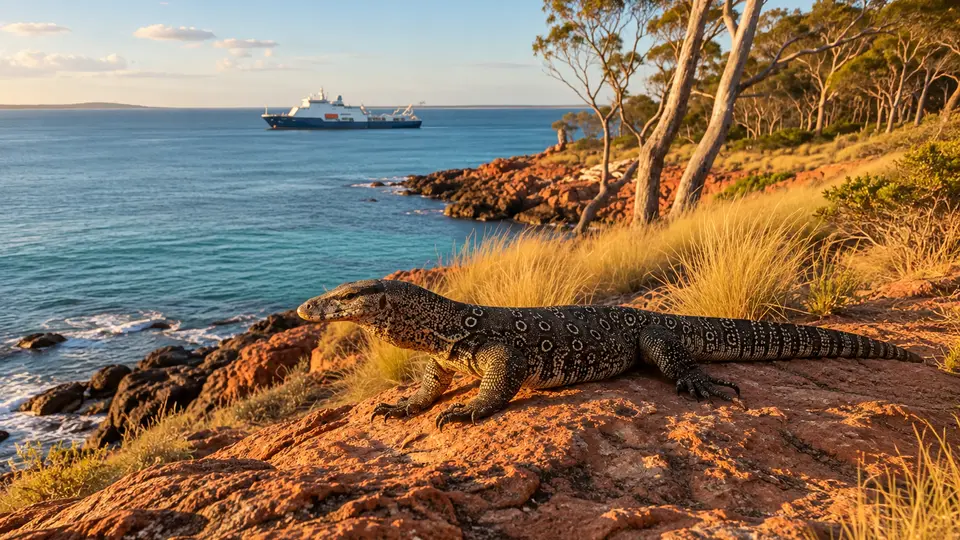
Perentie in its natural habitat, AI illustration

Perentie: where and when to see them

Varanus giganteus

Perentie at a glance

The perentie is Australia's largest lizard, a powerful monitor of arid and semiarid country. Cream spots and dark netlike markings break up its outline against stony ground, while its long neck and muscular tail give it a distinctive silhouette. Although impressive in size, it usually avoids people. Its presence is closely tied to shelter, especially rocky crevices and substantial burrows, rather than to the open sand alone.

Behaviour & reproduction

Size
1.5–2 m total length
Weight
5–15 kg
Lifespan
Not reliably established
Status
Least Concern

Perenties regulate their temperature by moving between sunshine, shade and underground shelter. They are active hunters, using a deeply forked tongue to collect chemical information from their surroundings. Individuals may travel considerable distances while searching for food, but retreat quickly when disturbed. A threatened animal can inflate its throat, hiss and lash its tail. Activity declines during cold weather, and extreme midday heat can also drive them into shelter. When cornered or threatened, perenties can stand on their hind legs and tail, making them appear even more imposing. Their powerful jaws are equipped with serrated teeth, and they possess a mild venom which aids in subduing prey and assisting digestion.

Top wildlife locations

Australia wildlife habitat

Australia

Look for suitable rocky desert habitat on a dedicated inland excursion; some western coastal ranges also support the species. Standard urban waterfronts are unsuitable, and even occupied sites offer no reliable sightings.

Adventure cruises in Australia
Destinations describe the species' habitat, not guaranteed cruise stops. Some animals require an optional inland excursion or are found in restricted reserves.

Fun facts about the Perentie

  • The perentie is Australia's largest living lizard.
  • Its forked tongue delivers scent particles to a sensory organ in the roof of its mouth.
  • The muscular tail serves both in locomotion and defensive strikes.
  • A perentie may excavate its own shelter or use existing rocky refuges.

Best time to see the Perentie

Spring and autumn often offer comfortable conditions for watching active perenties, although timing varies across their enormous range. Warm mornings are generally more promising than cold days or extreme summer afternoons. These are activity and travel considerations, not a single species-wide breeding calendar. Early mornings during the shoulder seasons are ideal, as perenties become active once ambient temperatures rise. Their activity is often tied to the availability of prey, which can also be seasonal.

Perentie: season matrix by destination

Travel and observation windows vary by region. Highlighted months are an orientation for planning, not confirmed sightings or a guarantee of access.

Australia

Shoulder-season warmth can support surface activity and manageable travel conditions; local latitude and daily temperatures matter more than these broad months.

JanFebMarAprMayJunJulAugSepOctNovDec
Cruise ships in Australia

Where the Perentie lives

This monitor inhabits inland and western Australia, including rocky ranges, stony plains, desert woodland and some offshore islands. Rock piles, escarpments and burrows provide essential refuges. Most visitors need a dedicated inland excursion rather than an ordinary coastal stop to reach suitable habitat. They are often found in arid and semi-arid zones, preferring rocky outcrops, breakaways, and open woodlands. Their extensive burrows provide essential refuge from extreme temperatures and predators.

What the Perentie eats

Perenties eat reptiles, small mammals, birds, eggs and carrion. Larger individuals can take substantial vertebrate prey, including other monitors. Their diet varies with local opportunities, and their keen chemical senses help them locate both concealed animals and carcasses across sparsely vegetated terrain. Juvenile perenties may consume a higher proportion of insects, transitioning to larger prey as they grow. They are apex predators in their ecosystem, playing a crucial role in controlling populations of their prey species.

Species at a glance

Common name
Perentie
Scientific name
Varanus giganteus
Animal group
Reptiles
Size
1.5–2 m total length
Weight
5–15 kg
Lifespan
Not reliably established
Status
Least Concern
Identification
Its very large size, long neck and cream-spotted, dark-reticulated pattern distinguish it from the generally smaller, more boldly banded sand goanna. Adult perenties can reach over 2.5 meters (8 feet) in length, making them the largest monitor lizard in Australia and the fourth largest lizard species globally. Their long, powerful tail is striped with black and cream bands, and its pattern is unique to each individual.

Perentie: frequently asked questions

Where can I see the Perentie?
Australia. Scan rocky slopes from established paths with binoculars. Keep clear of burrow entrances, never bait an animal, and leave ample retreat space: a cornered perentie can bite, scratch or strike with its tail. Maintain a respectful distance of at least 15-20 meters to avoid disturbing these powerful lizards. Use high-quality binoculars or a spotting scope for detailed views without encroaching on their space.
When is the best time to see the Perentie?
Spring and autumn often offer comfortable conditions for watching active perenties, although timing varies across their enormous range. Warm mornings are generally more promising than cold days or extreme summer afternoons. These are activity and travel considerations, not a single species-wide breeding calendar. Early mornings during the shoulder seasons are ideal, as perenties become active once ambient temperatures rise. Their activity is often tied to the availability of prey, which can also be seasonal.
How big does the Perentie get?
1.5–2 m total length. Adult weight: 5–15 kg. Size varies with age, sex and population.
How should I behave around the Perentie?
Scan rocky slopes from established paths with binoculars. Keep clear of burrow entrances, never bait an animal, and leave ample retreat space: a cornered perentie can bite, scratch or strike with its tail. Maintain a respectful distance of at least 15-20 meters to avoid disturbing these powerful lizards. Use high-quality binoculars or a spotting scope for detailed views without encroaching on their space.
What does the Perentie eat?
Perenties eat reptiles, small mammals, birds, eggs and carrion. Larger individuals can take substantial vertebrate prey, including other monitors. Their diet varies with local opportunities, and their keen chemical senses help them locate both concealed animals and carcasses across sparsely vegetated terrain. Juvenile perenties may consume a higher proportion of insects, transitioning to larger prey as they grow. They are apex predators in their ecosystem, playing a crucial role in controlling populations of their prey species.
Are wildlife sightings guaranteed on an adventure cruise?
No. Animals move freely and routes, weather, access restrictions and local conditions influence every outing. Confirm the actual itinerary and shore program before booking.

Compare wildlife in the same destinations

Explore other reptiles recorded in these destinations. Similar surroundings do not mean the animals share the same habits or viewing season.

Species comparison by animal group and destination
PerentiePerentieFlatback sea turtleFlatback sea turtleGreen Sea TurtleGreen Sea Turtle
Animal groupReptilesAnimal groupReptilesAnimal groupReptiles
DestinationsAustraliaDestinationsAustraliaDestinationsCosta Rica, Florida, Galapagos, Mexico, Cape Verde, Egypt, Greece, Seychelles, Turkey, Indonesia, Maldives, Thailand, Vietnam, Australia, Fiji, Polynesia
All wildlife destinations
Plan your trip

Find your next wildlife adventure

Compare destinations, shore programs and dates with the animals and habitats you would love to see.

  • Naturalist-led shore excursions
  • Responsible wildlife watching
  • Small expedition ships

Newsletter

Take Blue Rides with you

Adventure cruise offers, last-minute deals and trip inspiration.

Free, unsubscribe anytime. Details: Privacy Policy

Partner with Blue Rides

Affiliate Program

Recommend adventure cruises and earn commission on every confirmed booking.

Share. Track. Earn.

Your footage, our stage

Send us your videos or pictures.

Captured beautiful landscapes or wildlife? Share your videos and pictures with us, we may feature them on Blue Rides.