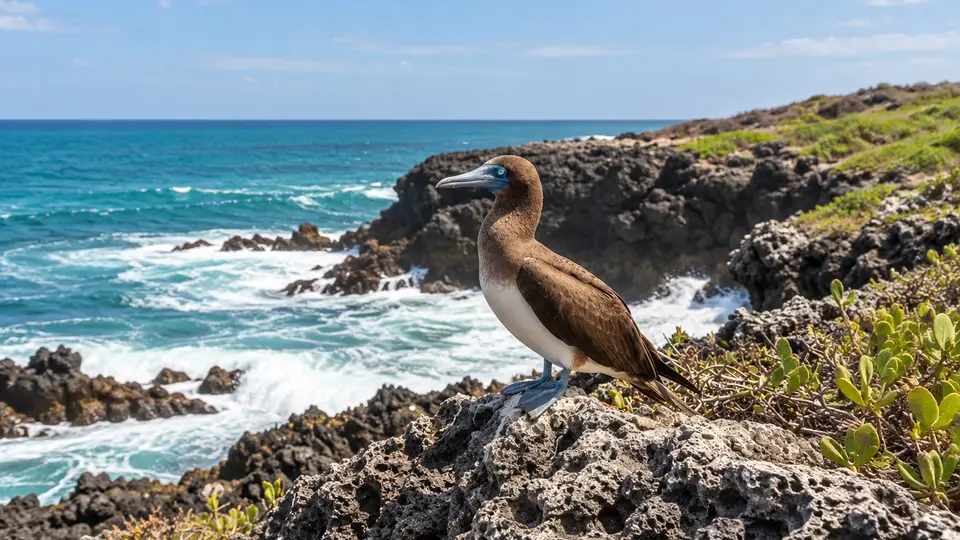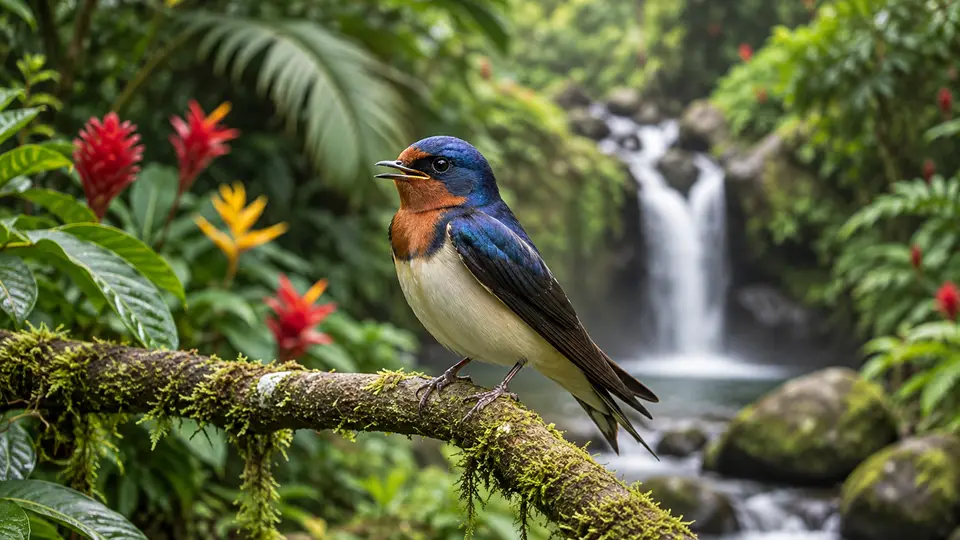
Pacific swallow in its natural habitat, AI illustration

Pacific swallow: where and when to see them

Hirundo javanica

Pacific swallow at a glance

The Pacific swallow is a small aerial insectivore of tropical Asian and Pacific landscapes, frequently seen sweeping over open ground and water. It combines glossy dark upperparts with a reddish face and relatively short, forked tail. Human structures often provide useful nesting ledges, allowing birds to live close to settlements. Modern taxonomic treatments separate it from the Tahiti swallow, so older references using Hirundo tahitica may describe a broader species concept.

Behaviour & reproduction

Size
13-14 cm long
Weight
9-14 g
Lifespan
Not reliably established
Status
Check current assessment

Pacific swallows catch insects in agile flight, making repeated circuits over lawns, roads, wetlands and sheltered shorelines. They often perch on wires or exposed branches between feeding bouts. Pairs build mud cups on protected ledges, sometimes beneath bridges or building eaves. Nearby birds may gather where insects concentrate, although nesting arrangements vary locally. Their low, rapid flight and frequent turns make them conspicuous in suitable open habitat but challenging to photograph. Courtship involves aerial chases, and pairs are generally monogamous within a breeding season. They exhibit communal roosting outside of the breeding season, often gathering in large numbers in reed beds or on wires.

Top wildlife locations

Fiji wildlife habitat

Fiji

Village waterfronts, open coastal gardens and wetland margins offer plausible viewing habitat without an inland expedition. Birds using bridges or eaves should be watched from public paths rather than approached at nests.

Adventure cruises in Fiji
Destinations describe the species' habitat, not guaranteed cruise stops. Some animals require an optional inland excursion or are found in restricted reserves.

Fun facts about the Pacific swallow

  • Mud pellets are assembled into an open cup nest.
  • Its short tail fork contrasts with the long streamers of adult barn swallows.
  • Buildings can provide substitutes for natural sheltered nesting ledges.
  • Older guides may list Pacific populations under Hirundo tahitica.

Best time to see the Pacific swallow

Fiji's generally drier May to October period offers comfortable conditions for coastal walks and watching aerial feeders. Resident swallows can be present year-round, however, and local insect activity may improve after rain. This travel window should not be treated as a fixed breeding season. While generally resident in Fiji, some local populations may undertake short distance movements in response to resource availability. Their activity is often highest during sunny periods after rain, when insect numbers increase.

Pacific swallow: season matrix by destination

Travel and observation windows vary by region. Highlighted months are an orientation for planning, not confirmed sightings or a guarantee of access.

Fiji

A generally drier coastal travel window; resident occurrence and local nesting are not restricted to these months.

JanFebMarAprMayJunJulAugSepOctNovDec
Cruise ships in Fiji

Where the Pacific swallow lives

Open country near water, village edges, coastal clearings and agricultural landscapes provide feeding space. Bridges, buildings and rocky overhangs can supply nest supports. Dense unbroken forest is less suitable than landscapes combining open airspace, insect sources and sheltered ledges. They are particularly common around human settlements, utilizing man-made structures for nesting sites. While adaptable, consistent access to open airspace for foraging is a primary driver of their presence in an area.

What the Pacific swallow eats

Small flying insects form the diet, captured directly in the air. Birds exploit locally abundant swarms and may forage over fresh or brackish water where insects emerge. Food availability changes with rainfall, wind and the daily activity of insect prey. Their diet consists almost entirely of small flying insects, making them opportunistic feeders. They are adept at exploiting temporary insect emergences over water bodies or agricultural fields.

Species at a glance

Common name
Pacific swallow
Scientific name
Hirundo javanica
Animal group
Birds
Size
13-14 cm long
Weight
9-14 g
Lifespan
Not reliably established
Status
Check current assessment
Identification
Compared with a barn swallow, it has much shorter outer tail streamers, greyer underparts and lacks the same sharply defined dark breast band. Key identification features include a distinctive rufous throat and forehead, contrasting with the greyer belly. The lack of a deeply forked tail, common in some other swallow species, is a notable field mark.

Pacific swallow: frequently asked questions

Where can I see the Pacific swallow?
Fiji. Watch over open coastal lawns or freshwater margins, staying clear of traffic when birds use roadside wires. Do not approach occupied mud nests or obstruct adults entering eaves, and avoid photographing beneath fragile nest cups. From an adventure cruise, observe them from deck as they forage over coastal waters or near port areas. On shore excursions, look for them hawking insects over hotel lawns or open village spaces.
When is the best time to see the Pacific swallow?
Fiji's generally drier May to October period offers comfortable conditions for coastal walks and watching aerial feeders. Resident swallows can be present year-round, however, and local insect activity may improve after rain. This travel window should not be treated as a fixed breeding season. While generally resident in Fiji, some local populations may undertake short distance movements in response to resource availability. Their activity is often highest during sunny periods after rain, when insect numbers increase.
How big does the Pacific swallow get?
13-14 cm long. Adult weight: 9-14 g. Size varies with age, sex and population.
How should I behave around the Pacific swallow?
Watch over open coastal lawns or freshwater margins, staying clear of traffic when birds use roadside wires. Do not approach occupied mud nests or obstruct adults entering eaves, and avoid photographing beneath fragile nest cups. From an adventure cruise, observe them from deck as they forage over coastal waters or near port areas. On shore excursions, look for them hawking insects over hotel lawns or open village spaces.
What does the Pacific swallow eat?
Small flying insects form the diet, captured directly in the air. Birds exploit locally abundant swarms and may forage over fresh or brackish water where insects emerge. Food availability changes with rainfall, wind and the daily activity of insect prey. Their diet consists almost entirely of small flying insects, making them opportunistic feeders. They are adept at exploiting temporary insect emergences over water bodies or agricultural fields.
Are wildlife sightings guaranteed on an adventure cruise?
No. Animals move freely and routes, weather, access restrictions and local conditions influence every outing. Confirm the actual itinerary and shore program before booking.

Compare wildlife in the same destinations

Explore other birds recorded in these destinations. Similar surroundings do not mean the animals share the same habits or viewing season.

Species comparison by animal group and destination
Pacific swallowPacific swallowBarking imperial pigeonBarking imperial pigeonBrown BoobyBrown Booby
Animal groupBirdsAnimal groupBirdsAnimal groupBirds
DestinationsFijiDestinationsFijiDestinationsCosta Rica, Cape Verde, Egypt, Fiji, Polynesia
All wildlife destinations
Plan your trip

Find your next wildlife adventure

Compare destinations, shore programs and dates with the animals and habitats you would love to see.

  • Naturalist-led shore excursions
  • Responsible wildlife watching
  • Small expedition ships

Newsletter

Take Blue Rides with you

Adventure cruise offers, last-minute deals and trip inspiration.

Free, unsubscribe anytime. Details: Privacy Policy

Partner with Blue Rides

Affiliate Program

Recommend adventure cruises and earn commission on every confirmed booking.

Share. Track. Earn.

Your footage, our stage

Send us your videos or pictures.

Captured beautiful landscapes or wildlife? Share your videos and pictures with us, we may feature them on Blue Rides.