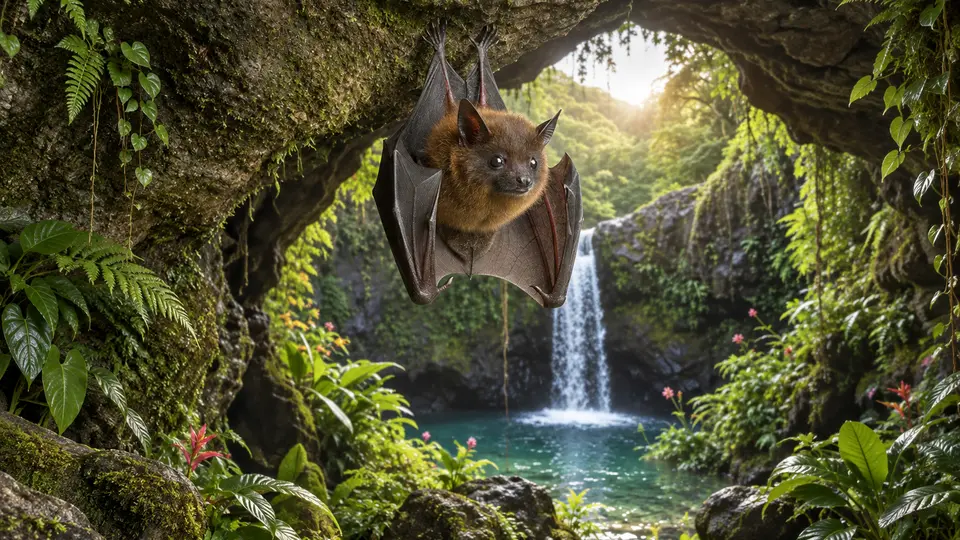
Pacific sheath-tailed bat in its natural habitat, AI illustration
Size4.1-5.0 cm head-body lengthLifespanNot reliably establishedStatusEndangered

Pacific sheath-tailed bat: where and when to see them

Emballonura semicaudata

Pacific sheath-tailed bat at a glance

The Pacific sheath-tailed bat is a small insect-eating bat native to scattered Pacific island groups. Once more widespread, it has disappeared or declined severely in many places, leaving isolated populations vulnerable to disturbance and environmental change. Its name refers to the distinctive relationship between the tail and the membrane stretched between the hind legs. This is not a flying fox, but a much smaller nocturnal hunter whose presence can be difficult to establish.

Behaviour & reproduction

Size
4.1-5.0 cm head-body length
Weight
5-9 g
Lifespan
Not reliably established
Status
Endangered

These bats shelter by day in caves, rock cavities and other protected recesses, emerging around dusk to pursue flying insects. Echolocation guides their movements and prey capture in darkness. Roosts may hold groups, making disturbance at a single shelter potentially important for a local population. Flight near vegetation or cave entrances can be brief and difficult to identify visually. Reliable surveys often require specialist acoustic work rather than casual observation alone. Colonies can range from a few individuals to hundreds, though most remaining roosts are small. The bats emerge rapidly from their roosts and forage in open air above the forest canopy or water surfaces, often returning to their day roosts before dawn.

Top wildlife locations

Polynesia wildlife habitat

Polynesia

Wooded coastal areas near confirmed surviving cave roosts provide only theoretical viewing opportunities. Populations are highly localized, many former sites no longer hold bats, and sensitive roosts may be inaccessible.

Adventure cruises in Polynesia

Destinations describe the species' habitat, not guaranteed cruise stops. Some animals require an optional inland excursion or are found in restricted reserves.

Fun facts about the Pacific sheath-tailed bat

  • The tail tip protrudes through the upper surface of the tail membrane.
  • It hunts with echolocation rather than relying solely on vision.
  • Several geographically isolated subspecies have traditionally been recognized.
  • Loss of one occupied cave can affect a substantial fraction of a small island population.

Best time to see the Pacific sheath-tailed bat

No dependable visitor observation season is established across Polynesia. Local weather, surviving colony locations and access restrictions matter more than a broad travel calendar. Calm evenings may improve general bat watching, but they do not establish this threatened species' presence. Peak insect activity, often associated with warmer, wetter months, might offer slightly better foraging conditions for the bats, but this does not directly translate to improved viewing opportunities. Any seasonal changes in bat activity are often overshadowed by the species' rarity and the remoteness of its remaining colonies.

Pacific sheath-tailed bat: season matrix by destination

Travel and observation windows vary by region. Highlighted months are an orientation for planning, not confirmed sightings or a guarantee of access.

Polynesia

No supported Polynesia-wide shore-observation window exists; obtain current local conservation advice without requesting access to sensitive roosts.

JanFebMarAprMayJunJulAugSepOctNovDec
Cruise ships in Polynesia

Where the Pacific sheath-tailed bat lives

Suitable islands combine secure caves or rocky shelters with insect-rich foraging habitat, including forest and wooded landscapes. Coastal caves can be important, but occupied roosts are not necessarily accessible. Habitat degradation and changes around roost entrances can reduce already limited opportunities. This species exhibits a strong fidelity to its chosen roost sites, often occupying the same caves for many generations. Coastal caves are particularly vulnerable to sea-level rise and storm surges, threatening these critical shelters.

What the Pacific sheath-tailed bat eats

It feeds on small flying insects caught during nocturnal flight. Detailed prey composition is poorly documented across its fragmented range, so precise universal lists are inappropriate. Productive vegetation and healthy surrounding habitats help sustain the insect populations on which it depends. Despite limited documentation, primary prey items are generally thought to include moths, beetles, and small flies. Maintaining the diverse vegetation that supports these insect populations is crucial for the bat's survival.

Species at a glance

Common name
Pacific sheath-tailed bat
Scientific name
Emballonura semicaudata
Animal group
Mammals
Size
4.1-5.0 cm head-body length
Weight
5-9 g
Lifespan
Not reliably established
Status
Endangered
Identification
A tiny brown insectivorous bat with a tail emerging through the upper tail membrane differs markedly from large flying foxes, but separation from other small bats requires specialist confirmation. The prominent tail membrane that encloses the first caudal vertebrae but leaves the tail tip exposed is a key characteristic separating it from other bats in its range. Its small size, typically weighing less than 10 grams, further distinguishes it from larger microbats and fruit bats.

Pacific sheath-tailed bat: frequently asked questions

Where can I see the Pacific sheath-tailed bat?
Polynesia. Observe only from authorized outdoor viewpoints without approaching cave entrances. Never enter roosts, shine lights at emerging bats or handle animals. Identification from a fleeting silhouette is unreliable, and sightings should not be expected. Shore excursions generally do not target this elusive bat due to its rarity and inaccessible roosts. Observing during dusk or dawn from a distance where a known roost is active requires patience and specialized equipment, such as night vision, to potentially glimpse emerging bats.
When is the best time to see the Pacific sheath-tailed bat?
No dependable visitor observation season is established across Polynesia. Local weather, surviving colony locations and access restrictions matter more than a broad travel calendar. Calm evenings may improve general bat watching, but they do not establish this threatened species' presence. Peak insect activity, often associated with warmer, wetter months, might offer slightly better foraging conditions for the bats, but this does not directly translate to improved viewing opportunities. Any seasonal changes in bat activity are often overshadowed by the species' rarity and the remoteness of its remaining colonies.
How big does the Pacific sheath-tailed bat get?
4.1-5.0 cm head-body length. Adult weight: 5-9 g. Size varies with age, sex and population.
How should I behave around the Pacific sheath-tailed bat?
Observe only from authorized outdoor viewpoints without approaching cave entrances. Never enter roosts, shine lights at emerging bats or handle animals. Identification from a fleeting silhouette is unreliable, and sightings should not be expected. Shore excursions generally do not target this elusive bat due to its rarity and inaccessible roosts. Observing during dusk or dawn from a distance where a known roost is active requires patience and specialized equipment, such as night vision, to potentially glimpse emerging bats.
What does the Pacific sheath-tailed bat eat?
It feeds on small flying insects caught during nocturnal flight. Detailed prey composition is poorly documented across its fragmented range, so precise universal lists are inappropriate. Productive vegetation and healthy surrounding habitats help sustain the insect populations on which it depends. Despite limited documentation, primary prey items are generally thought to include moths, beetles, and small flies. Maintaining the diverse vegetation that supports these insect populations is crucial for the bat's survival.
Are wildlife sightings guaranteed on an adventure cruise?
No. Animals move freely and routes, weather, access restrictions and local conditions influence every outing. Confirm the actual itinerary and shore programme before booking.

Compare wildlife in the same destinations

Explore other mammals recorded in these destinations. Similar surroundings do not mean the animals share the same habits or viewing season.

Species comparison by animal group and destination
Pacific sheath-tailed batPacific sheath-tailed batHumpback WhaleHumpback WhaleSperm WhaleSperm Whale
Animal groupMammalsAnimal groupMammalsAnimal groupMammals
DestinationsPolynesiaDestinationsAlaska, Costa Rica, Mexico, New England, Cape Verde, Norway, Portugal, Scotland, Seychelles, Antarctica, Arctic, Australia, Fiji, New Zealand, PolynesiaDestinationsGalapagos, Mexico, Greece, Norway, Portugal, Turkey, Indonesia, Maldives, New Zealand, Polynesia
All wildlife destinations
Plan your trip

Find your next wildlife adventure

Compare destinations, shore programmes and dates with the animals and habitats you would love to see.

  • Naturalist-led shore excursions
  • Responsible wildlife watching
  • Small expedition ships

Newsletter

Take Blue Rides with you

Adventure cruise offers, last-minute deals and trip inspiration.

Free, unsubscribe anytime. Details: Privacy Policy

Partner with Blue Rides

Affiliate Program

Recommend adventure cruises and earn commission on every confirmed booking.

Share. Track. Earn.