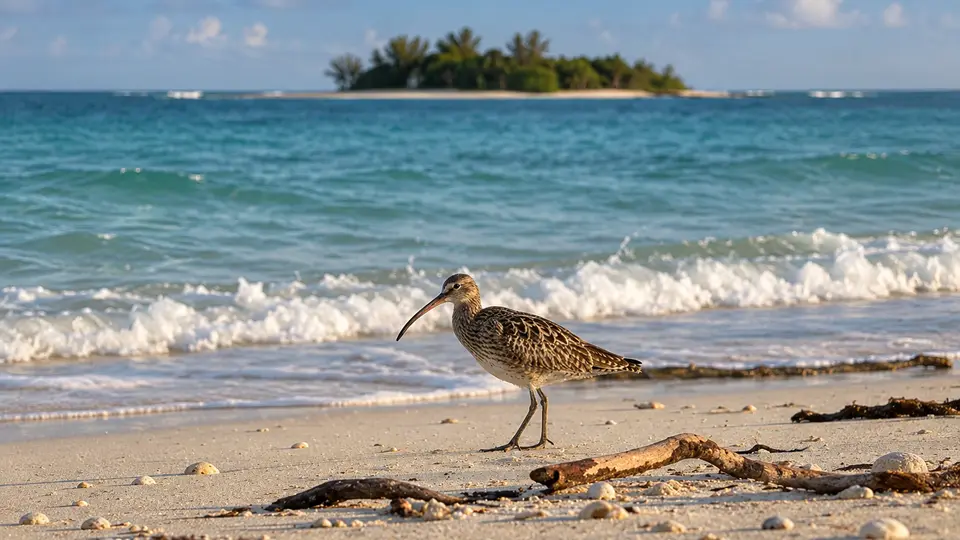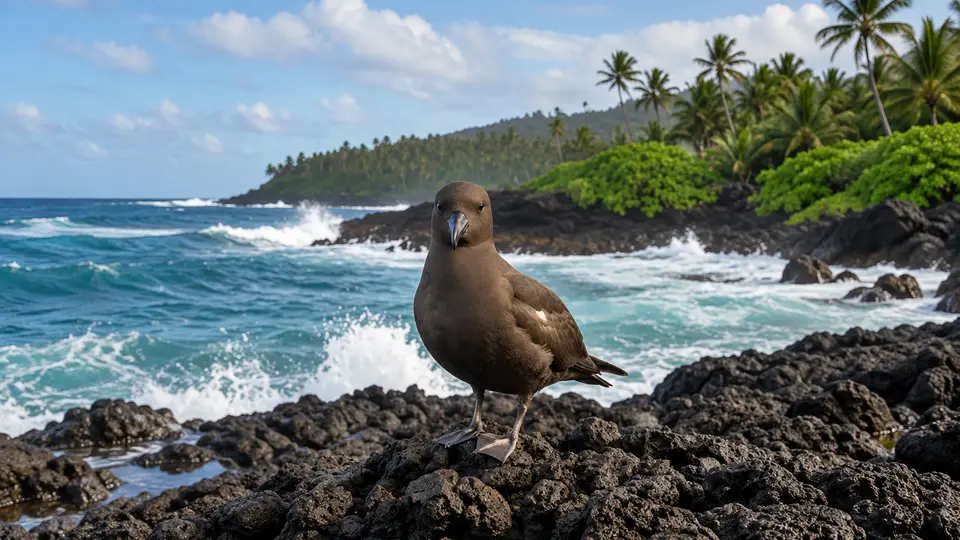
Murphy's petrel in its natural habitat, AI illustration

Murphy's petrel: where and when to see them

Pterodroma ultima

Murphy's petrel at a glance

Murphy's petrel is a dark, ocean-ranging gadfly petrel that breeds on remote islands of the subtropical South Pacific. Much of its life unfolds far beyond ordinary coastal viewpoints, and its wide-ranging movements can carry it into the North Pacific. Its understated plumage makes identification challenging against similar petrels. Remote breeding habitat offers some protection from everyday disturbance, but introduced predators can threaten colonies where formerly safe nesting islands become accessible to mammals.

Behaviour & reproduction

Size
38-41 cm long
Weight
300-450 g
Lifespan
Not reliably established
Status
Least Concern

This petrel travels with the characteristic arcing flight of gadfly petrels, using wind above waves to cover large distances efficiently. It collects food near the sea surface and spends long periods away from land. Breeding birds return to island colonies, where they lay a single egg and share parental duties. Visits to nesting areas are often concentrated in darkness, so daytime coastal presence need not reveal an active colony nearby. Courtship and nesting activities primarily occur at night to avoid predators, with adult birds making regular nocturnal visits to their burrows. After the chick hatches, one parent remains to guard it while the other forages, switching roles periodically.

Top wildlife locations

Polynesia wildlife habitat

Polynesia

Remote islands and atolls within parts of Polynesia provide breeding habitat, but colonies are generally inaccessible and not standard landings. Distant deck views are more plausible than ordinary shore sightings, with identification often uncertain.

Adventure cruises in Polynesia
Destinations describe the species' habitat, not guaranteed cruise stops. Some animals require an optional inland excursion or are found in restricted reserves.

Fun facts about the Murphy's petrel

  • The species was formally described in 1949.
  • It belongs to Pterodroma, the genus known as the gadfly petrels.
  • Nonbreeding birds can travel from South Pacific colonies into the North Pacific.
  • Like other petrels, it has tubular nostrils associated with a well-developed sense of smell.

Best time to see the Murphy's petrel

There is no reliable observation season for Polynesia as a whole. Breeding schedules and ocean movements differ among island groups, and relevant colonies are remote. Any travel window should be based on a specific lawful itinerary, weather and current local seabird expertise. For general pelagic birdwatching, the austral summer months (December to February) might offer opportunities for sightings during oceanic transits, particularly in areas with upwellings. However, specific breeding colony visits are highly regulated and only permissible during limited periods, often in the austral winter for some populations.

Murphy's petrel: season matrix by destination

Travel and observation windows vary by region. Highlighted months are an orientation for planning, not confirmed sightings or a guarantee of access.

Polynesia

The destination is too broad for a defensible monthly window; island-specific breeding timing, legal access and ocean conditions must be established separately.

JanFebMarAprMayJunJulAugSepOctNovDec
Cruise ships in Polynesia

Where the Murphy's petrel lives

Its principal habitat is open ocean, with breeding restricted to remote South Pacific islands and atolls. Nests occur on the ground in suitable sheltered sites. Most colonies are inaccessible to ordinary visitors, and routine shore viewing across Polynesia is unlikely. While breeding, birds may be found on high volcanic islands or low-lying coral atolls, often selecting sites with dense vegetation or rock crevices for shelter. Chicks fledge in autumn, after which all birds disperse widely across the Pacific Ocean for their non-breeding phase.

What the Murphy's petrel eats

Squid are important prey, alongside fish and crustaceans collected from oceanic waters. Some food may be obtained from organisms available at the surface at night. Detailed feeding information remains limited because birds range widely through remote marine environments. Prey items are typically soft-bodied, such as squid and gelatinous zooplankton, which are often found in surface waters. These petrels employ surface-seizing and shallow-plunge methods to capture food, rather than deep diving.

Species at a glance

Common name
Murphy's petrel
Scientific name
Pterodroma ultima
Animal group
Birds
Size
38-41 cm long
Weight
300-450 g
Lifespan
Not reliably established
Status
Least Concern
Identification
It is a largely uniform dark gray-brown petrel with a paler chin and subtle pale underwing areas, but separation from other dark gadfly petrels usually requires expert views. Distinguishing features include a relatively short, stout bill and a dark 'M' pattern across the upperwings when viewed from above, though this can be difficult to discern at sea. The pale chin patch is often inconspicuous unless birds are seen at close range in good light.

Murphy's petrel: frequently asked questions

Where can I see the Murphy's petrel?
Polynesia. Watch distant birds from stable coastal viewpoints or a vessel deck, using photographs cautiously for identification. Do not enter nesting grounds, use bright lights near colonies or encourage vessel maneuvers to pursue individual birds. Focus on observing birds in flight far from the vessel, noting their characteristic flight pattern and overall plumage. Binoculars are essential for distant pelagic sightings, as these birds rarely approach vessels closely.
When is the best time to see the Murphy's petrel?
There is no reliable observation season for Polynesia as a whole. Breeding schedules and ocean movements differ among island groups, and relevant colonies are remote. Any travel window should be based on a specific lawful itinerary, weather and current local seabird expertise. For general pelagic birdwatching, the austral summer months (December to February) might offer opportunities for sightings during oceanic transits, particularly in areas with upwellings. However, specific breeding colony visits are highly regulated and only permissible during limited periods, often in the austral winter for some populations.
How big does the Murphy's petrel get?
38-41 cm long. Adult weight: 300-450 g. Size varies with age, sex and population.
How should I behave around the Murphy's petrel?
Watch distant birds from stable coastal viewpoints or a vessel deck, using photographs cautiously for identification. Do not enter nesting grounds, use bright lights near colonies or encourage vessel maneuvers to pursue individual birds. Focus on observing birds in flight far from the vessel, noting their characteristic flight pattern and overall plumage. Binoculars are essential for distant pelagic sightings, as these birds rarely approach vessels closely.
What does the Murphy's petrel eat?
Squid are important prey, alongside fish and crustaceans collected from oceanic waters. Some food may be obtained from organisms available at the surface at night. Detailed feeding information remains limited because birds range widely through remote marine environments. Prey items are typically soft-bodied, such as squid and gelatinous zooplankton, which are often found in surface waters. These petrels employ surface-seizing and shallow-plunge methods to capture food, rather than deep diving.
Are wildlife sightings guaranteed on an adventure cruise?
No. Animals move freely and routes, weather, access restrictions and local conditions influence every outing. Confirm the actual itinerary and shore programme before booking.

Compare wildlife in the same destinations

Explore other birds recorded in these destinations. Similar surroundings do not mean the animals share the same habits or viewing season.

Species comparison by animal group and destination
Murphy's petrelMurphy's petrelBlue lorikeetBlue lorikeetBristle-thighed curlewBristle-thighed curlew
Animal groupBirdsAnimal groupBirdsAnimal groupBirds
DestinationsPolynesiaDestinationsPolynesiaDestinationsPolynesia
All wildlife destinations
Plan your trip

Find your next wildlife adventure

Compare destinations, shore programmes and dates with the animals and habitats you would love to see.

  • Naturalist-led shore excursions
  • Responsible wildlife watching
  • Small expedition ships

Newsletter

Take Blue Rides with you

Adventure cruise offers, last-minute deals and trip inspiration.

Free, unsubscribe anytime. Details: Privacy Policy

Partner with Blue Rides

Affiliate Program

Recommend adventure cruises and earn commission on every confirmed booking.

Share. Track. Earn.