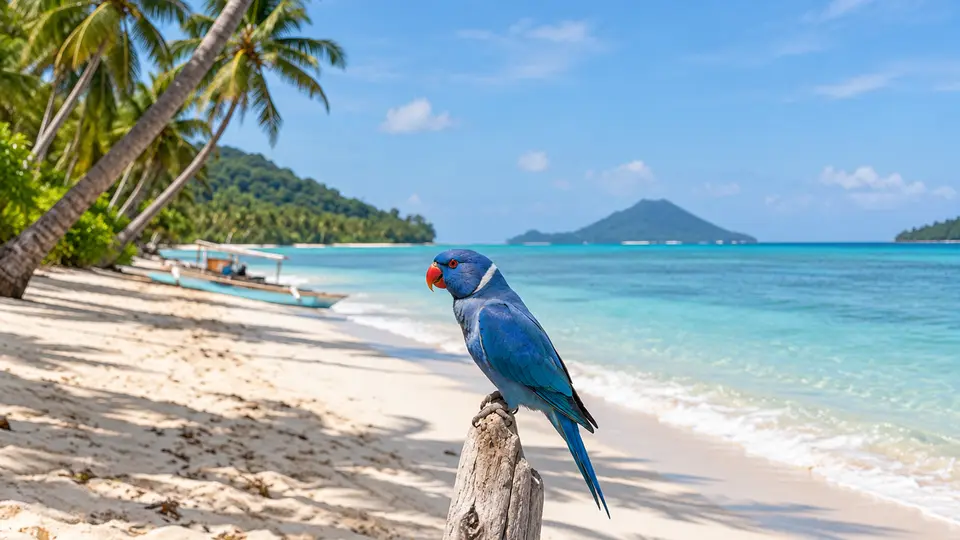
Blue lorikeet in its natural habitat, AI illustration
Size18 cm longLifespanNot reliably establishedStatusVulnerable

Blue lorikeet: where and when to see them

Vini peruviana

Blue lorikeet at a glance

The blue lorikeet is a small Polynesian parrot with deep blue plumage, a white throat and face, and a bright orange bill. Its remaining distribution is fragmented among islands, with introduced predators posing a major threat. Despite the scientific name peruviana, it is not a native Peruvian bird. Flower-rich vegetation is essential to its daily life, and surviving populations depend on suitable island habitat that is often geographically isolated from common visitor routes.

Behaviour & reproduction

Size
18 cm long
Weight
30–50 g
Lifespan
Not reliably established
Status
Vulnerable

Active birds move between flowering trees in small groups, calling as they travel and clambering among blossoms to feed. Their specialized tongues collect nectar and pollen, and the bill helps manipulate flowers and soft food. Nesting takes place in cavities, including those in palms and other trees. Island populations can be vulnerable to rats entering nest cavities, while the lorikeets' mobility means a flowering tree may be busy one day and quiet the next. Courtship displays involve the male feeding the female and mutual preening, strengthening pair bonds. Their highly mobile foraging strategy means that a single individual or small group may range across multiple kilometers of island habitat daily.

Top wildlife locations

Polynesia wildlife habitat

Polynesia

Flowering coastal groves on currently occupied islands offer plausible land-based views. Distribution is highly patchy, and some populations are remote or inaccessible; a generic Polynesian island visit does not imply an observation opportunity.

Adventure cruises in Polynesia
Destinations describe the species' habitat, not guaranteed cruise stops. Some animals require an optional inland excursion or are found in restricted reserves.

Fun facts about the Blue lorikeet

  • Its scientific name misleadingly suggests a connection with Peru.
  • A brush-tipped tongue helps it gather nectar and pollen.
  • Juveniles lack the adult's extensive clean white throat patch.
  • Introduced rats can threaten it by reaching eggs and chicks inside nest cavities.

Best time to see the Blue lorikeet

Observation depends more on choosing an island with a current population and finding flowering trees than on a universal season. Drier months may ease walking and inter-island travel in parts of Polynesia, but rainfall regimes vary and do not define lorikeet breeding schedules. Breeding can occur year-round if food resources are consistently available, but often peaks during periods of abundant flowering. Guides often monitor local conditions and recent sightings to determine the most promising viewing locations.

Blue lorikeet: season matrix by destination

Travel and observation windows vary by region. Highlighted months are an orientation for planning, not confirmed sightings or a guarantee of access.

Polynesia

The destination is too broad for a defensible shared window; select an occupied island and verify local travel conditions and current access.

JanFebMarAprMayJunJulAugSepOctNovDec
Cruise ships in Polynesia

Where the Blue lorikeet lives

Coconut groves, wooded atolls, coastal vegetation and gardens with suitable flowering trees can support populations on occupied islands. Habitat suitability alone does not establish presence. Many seemingly appropriate Polynesian islands have lost the species or lie outside its surviving distribution. The species now persists only on a few scattered islands, such as Fakarava, Rangiroa, and Manihi, where rat populations may be controlled or absent. Remnant populations are often found on smaller motus or islets that are naturally isolated from larger landmasses and their introduced predators.

What the Blue lorikeet eats

Nectar and pollen are central foods, supplemented by soft fruit and other plant material. Flowers of coconut palms and various island trees provide feeding opportunities. Its brush-tipped tongue is adapted to gathering liquid and powdery foods rather than relying mainly on hard seeds. They play a significant role as pollinators for various native plants across their range, transferring pollen as they move between blossoms. While specializing in nectar, they also consume some small insects, especially when feeding young.

Species at a glance

Common name
Blue lorikeet
Scientific name
Vini peruviana
Animal group
Birds
Size
18 cm long
Weight
30–50 g
Lifespan
Not reliably established
Status
Vulnerable
Identification
The deep blue body with a white lower face and throat separates adults from the darker, differently patterned ultramarine lorikeet. Juveniles are similar to adults but have a duller white face and throat, sometimes with a faint blue wash. Unlike other lorikeet species, its small size and entirely blue body are key differentiating features.

Blue lorikeet: frequently asked questions

Where can I see the Blue lorikeet?
Polynesia. Watch flowering trees quietly from permitted paths, leaving nest cavities undisturbed. Follow island biosecurity rules carefully, especially checks against transporting rodents; never feed birds or seek access to restricted conservation islands without authorization. Listen for their distinctive high pitched, squeaky calls that often betray their presence in dense foliage. On larger vessels, scan flowering trees on shore when anchored, especially early morning or late afternoon.
When is the best time to see the Blue lorikeet?
Observation depends more on choosing an island with a current population and finding flowering trees than on a universal season. Drier months may ease walking and inter-island travel in parts of Polynesia, but rainfall regimes vary and do not define lorikeet breeding schedules. Breeding can occur year-round if food resources are consistently available, but often peaks during periods of abundant flowering. Guides often monitor local conditions and recent sightings to determine the most promising viewing locations.
How big does the Blue lorikeet get?
18 cm long. Adult weight: 30–50 g. Size varies with age, sex and population.
How should I behave around the Blue lorikeet?
Watch flowering trees quietly from permitted paths, leaving nest cavities undisturbed. Follow island biosecurity rules carefully, especially checks against transporting rodents; never feed birds or seek access to restricted conservation islands without authorization. Listen for their distinctive high pitched, squeaky calls that often betray their presence in dense foliage. On larger vessels, scan flowering trees on shore when anchored, especially early morning or late afternoon.
What does the Blue lorikeet eat?
Nectar and pollen are central foods, supplemented by soft fruit and other plant material. Flowers of coconut palms and various island trees provide feeding opportunities. Its brush-tipped tongue is adapted to gathering liquid and powdery foods rather than relying mainly on hard seeds. They play a significant role as pollinators for various native plants across their range, transferring pollen as they move between blossoms. While specializing in nectar, they also consume some small insects, especially when feeding young.
Are wildlife sightings guaranteed on an adventure cruise?
No. Animals move freely and routes, weather, access restrictions and local conditions influence every outing. Confirm the actual itinerary and shore programme before booking.

Compare wildlife in the same destinations

Explore other birds recorded in these destinations. Similar surroundings do not mean the animals share the same habits or viewing season.

Species comparison by animal group and destination
Blue lorikeetBlue lorikeetBristle-thighed curlewBristle-thighed curlewBrown BoobyBrown Booby
Animal groupBirdsAnimal groupBirdsAnimal groupBirds
DestinationsPolynesiaDestinationsPolynesiaDestinationsCosta Rica, Cape Verde, Egypt, Fiji, Polynesia
All wildlife destinations
Plan your trip

Find your next wildlife adventure

Compare destinations, shore programmes and dates with the animals and habitats you would love to see.

  • Naturalist-led shore excursions
  • Responsible wildlife watching
  • Small expedition ships

Newsletter

Take Blue Rides with you

Adventure cruise offers, last-minute deals and trip inspiration.

Free, unsubscribe anytime. Details: Privacy Policy

Partner with Blue Rides

Affiliate Program

Recommend adventure cruises and earn commission on every confirmed booking.

Share. Track. Earn.