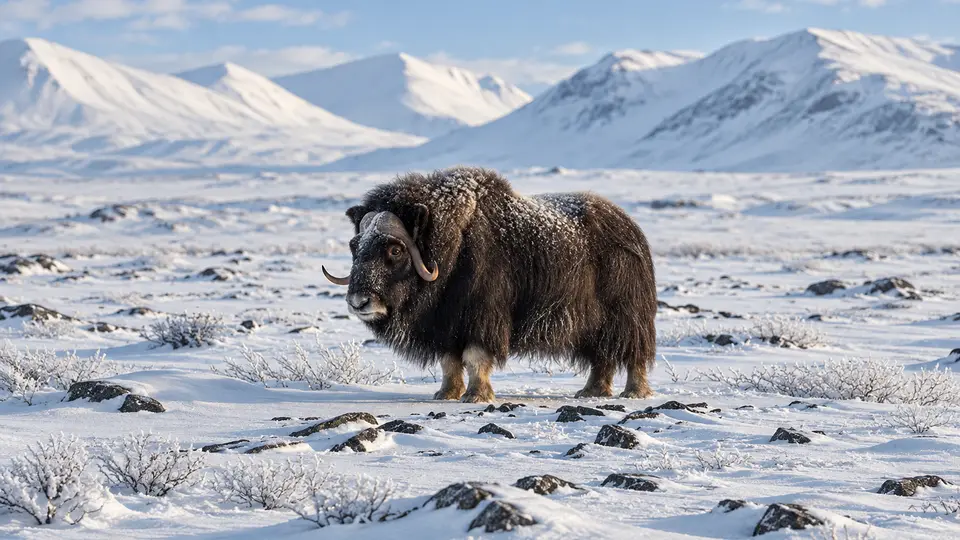
Muskox in its natural habitat, AI illustration

MuskoxOvibos moschatusWhere and when to see them

Muskox at a glance

The muskox is a heavily insulated Arctic grazer, more closely related to sheep and goats than to cattle. Its long outer coat hangs almost to the ground, shielding an exceptionally fine undercoat called qiviut. Both sexes carry curved horns, although mature males develop a much heavier forehead boss. Native populations inhabit Greenland and Arctic North America; Norway's mainland animals descend from introductions rather than an uninterrupted local wild population.

Behaviour & reproduction

Size
1.1-1.5 m shoulder height
Weight
180-400 kg
Lifespan
12-20 years
Status
Least Concern

Muskoxen usually live in mixed herds, with adult bulls sometimes solitary or in small male groups. When threatened, a herd may cluster with adults facing outward and calves sheltered behind them. This formation is a defensive response, not an invitation to approach. During the late-summer rut, males compete through displays and powerful head-on clashes. Winter activity is economical, with long resting periods and feeding concentrated where snow permits access to vegetation. The qiviut sheds in spring, often in large sheets, and can be seen trailing from the animals. Young calves are born in spring and stay close to their mothers, typically within the protective herd formation.

Top wildlife locations

Norway wildlife habitat

Norway

Dovrefjell supports an introduced population on open alpine tundra. An inland excursion is required from coastal itineraries; sightings depend on animal movements, weather and access, preferably assessed with a local guide.

Arctic wildlife habitat

Arctic

In parts of Greenland and Arctic Canada, muskoxen occupy tundra valleys sometimes visible from permitted shore routes. Distribution is highly localized, and many populations are inaccessible during ordinary coastal visits.

Destinations describe the species' habitat, not guaranteed cruise stops. Some animals require an optional inland excursion or are found in restricted reserves.

Fun facts about the Muskox

  • Qiviut is shed each spring rather than continuously growing as a permanent insulating layer.
  • Both sexes have horns, but the massive joined-looking forehead boss is characteristic of mature bulls.
  • Muskoxen belong to the goat-antelope branch of the cattle family.
  • Calves can stand and follow their mothers shortly after birth.

Best time to see the Muskox

July through September generally offers the most practical Arctic travel and open-ground observation, depending on region and ice conditions. Norwegian Dovrefjell excursions are also more accessible in summer. Late summer overlaps the rut, when extra distance from bulls is especially important. The relatively short Arctic summer also means that muskoxen must rapidly build up fat reserves for the long winter. Increased daylight hours in summer make spotting them during extended shore excursions or zodiac cruises more feasible.

Muskox: season matrix by destination

Travel and observation windows vary by region. Highlighted months are an orientation for planning, not confirmed sightings or a guarantee of access.

Norway

These months offer more practical hiking access, not a guarantee of sightings; snow and mountain weather remain variable.

JanFebMarAprMayJunJulAugSepOctNovDec
Cruise ships in Norway

Arctic

A broad summer coastal-access window only; local ice, permissions and the destination's actual muskox distribution determine feasibility.

JanFebMarAprMayJunJulAugSepOctNovDec
Cruise ships in Arctic

Where the Muskox lives

Open tundra, windswept plateaus and broad Arctic valleys provide forage without deep, persistent snow cover. Summer feeding often shifts toward moist sedge meadows. In mainland Norway, introduced muskoxen occupy the alpine landscape of Dovrefjell, well inland from ordinary coastal travel routes. They are highly adapted to cold, dry Arctic environments, favoring areas with good visibility to detect predators. While native to Arctic North America and Greenland, their range in Russia and Scandinavia is a result of reintroductions.

What the Muskox eats

Muskoxen are ruminants that eat sedges, grasses, willow leaves and other tundra plants. They shift toward woody shoots and available dry vegetation in winter. Hooves and muzzles help expose forage through snow, but thick ice crusts can severely restrict feeding. Their four-chambered stomach allows efficient digestion of tough, fibrous plant matter. They often browse on willow and birch twigs in addition to grazing on grasses and sedges.

Species at a glance

Common name
Muskox
Scientific name
Ovibos moschatus
Animal group
Mammals
Size
1.1-1.5 m shoulder height
Weight
180-400 kg
Lifespan
12-20 years
Status
Least Concern
Identification
A low, shaggy body and horns curving downward before turning upward distinguish muskoxen from the taller, shorter-coated bison. Both males and females possess horns, though those of males are typically larger and thicker at the base, forming a 'boss' that can cover much of the forehead. Their thick, shaggy coat, called a qiviut, provides exceptional insulation against extreme cold.

Muskox: frequently asked questions

Where can I see the Muskox?
Norway, Arctic. Use binoculars from a distant trail or an authorized guided viewpoint. In Norway, follow advice to remain at least 200 metres away. Never approach a defensive herd, pass between animals or block their escape route. Always maintain a safe distance and never attempt to get between a calf and its mother. When viewing from a cruise ship, utilize the ship's binoculars or long-range camera lenses for close-up views without disturbance.
When is the best time to see the Muskox?
July through September generally offers the most practical Arctic travel and open-ground observation, depending on region and ice conditions. Norwegian Dovrefjell excursions are also more accessible in summer. Late summer overlaps the rut, when extra distance from bulls is especially important. The relatively short Arctic summer also means that muskoxen must rapidly build up fat reserves for the long winter. Increased daylight hours in summer make spotting them during extended shore excursions or zodiac cruises more feasible.
How big does the Muskox get?
1.1-1.5 m shoulder height. Adult weight: 180-400 kg. Size varies with age, sex and population.
How should I behave around the Muskox?
Use binoculars from a distant trail or an authorized guided viewpoint. In Norway, follow advice to remain at least 200 metres away. Never approach a defensive herd, pass between animals or block their escape route. Always maintain a safe distance and never attempt to get between a calf and its mother. When viewing from a cruise ship, utilize the ship's binoculars or long-range camera lenses for close-up views without disturbance.
What does the Muskox eat?
Muskoxen are ruminants that eat sedges, grasses, willow leaves and other tundra plants. They shift toward woody shoots and available dry vegetation in winter. Hooves and muzzles help expose forage through snow, but thick ice crusts can severely restrict feeding. Their four-chambered stomach allows efficient digestion of tough, fibrous plant matter. They often browse on willow and birch twigs in addition to grazing on grasses and sedges.
Are wildlife sightings guaranteed on an adventure cruise?
No. Animals move freely and routes, weather, access restrictions and local conditions influence every outing. Confirm the actual itinerary and shore program before booking.

Compare wildlife in the same destinations

Explore other mammals recorded in these destinations. Similar surroundings do not mean the animals share the same habits or viewing season.

Species comparison by animal group and destination
MuskoxMuskoxArctic FoxArctic FoxArctic HareArctic Hare
Animal groupMammalsAnimal groupMammalsAnimal groupMammals
DestinationsNorway, ArcticDestinationsNorway, ArcticDestinationsArctic
All wildlife destinations
Plan your trip

Find your next wildlife adventure

Compare destinations, shore programs and dates with the animals and habitats you would love to see.

  • Naturalist-led shore excursions
  • Responsible wildlife watching
  • Small expedition ships

Newsletter

Take Blue Rides with you

Adventure cruise offers, last-minute deals and trip inspiration.

Free, unsubscribe anytime. Details: Privacy Policy

Partner with Blue Rides

Affiliate Program

Recommend adventure cruises and earn commission on every confirmed booking.

Share. Track. Earn.

Your footage, our stage

Send us your videos or pictures.

Captured remarkable nature or wildlife on your journey? Share it with us, we may feature it on Blue Rides.