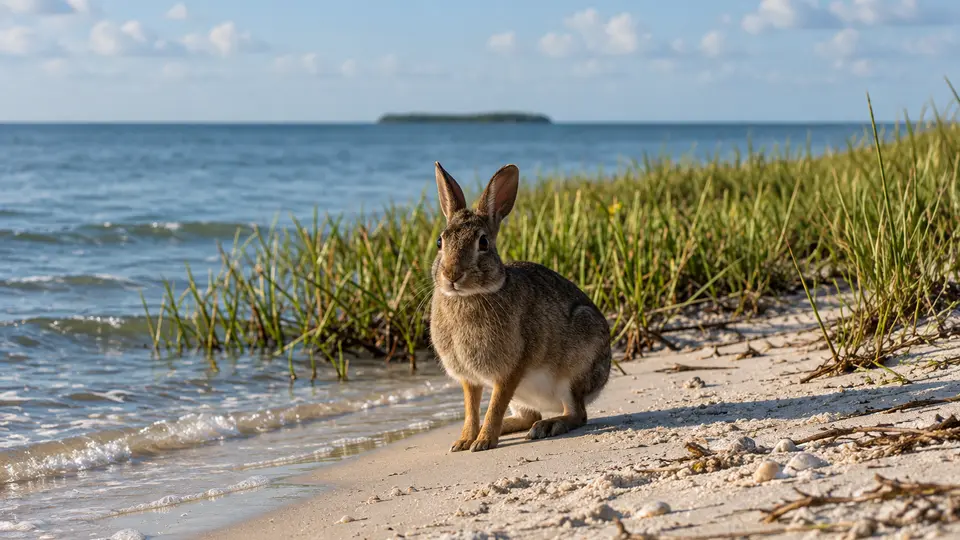
Marsh Rabbit in its natural habitat, AI illustration

Marsh Rabbit: where and when to see them

Sylvilagus palustris

Marsh Rabbit at a glance

The marsh rabbit is a wetland-adapted cottontail of the southeastern United States, including Florida. Compared with the familiar eastern cottontail, it has shorter ears, relatively small hind feet and a less conspicuous tail. Its dark, coarse-looking coat blends into marsh vegetation. The species as a whole is widespread, but the Lower Keys marsh rabbit is a highly threatened subspecies requiring a separate conservation perspective.

Behaviour & reproduction

Size
43–54 cm long
Weight
1.2–2.2 kg
Lifespan
Not reliably established
Status
Least Concern

Marsh rabbits are most active around dusk, at night and in early morning, often remaining concealed during the day. They use well-worn routes through dense vegetation and can move with a walking gait rather than always bounding. Water is not a strong barrier: they swim readily when escaping danger. Females build concealed nests from vegetation and fur, and young receive brief nursing visits rather than continuous attendance. Unlike many rabbit species, marsh rabbits do not typically burrow but instead create 'forms' or flattened resting places in dense vegetation. They are known for their ability to swim long distances underwater to escape predators like alligators and bobcats.

Top wildlife locations

Florida wildlife habitat

Florida

Coastal wetland trails and vegetated freshwater margins offer plausible viewing, with some sites requiring an inland excursion. Rabbits are easily overlooked; sensitive Lower Keys habitat may be restricted and should not be entered.

Adventure cruises in Florida
Destinations describe the species' habitat, not guaranteed cruise stops. Some animals require an optional inland excursion or are found in restricted reserves.

Fun facts about the Marsh Rabbit

  • It is a capable swimmer and may enter water to escape predators.
  • It often walks through dense cover instead of using long bounding hops.
  • Its tail lacks the conspicuous white flag typical of many cottontails.
  • The Lower Keys marsh rabbit has a much more precarious conservation status than the species overall.

Best time to see the Marsh Rabbit

Marsh rabbits can be present year-round in Florida. November through April generally offers more comfortable walking conditions and fewer summer thunderstorms. Dawn and dusk are often better than midday, although flooding, vegetation density and local disturbance strongly affect visibility from paths. Breeding can occur year-round in Florida due to the warm climate, though it may peak in spring. Viewing is also good after cold fronts, as rabbits may be more active during the day to forage in the sun.

Marsh Rabbit: season matrix by destination

Travel and observation windows vary by region. Highlighted months are an orientation for planning, not confirmed sightings or a guarantee of access.

Florida

A comfortable shore-walking window for a resident mammal, not a breeding or confirmed sighting schedule.

JanFebMarAprMayJunJulAugSepOctNovDec
Cruise ships in Florida

Where the Marsh Rabbit lives

Freshwater marshes, wet prairies, swamp edges and dense vegetation beside ponds or canals provide cover. Some populations also occupy coastal brackish wetlands. Suitable habitat needs both feeding vegetation and sheltered ground, making heavily mown waterfronts less useful than intact wetland margins. They are often found in areas with emergent vegetation like cattails, sawgrass, and sedges. While primarily terrestrial, they are exceptional swimmers and frequently found in extremely wet environments.

What the Marsh Rabbit eats

Grasses, sedges and other wetland plants form the diet, including leaves, stems and tender shoots. Seasonal and local plant availability influence feeding. Like other rabbits, they reingest nutrient-rich soft droppings, allowing further recovery of nutrients produced during hindgut fermentation. In addition to herbaceous plants, marsh rabbits may consume woody vegetation such as bark and twigs, particularly in less ideal conditions. They are also known to eat berries and fruits when available in their wetland habitats.

Species at a glance

Common name
Marsh Rabbit
Scientific name
Sylvilagus palustris
Animal group
Mammals
Size
43–54 cm long
Weight
1.2–2.2 kg
Lifespan
Not reliably established
Status
Least Concern
Identification
Short ears, small hind feet and a dark, inconspicuous tail separate it from the larger-eared eastern cottontail with its flashing white tail. Their uniformly dark brown or reddish-brown fur lacks the grizzled appearance common in other rabbit species. The marsh rabbit's compact, rounded body shape and short, powerful legs are adapted for navigating dense, wet terrain.

Marsh Rabbit: frequently asked questions

Where can I see the Marsh Rabbit?
Florida. Watch quietly from wetland paths at dawn or dusk, keeping dogs leashed and never flushing rabbits toward water. Stay clear of alligator habitat at the water’s edge, use insect protection, and avoid trampling dense cover that may conceal nests. Look for subtle movements in dense undergrowth or along the edges of waterways, where their camouflage makes them difficult to spot. Early morning is particularly fruitful for observation as they dry off after overnight dew.
When is the best time to see the Marsh Rabbit?
Marsh rabbits can be present year-round in Florida. November through April generally offers more comfortable walking conditions and fewer summer thunderstorms. Dawn and dusk are often better than midday, although flooding, vegetation density and local disturbance strongly affect visibility from paths. Breeding can occur year-round in Florida due to the warm climate, though it may peak in spring. Viewing is also good after cold fronts, as rabbits may be more active during the day to forage in the sun.
How big does the Marsh Rabbit get?
43–54 cm long. Adult weight: 1.2–2.2 kg. Size varies with age, sex and population.
How should I behave around the Marsh Rabbit?
Watch quietly from wetland paths at dawn or dusk, keeping dogs leashed and never flushing rabbits toward water. Stay clear of alligator habitat at the water’s edge, use insect protection, and avoid trampling dense cover that may conceal nests. Look for subtle movements in dense undergrowth or along the edges of waterways, where their camouflage makes them difficult to spot. Early morning is particularly fruitful for observation as they dry off after overnight dew.
What does the Marsh Rabbit eat?
Grasses, sedges and other wetland plants form the diet, including leaves, stems and tender shoots. Seasonal and local plant availability influence feeding. Like other rabbits, they reingest nutrient-rich soft droppings, allowing further recovery of nutrients produced during hindgut fermentation. In addition to herbaceous plants, marsh rabbits may consume woody vegetation such as bark and twigs, particularly in less ideal conditions. They are also known to eat berries and fruits when available in their wetland habitats.
Are wildlife sightings guaranteed on an adventure cruise?
No. Animals move freely and routes, weather, access restrictions and local conditions influence every outing. Confirm the actual itinerary and shore program before booking.

Compare wildlife in the same destinations

Explore other mammals recorded in these destinations. Similar surroundings do not mean the animals share the same habits or viewing season.

Species comparison by animal group and destination
Marsh RabbitMarsh RabbitBobcatBobcatCommon Bottlenose DolphinCommon Bottlenose Dolphin
Animal groupMammalsAnimal groupMammalsAnimal groupMammals
DestinationsFloridaDestinationsFloridaDestinationsCosta Rica, Florida, Galapagos, Mexico, Cape Verde, Croatia, Greece, Portugal, Scotland, Seychelles, Turkey, Maldives, Australia, New Zealand
All wildlife destinations
Plan your trip

Find your next wildlife adventure

Compare destinations, shore programs and dates with the animals and habitats you would love to see.

  • Naturalist-led shore excursions
  • Responsible wildlife watching
  • Small expedition ships

Newsletter

Take Blue Rides with you

Adventure cruise offers, last-minute deals and trip inspiration.

Free, unsubscribe anytime. Details: Privacy Policy

Partner with Blue Rides

Affiliate Program

Recommend adventure cruises and earn commission on every confirmed booking.

Share. Track. Earn.