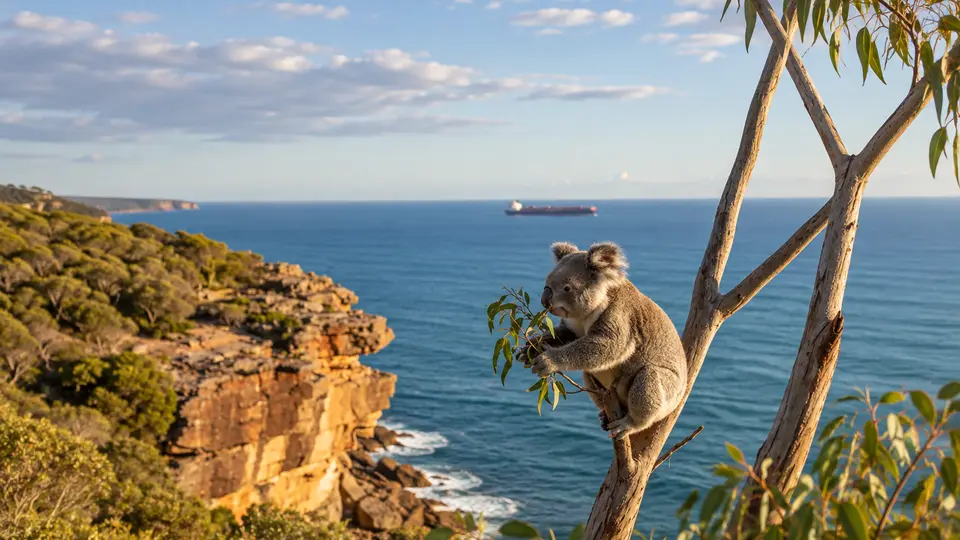
Koala in its natural habitat, AI illustration

KoalaPhascolarctos cinereusWhere and when to see them

Koala at a glance

The koala is an Australian tree-dwelling marsupial specialized for eating eucalyptus foliage. Its rounded ears, broad dark nose and tailless appearance make it unmistakable, but it is not a bear. Populations vary markedly in body size, density and conservation condition across eastern and southeastern Australia. Habitat clearing, vehicle collisions, dog attacks, disease and extreme heat are major pressures, and abundant animals in one locality do not indicate security everywhere.

Behaviour & reproduction

Size
60-85 cm long
Weight
4-14 kg
Lifespan
10-15 years
Status
Vulnerable

Koalas spend much of the day resting in tree forks, conserving energy on a fibrous, relatively low-energy diet. Feeding and movement increase at night, although individuals may change trees or feed during daylight. Adults communicate through scent marking and unexpectedly deep vocalizations, especially during breeding. They descend to the ground to move between trees, exposing themselves to traffic and dogs. Young develop in a pouch before riding on their mother's body. Koalas typically rest for up to 18-20 hours a day to conserve energy, waking primarily at dusk to feed. Breeding season, usually from September to March, is when males are most vocal, emitting deep grunting calls to attract females and ward off rivals.

Top wildlife locations

Australia wildlife habitat

Australia

Occupied coastal eucalypt woodland in eastern and southeastern Australia can offer land-based viewing from public trails. A regional or inland excursion may be necessary, and most Australian coastlines do not support koalas.
Destinations describe the species' habitat, not guaranteed cruise stops. Some animals require an optional inland excursion or are found in restricted reserves.

Fun facts about the Koala

  • Koalas are marsupials rather than bears.
  • Their fingerprints have ridge patterns remarkably similar to human fingerprints.
  • Young acquire important gut microbes by eating a specialized maternal substance called pap.
  • Males possess additional vocal folds that help produce unusually low-pitched calls.

Best time to see the Koala

Koalas can be observed year-round in occupied habitat. April to October often provides comfortable walking conditions across many eastern and southeastern locations, though southern winters can be wet or cold. Local access, heat and fire risk matter more than a single nationwide wildlife season. Prime viewing often coincides with cooler periods when koalas are more active and less prone to heat stress, though they are always present. Dry, warm periods can increase fire risk in eucalypt forests, which should be considered for any onshore excursions.

Koala: season matrix by destination

Travel and observation windows vary by region. Highlighted months are an orientation for planning, not confirmed sightings or a guarantee of access.

Australia

A broad cooler-weather travel window rather than a breeding-season claim; regional weather, fire closures and verified local distribution should guide planning.

JanFebMarAprMayJunJulAugSepOctNovDec
Cruise ships in Australia

Where the Koala lives

Koalas occupy eucalypt forests and woodlands where suitable food trees, resting trees and connected vegetation remain. Some populations occur in coastal landscapes and suburban remnants. They are not distributed throughout Australia, and apparently suitable woodland may lack the particular tree species or local conditions they require. Habitat destruction, fragmentation, and climate change are significant threats to their populations, leading to increased stress and disease susceptibility. Their distribution is primarily concentrated in eastern and southeastern Australia, with significant populations in Queensland, New South Wales, Victoria, and a small population in South Australia.

What the Koala eats

Eucalyptus leaves dominate the diet, with strong preferences for particular species and individual trees. Some other related trees are also used. A specialized hindgut microbial community helps process fibrous foliage, while selective feeding limits exposure to plant chemicals and balances water and nutrient intake. They obtain most of their water needs from eucalyptus leaves, requiring minimal direct drinking water. Young koalas consume a special pap from their mother, which introduces essential gut bacteria for digesting eucalyptus.

Species at a glance

Common name
Koala
Scientific name
Phascolarctos cinereus
Animal group
Mammals
Size
60-85 cm long
Weight
4-14 kg
Lifespan
10-15 years
Status
Vulnerable
Identification
Unlike wombats and possums, the koala combines an arboreal lifestyle with large fluffy ears, a prominent bare dark nose and no externally visible tail. Their large, dark, leathery nose is unique, distinguishing them from other arboreal marsupials. The fur coloration ranges from ash-grey to brownish, with lighter fur on their belly and large, prominent tufts of white fur inside their ears.

Koala: frequently asked questions

Where can I see the Koala?
Australia. Scan tree forks quietly from public paths and never shake trees or attempt handling. Keep dogs away and give ground-moving koalas space. Avoid blocking their route, and report injured animals to a licensed local wildlife rescue service. Look for their characteristic rounded body shape and dense grey fur nestled in tree branches, often appearing as a lump. Binoculars are highly recommended for detailed viewing from a distance, allowing observation without disturbance.
When is the best time to see the Koala?
Koalas can be observed year-round in occupied habitat. April to October often provides comfortable walking conditions across many eastern and southeastern locations, though southern winters can be wet or cold. Local access, heat and fire risk matter more than a single nationwide wildlife season. Prime viewing often coincides with cooler periods when koalas are more active and less prone to heat stress, though they are always present. Dry, warm periods can increase fire risk in eucalypt forests, which should be considered for any onshore excursions.
How big does the Koala get?
60-85 cm long. Adult weight: 4-14 kg. Size varies with age, sex and population.
How should I behave around the Koala?
Scan tree forks quietly from public paths and never shake trees or attempt handling. Keep dogs away and give ground-moving koalas space. Avoid blocking their route, and report injured animals to a licensed local wildlife rescue service. Look for their characteristic rounded body shape and dense grey fur nestled in tree branches, often appearing as a lump. Binoculars are highly recommended for detailed viewing from a distance, allowing observation without disturbance.
What does the Koala eat?
Eucalyptus leaves dominate the diet, with strong preferences for particular species and individual trees. Some other related trees are also used. A specialized hindgut microbial community helps process fibrous foliage, while selective feeding limits exposure to plant chemicals and balances water and nutrient intake. They obtain most of their water needs from eucalyptus leaves, requiring minimal direct drinking water. Young koalas consume a special pap from their mother, which introduces essential gut bacteria for digesting eucalyptus.
Are wildlife sightings guaranteed on an adventure cruise?
No. Animals move freely and routes, weather, access restrictions and local conditions influence every outing. Confirm the actual itinerary and shore program before booking.

Compare wildlife in the same destinations

Explore other mammals recorded in these destinations. Similar surroundings do not mean the animals share the same habits or viewing season.

Species comparison by animal group and destination
KoalaKoalaAustralian fur sealAustralian fur sealAustralian sea lionAustralian sea lion
Animal groupMammalsAnimal groupMammalsAnimal groupMammals
DestinationsAustraliaDestinationsAustraliaDestinationsAustralia
All wildlife destinations
Plan your trip

Find your next wildlife adventure

Compare destinations, shore programs and dates with the animals and habitats you would love to see.

  • Naturalist-led shore excursions
  • Responsible wildlife watching
  • Small expedition ships

Newsletter

Take Blue Rides with you

Adventure cruise offers, last-minute deals and trip inspiration.

Free, unsubscribe anytime. Details: Privacy Policy

Partner with Blue Rides

Affiliate Program

Recommend adventure cruises and earn commission on every confirmed booking.

Share. Track. Earn.

Your footage, our stage

Send us your videos or pictures.

Captured remarkable nature or wildlife on your journey? Share it with us, we may feature it on Blue Rides.