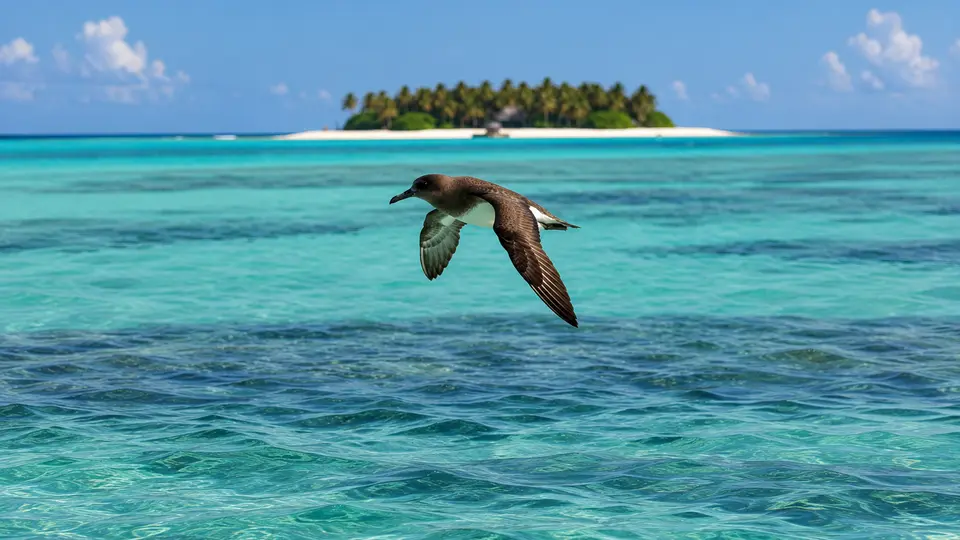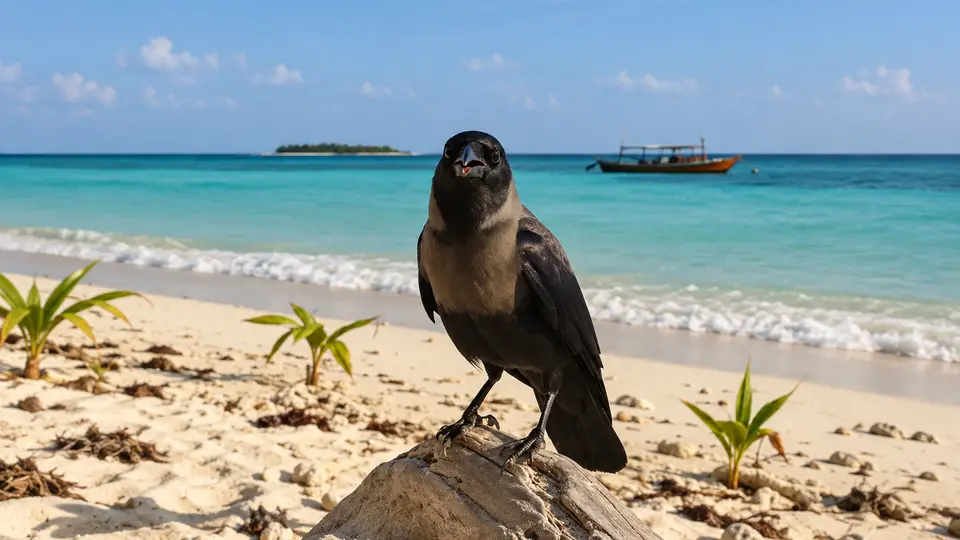
House crow in its natural habitat, AI illustration

House crow: where and when to see them

Corvus splendens

House crow at a glance

The house crow is a slender, adaptable crow native to South Asia and established in several places through human-assisted dispersal. In the Maldives it is associated with inhabited islands and human food resources rather than pristine wilderness. A grey neck and breast contrast with its black head, wings and tail. Its intelligence and close relationship with settlements help it exploit changing environments, while introduced populations can create problems for native wildlife.

Behaviour & reproduction

Size
40-43 cm long
Weight
250-350 g
Lifespan
Not reliably established
Status
Least Concern

House crows forage socially, monitor one another's discoveries and readily investigate predictable food sources. They gather at communal roosts and communicate with a variety of harsh calls. Pairs build stick nests in trees or suitable structures, and adults may defend nearby young. Their boldness around people reflects learning and opportunity rather than domestication, and feeding can encourage persistent approaches or concentrate birds where conflicts are more likely. House crows are highly intelligent and adaptable, capable of complex problem-solving to access food or avoid perceived threats. Their social learning enables rapid exploitation of new food sources and adaptation to human environments, which contributes to their success as an invasive species.

Top wildlife locations

Maldives wildlife habitat

Maldives

Inhabited island waterfronts, harbour margins and coastal streets provide plausible viewing without an inland excursion. Presence varies between islands, and remote or tightly managed islands may have few or no birds.

Adventure cruises in Maldives
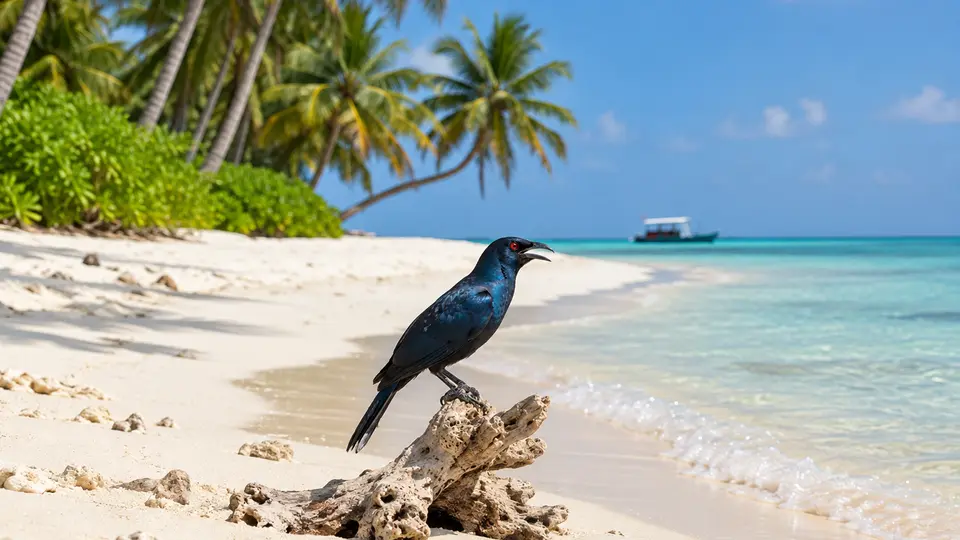
Destinations describe the species' habitat, not guaranteed cruise stops. Some animals require an optional inland excursion or are found in restricted reserves.

Fun facts about the House crow

  • Ship-assisted transport has helped it establish far beyond South Asia.
  • Communal roosts can contain many birds from surrounding feeding areas.
  • Its grey collar contrasts with the glossy black face and crown.
  • It can learn recurring human routines associated with food.

Best time to see the House crow

Resident populations can be observed throughout the year where established. Morning and late afternoon often provide active foraging and movements toward roosts. The Maldives' drier months improve walking conditions, but they are not a demonstrated island-wide breeding season for this species. While breeding activity can occur throughout the year in tropical climates, peak nesting periods might be influenced by local food availability. Their year-round presence means that any visit to inhabited Maldivian islands is likely to offer opportunities for observation.

House crow: season matrix by destination

Travel and observation windows vary by region. Highlighted months are an orientation for planning, not confirmed sightings or a guarantee of access.

Maldives

This generally drier walking window is a travel convenience; established populations are resident and may be observed in other months.

JanFebMarAprMayJunJulAugSepOctNovDec
Cruise ships in Maldives

Where the House crow lives

Typical habitat includes towns, ports, markets, gardens and other settled coastal areas with trees or structures for nesting and roosting. In the Maldives, availability of food waste strongly influences use of inhabited islands. Remote natural islands should not be assumed to support them. Originally from South Asia, the house crow has become an invasive species in many parts of the world, including some Indian Ocean islands. Its presence in the Maldives is a result of human introduction, likely via cargo ships or dhows from the subcontinent.

What the House crow eats

An opportunistic omnivore, the house crow eats insects, small vertebrates, eggs, fruit, grain, carrion and discarded food. It may raid nests or steal food from other birds. Secure waste management reduces artificial feeding opportunities and can help limit impacts on native species. In areas with abundant human food waste, house crows can become highly dependent on these resources, leading to population increases. Their varied diet allows them to adapt to diverse urban and semi-urban environments where human activity provides consistent food sources.

Species at a glance

Common name
House crow
Scientific name
Corvus splendens
Animal group
Birds
Size
40-43 cm long
Weight
250-350 g
Lifespan
Not reliably established
Status
Least Concern
Identification
The contrasting grey neck and breast, slim bill and relatively slender build distinguish it from larger, more uniformly black crows. The glossy black head, wings, and tail sharply contrast with the duller grey nape, neck, and underparts. Its relatively small size and high-pitched 'kaaw-kaaw' call are also key distinguishing features from larger corvid species.

House crow: frequently asked questions

Where can I see the House crow?
Maldives. Watch from public streets or coastal paths without offering food. Keep snacks secured, avoid standing beneath active nests, and give defensive adults space; do not approach chicks or disturb communal roosts. On populated islands, house crows are often easily seen perched on buildings, utility poles, or trees, especially near markets or residential areas. From cruise ship decks or tenders approaching inhabited islands, look for their distinctive silhouettes and flight patterns near the shore.
When is the best time to see the House crow?
Resident populations can be observed throughout the year where established. Morning and late afternoon often provide active foraging and movements toward roosts. The Maldives' drier months improve walking conditions, but they are not a demonstrated island-wide breeding season for this species. While breeding activity can occur throughout the year in tropical climates, peak nesting periods might be influenced by local food availability. Their year-round presence means that any visit to inhabited Maldivian islands is likely to offer opportunities for observation.
How big does the House crow get?
40-43 cm long. Adult weight: 250-350 g. Size varies with age, sex and population.
How should I behave around the House crow?
Watch from public streets or coastal paths without offering food. Keep snacks secured, avoid standing beneath active nests, and give defensive adults space; do not approach chicks or disturb communal roosts. On populated islands, house crows are often easily seen perched on buildings, utility poles, or trees, especially near markets or residential areas. From cruise ship decks or tenders approaching inhabited islands, look for their distinctive silhouettes and flight patterns near the shore.
What does the House crow eat?
An opportunistic omnivore, the house crow eats insects, small vertebrates, eggs, fruit, grain, carrion and discarded food. It may raid nests or steal food from other birds. Secure waste management reduces artificial feeding opportunities and can help limit impacts on native species. In areas with abundant human food waste, house crows can become highly dependent on these resources, leading to population increases. Their varied diet allows them to adapt to diverse urban and semi-urban environments where human activity provides consistent food sources.
Are wildlife sightings guaranteed on an adventure cruise?
No. Animals move freely and routes, weather, access restrictions and local conditions influence every outing. Confirm the actual itinerary and shore program before booking.

Compare wildlife in the same destinations

Explore other birds recorded in these destinations. Similar surroundings do not mean the animals share the same habits or viewing season.

Species comparison by animal group and destination
House crowHouse crowAsian koelAsian koelAudubon's shearwaterAudubon's shearwater
Animal groupBirdsAnimal groupBirdsAnimal groupBirds
DestinationsMaldivesDestinationsMaldivesDestinationsMaldives
All wildlife destinations
Plan your trip

Find your next wildlife adventure

Compare destinations, shore programs and dates with the animals and habitats you would love to see.

  • Naturalist-led shore excursions
  • Responsible wildlife watching
  • Small expedition ships

Newsletter

Take Blue Rides with you

Adventure cruise offers, last-minute deals and trip inspiration.

Free, unsubscribe anytime. Details: Privacy Policy

Partner with Blue Rides

Affiliate Program

Recommend adventure cruises and earn commission on every confirmed booking.

Share. Track. Earn.

Your footage, our stage

Send us your videos or pictures.

Captured beautiful landscapes or wildlife? Share your videos and pictures with us, we may feature them on Blue Rides.