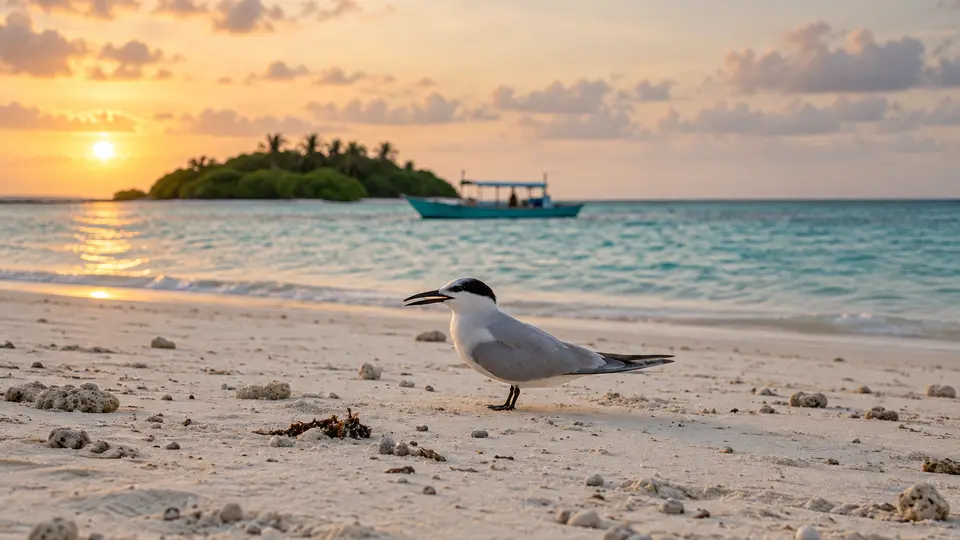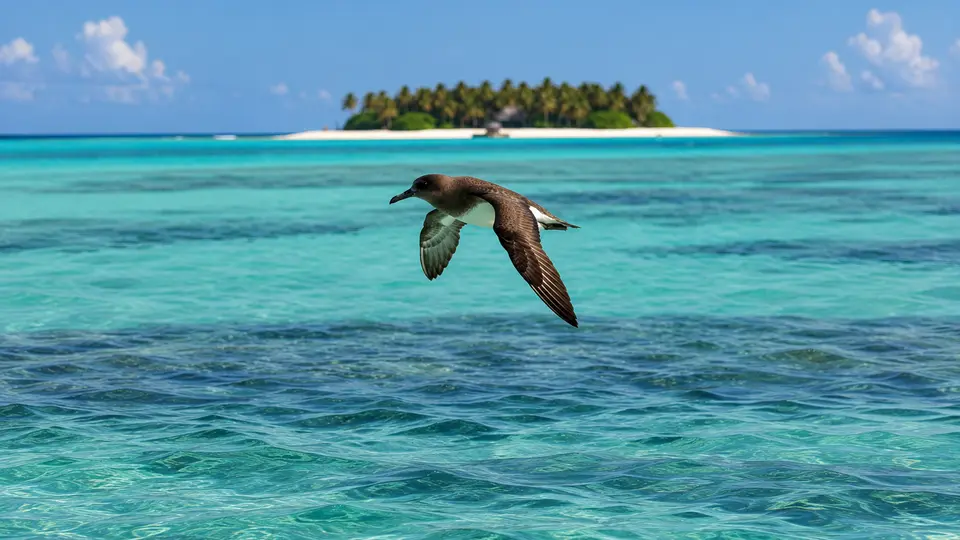
Audubon's shearwater in its natural habitat, AI illustration

Audubon's shearwater: where and when to see them

Puffinus lherminieri

Audubon's shearwater at a glance

Audubon's shearwater is a small, dark-backed, white-bellied seabird associated with the tropical western Atlantic under modern, narrower taxonomy. Older references used its name for a much broader collection of tropical shearwaters. That history matters for this catalog: birds formerly labelled Audubon's shearwater in the Maldives are generally treated as tropical shearwaters, not this species. A Maldives entry therefore cannot be presented as an established opportunity to observe true Audubon's shearwater.

Behaviour & reproduction

Size
30–33 cm long
Weight
150–230 g
Lifespan
Not reliably established
Status
Least Concern

At sea, Audubon's shearwaters alternate quick wingbeats with low glides and gather where small prey becomes available. They nest in concealed cavities, crevices or burrows on islands, commonly visiting colonies after dark. Pairs share incubation and chick provisioning, usually raising a single chick per attempt. Their secretive nesting and similarity to related shearwaters complicate identification. Old records from outside the Atlantic require careful taxonomic interpretation rather than automatic assignment to this species today. Outside of the breeding season, they are largely pelagic, spending most of their time far out at sea. During breeding, adults are nocturnal at their colonies, helping to avoid diurnal predators like gulls and raptors.

Top wildlife locations

Maldives wildlife habitat

Maldives

Ocean-facing island shores and decks can offer distant shearwater views, but true Audubon's shearwater is not an established Maldives target. Historical local use of this name generally refers to tropical shearwater under newer taxonomy.

Adventure cruises in Maldives
Destinations describe the species' habitat, not guaranteed cruise stops. Some animals require an optional inland excursion or are found in restricted reserves.

Fun facts about the Audubon's shearwater

  • Its common name honours John James Audubon.
  • The formerly broad species concept has been divided into several geographically distinct species.
  • It normally lays a single egg in a concealed nest.
  • Nocturnal colony visits help reduce exposure to daytime predators.

Best time to see the Audubon's shearwater

There is no supported Maldives season for observing Audubon's shearwater as currently defined. Western Atlantic colony schedules cannot be transferred to the Indian Ocean. Any Maldives seabird planning should first resolve the intended species and then use locally supported information for that taxon. Globally, nesting typically occurs during the spring and summer months, though breeding seasons can vary geographically across its wide range. For any potential sightings in the Maldives, local seasonal patterns of seabird movement or vagrancy would need to be considered.

Audubon's shearwater: season matrix by destination

Travel and observation windows vary by region. Highlighted months are an orientation for planning, not confirmed sightings or a guarantee of access.

Maldives

No credible Maldives observation window is supported for Puffinus lherminieri; the catalog destination appears to reflect an older, broader taxonomic treatment.

JanFebMarAprMayJunJulAugSepOctNovDec
Cruise ships in Maldives

Where the Audubon's shearwater lives

The species uses warm western Atlantic marine waters and predator-free or predator-limited islands for breeding. Nest sites are concealed in rocky cavities or burrows. The Maldives lies outside its accepted normal range, so apparently suitable tropical island habitat there does not establish its presence. While the Maldives is outside its primary range, some vagrants or dispersers might occasionally occur. It is generally found in warm, tropical and subtropical waters of the Atlantic Ocean and Caribbean Sea.

What the Audubon's shearwater eats

Small fish, squid and marine crustaceans form its diet. Prey is obtained at or below the surface, sometimes where other predators concentrate food. Feeding observations attributed to broadly defined Audubon's shearwaters in older Indian Ocean accounts may concern different species under current taxonomy. They employ a 'surface-seizing' feeding technique, diving shallowly to snatch prey. This species will also join mixed-species feeding flocks to exploit bait balls or fish schools pushed to the surface by larger predators.

Species at a glance

Common name
Audubon's shearwater
Scientific name
Puffinus lherminieri
Animal group
Birds
Size
30–33 cm long
Weight
150–230 g
Lifespan
Not reliably established
Status
Least Concern
Identification
Compared with tropical shearwater, Audubon's shearwater often shows darker undertail coverts, but these similar birds require careful assessment of plumage, structure and geographic range. Note the distinctive dark brown upperparts contrasting with white underparts, and pay close attention to the underwing pattern for subtle variations. Audubon's shearwater is generally a small, compact shearwater species, typically measuring around 30 cm in length.

Audubon's shearwater: frequently asked questions

Where can I see the Audubon's shearwater?
Maldives. From shore or a stable deck, document distant small shearwaters without assuming the catalog name is correct. Avoid flashlights near nesting seabirds, and seek expert review of photographs before reporting Audubon's shearwater in the Maldives. When observed at sea, look for their characteristic flight pattern of rapid wingbeats followed by short glides close to the water's surface. Binoculars or a spotting scope are essential for distinguishing small, distant seabirds from a moving vessel.
When is the best time to see the Audubon's shearwater?
There is no supported Maldives season for observing Audubon's shearwater as currently defined. Western Atlantic colony schedules cannot be transferred to the Indian Ocean. Any Maldives seabird planning should first resolve the intended species and then use locally supported information for that taxon. Globally, nesting typically occurs during the spring and summer months, though breeding seasons can vary geographically across its wide range. For any potential sightings in the Maldives, local seasonal patterns of seabird movement or vagrancy would need to be considered.
How big does the Audubon's shearwater get?
30–33 cm long. Adult weight: 150–230 g. Size varies with age, sex and population.
How should I behave around the Audubon's shearwater?
From shore or a stable deck, document distant small shearwaters without assuming the catalog name is correct. Avoid flashlights near nesting seabirds, and seek expert review of photographs before reporting Audubon's shearwater in the Maldives. When observed at sea, look for their characteristic flight pattern of rapid wingbeats followed by short glides close to the water's surface. Binoculars or a spotting scope are essential for distinguishing small, distant seabirds from a moving vessel.
What does the Audubon's shearwater eat?
Small fish, squid and marine crustaceans form its diet. Prey is obtained at or below the surface, sometimes where other predators concentrate food. Feeding observations attributed to broadly defined Audubon's shearwaters in older Indian Ocean accounts may concern different species under current taxonomy. They employ a 'surface-seizing' feeding technique, diving shallowly to snatch prey. This species will also join mixed-species feeding flocks to exploit bait balls or fish schools pushed to the surface by larger predators.
Are wildlife sightings guaranteed on an adventure cruise?
No. Animals move freely and routes, weather, access restrictions and local conditions influence every outing. Confirm the actual itinerary and shore program before booking.

Compare wildlife in the same destinations

Explore other birds recorded in these destinations. Similar surroundings do not mean the animals share the same habits or viewing season.

Species comparison by animal group and destination
Audubon's shearwaterAudubon's shearwaterAsian koelAsian koelBlack-naped ternBlack-naped tern
Animal groupBirdsAnimal groupBirdsAnimal groupBirds
DestinationsMaldivesDestinationsMaldivesDestinationsMaldives
All wildlife destinations
Plan your trip

Find your next wildlife adventure

Compare destinations, shore programs and dates with the animals and habitats you would love to see.

  • Naturalist-led shore excursions
  • Responsible wildlife watching
  • Small expedition ships

Newsletter

Take Blue Rides with you

Adventure cruise offers, last-minute deals and trip inspiration.

Free, unsubscribe anytime. Details: Privacy Policy

Partner with Blue Rides

Affiliate Program

Recommend adventure cruises and earn commission on every confirmed booking.

Share. Track. Earn.