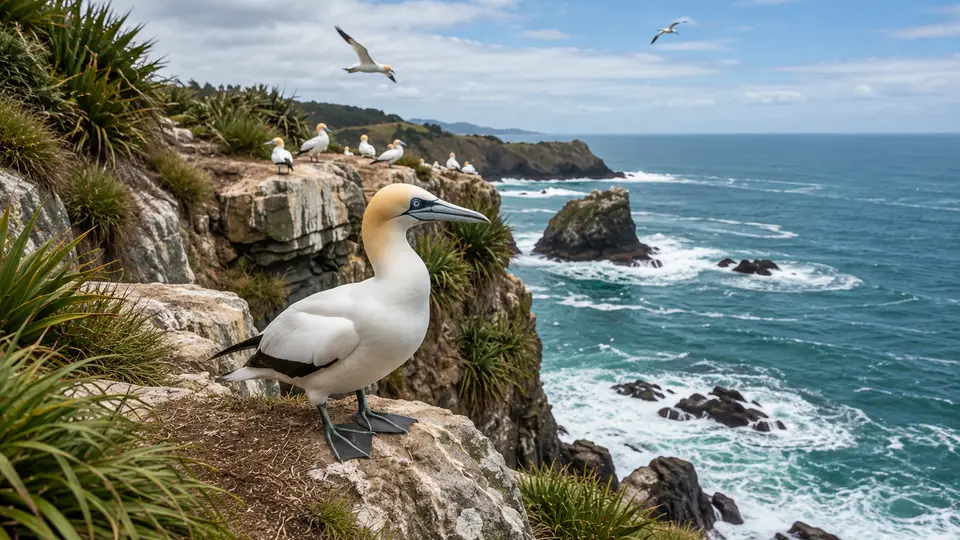
Australasian gannet in its natural habitat, AI illustration

Australasian gannet: where and when to see them

Morus serrator

Australasian gannet at a glance

The Australasian gannet is a large white seabird of New Zealand and southern Australia, recognised by its golden head, pointed bill and black flight feathers. Dense breeding colonies can occupy conspicuous coastal headlands and offshore islands. Adults range widely over surrounding seas in search of schooling fish. Its streamlined shape reflects an aerial hunting lifestyle, while accessible colony viewpoints offer opportunities to study courtship, nesting and chick development without entering breeding ground.

Behaviour & reproduction

Size
84–91 cm long
Weight
2.3–3 kg
Lifespan
20–30 years
Status
Least Concern

Gannets breed in crowded colonies where pairs defend small nest territories using calls, bill gestures and ritualised displays. Both adults incubate the egg and feed the chick. Offshore, birds search from the air and plunge into the sea after prey, often forming feeding gatherings. Young birds disperse after fledging, and many New Zealand juveniles cross the Tasman Sea. Adults typically show strong attachment to established breeding colonies and return for successive nesting seasons. Courtship rituals involve head-shaking and mutual preening, reinforcing pair bonds before and during nesting. Parents take turns fishing and guarding the chick, which remains in the nest for an extended fledging period. Post-breeding dispersal sees young birds undertake significant journeys, with many making a trans-Tasman crossing before returning to breed as adults.

Top wildlife locations

New Zealand wildlife habitat

New Zealand

Established coastal colony viewpoints, including managed headland paths, offer shore observation where currently open. Some colonies require a separate land excursion, and offshore colonies or unstable coastal approaches may be inaccessible to visitors.

Adventure cruises in New Zealand
Destinations describe the species' habitat, not guaranteed cruise stops. Some animals require an optional inland excursion or are found in restricted reserves.

Fun facts about the Australasian gannet

  • Parents incubate the egg using their highly vascularised feet.
  • A typical breeding attempt involves just one egg.
  • Many juveniles from New Zealand disperse to Australian waters.
  • Young birds begin with dark, speckled plumage and whiten over several years.

Best time to see the Australasian gannet

New Zealand colonies are generally most rewarding from spring through summer, with many birds present between September and February. Some colonies remain active later as chicks develop. Exact timing and public access differ, so use current colony information rather than assuming year-round attendance. Prime viewing opportunities from a ship's deck often occur as birds commute to and from offshore feeding grounds, particularly during the breeding season. Many colonies are protected reserves, so visitors must adhere to specific viewing guidelines during the breeding months. Early morning or late afternoon can sometimes offer particularly active colony scenes.

Australasian gannet: season matrix by destination

Travel and observation windows vary by region. Highlighted months are an orientation for planning, not confirmed sightings or a guarantee of access.

New Zealand

Spring and summer generally overlap active nesting; colony schedules, fledging dates and access closures vary.

JanFebMarAprMayJunJulAugSepOctNovDec
Cruise ships in New Zealand

Where the Australasian gannet lives

Breeding colonies occupy exposed headlands, rocky islands and coastal platforms with open flight access. Feeding habitat is mainly productive coastal and continental-shelf water. Suitable land viewpoints exist at some New Zealand colonies, but cliffs, unstable terrain and seasonal access restrictions limit others. Nests are typically built on flat ground or slight inclines on the chosen platforms, often utilizing available vegetation or guano to form a shallow cup. The availability of suitable, predator-free nesting sites is a crucial factor limiting colony expansion. They are pelagic outside the breeding season, ranging widely over coastal waters.

What the Australasian gannet eats

Schooling fish, including pilchards, anchovies, garfish and other locally abundant species, provide most food. Squid may also be taken. Adults swallow prey at sea and later regurgitate meals to chicks, whose growth depends on repeated deliveries from the surrounding marine environment. Their diet can vary geographically depending on local prey abundance and species distribution. While primarily fish, they are opportunistic hunters and will exploit other marine organisms if available. Chicks grow rapidly, consuming large quantities of fish, which can sometimes lead to visible 'fish runs' where adults return with full crops.

Species at a glance

Common name
Australasian gannet
Scientific name
Morus serrator
Animal group
Birds
Size
84–91 cm long
Weight
2.3–3 kg
Lifespan
20–30 years
Status
Least Concern
Identification
Its black central tail feathers distinguish it from the white-tailed northern gannet and the much more extensively black-tailed Cape gannet. Adult Australasian gannets have a distinctive buff-yellow wash on the head, which is particularly prominent during the breeding season. Immature birds exhibit a mottled brown and white plumage, gradually acquiring adult coloration over several years. Their large size and powerful, conical bill are also key identification features at all ages.

Australasian gannet: frequently asked questions

Where can I see the Australasian gannet?
New Zealand. Use designated colony overlooks and remain behind barriers; nesting birds can jab with sharp bills if approached. Keep clear of cliff edges and obey landslide or tide-related closures. Do not enter colonies for closer photographs. Binoculars are highly recommended for detailed viewing of individual birds within the dense colony structure. When watching from a vessel, keep a respectful distance to avoid disturbing rafting or feeding birds. Remember that the strong smell characteristic of gannetries is a natural part of the colony experience.
When is the best time to see the Australasian gannet?
New Zealand colonies are generally most rewarding from spring through summer, with many birds present between September and February. Some colonies remain active later as chicks develop. Exact timing and public access differ, so use current colony information rather than assuming year-round attendance. Prime viewing opportunities from a ship's deck often occur as birds commute to and from offshore feeding grounds, particularly during the breeding season. Many colonies are protected reserves, so visitors must adhere to specific viewing guidelines during the breeding months. Early morning or late afternoon can sometimes offer particularly active colony scenes.
How big does the Australasian gannet get?
84–91 cm long. Adult weight: 2.3–3 kg. Size varies with age, sex and population.
How should I behave around the Australasian gannet?
Use designated colony overlooks and remain behind barriers; nesting birds can jab with sharp bills if approached. Keep clear of cliff edges and obey landslide or tide-related closures. Do not enter colonies for closer photographs. Binoculars are highly recommended for detailed viewing of individual birds within the dense colony structure. When watching from a vessel, keep a respectful distance to avoid disturbing rafting or feeding birds. Remember that the strong smell characteristic of gannetries is a natural part of the colony experience.
What does the Australasian gannet eat?
Schooling fish, including pilchards, anchovies, garfish and other locally abundant species, provide most food. Squid may also be taken. Adults swallow prey at sea and later regurgitate meals to chicks, whose growth depends on repeated deliveries from the surrounding marine environment. Their diet can vary geographically depending on local prey abundance and species distribution. While primarily fish, they are opportunistic hunters and will exploit other marine organisms if available. Chicks grow rapidly, consuming large quantities of fish, which can sometimes lead to visible 'fish runs' where adults return with full crops.
Are wildlife sightings guaranteed on an adventure cruise?
No. Animals move freely and routes, weather, access restrictions and local conditions influence every outing. Confirm the actual itinerary and shore program before booking.

Compare wildlife in the same destinations

Explore other birds recorded in these destinations. Similar surroundings do not mean the animals share the same habits or viewing season.

Species comparison by animal group and destination
Australasian gannetAustralasian gannetBar-tailed godwitBar-tailed godwitBuller's albatrossBuller's albatross
Animal groupBirdsAnimal groupBirdsAnimal groupBirds
DestinationsNew ZealandDestinationsAustralia, New ZealandDestinationsNew Zealand
All wildlife destinations
Plan your trip

Find your next wildlife adventure

Compare destinations, shore programs and dates with the animals and habitats you would love to see.

  • Naturalist-led shore excursions
  • Responsible wildlife watching
  • Small expedition ships

Newsletter

Take Blue Rides with you

Adventure cruise offers, last-minute deals and trip inspiration.

Free, unsubscribe anytime. Details: Privacy Policy

Partner with Blue Rides

Affiliate Program

Recommend adventure cruises and earn commission on every confirmed booking.

Share. Track. Earn.