
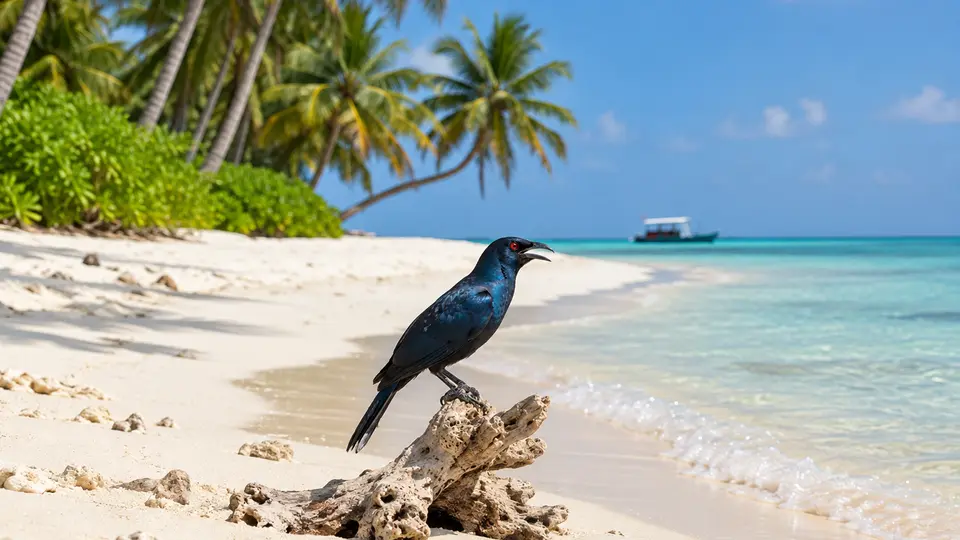
Black-naped tern in its natural habitat, AI illustration

Black-naped tern: where and when to see them

Sterna sumatrana

Black-naped tern at a glance

The black-naped tern is a delicate tropical seabird associated with coral islands, sheltered coastal waters and pale sandy shores. Its largely white head is marked by a narrow black band through the eye and around the nape, rather than the full dark cap typical of many terns. Small breeding groups can be inconspicuous against bright sand or coral rubble. Although widespread across the tropical Indo-Pacific, suitable undisturbed nesting places are locally limited.

Behaviour & reproduction

Size
30–35 cm long
Weight
90–140 g
Lifespan
Not reliably established
Status
Least Concern

Birds patrol shallow coastal waters with buoyant flight, pausing or hovering before dropping toward small fish near the surface. They often rest together on exposed rocks, sandbars or boats. Breeding pairs lay eggs in shallow scrapes on bare ground, where camouflage offers more protection than nest structure. Adults alarm-call around intruders, but repeated disturbance can still leave eggs vulnerable to heat, trampling or predation by other birds. Courtship displays involve aerial pursuits and the male offering fish to the female. Chicks are semi-precocial, able to move shortly after hatching, and are often cryptically patterned to blend with their surroundings.

Top wildlife locations

Maldives wildlife habitat

Maldives

Lagoon-facing shores, exposed sandbars and coral-rubble islets offer plausible distant views. Nesting islets may be inaccessible or protected, and resort beach access does not imply permission to enter nearby seabird habitat.

Adventure cruises in Maldives
Destinations describe the species' habitat, not guaranteed cruise stops. Some animals require an optional inland excursion or are found in restricted reserves.

Fun facts about the Black-naped tern

  • Adults retain a predominantly white crown rather than a full black breeding cap.
  • Eggs are laid directly in a shallow ground scrape.
  • Its pale upperparts can look almost white in strong tropical sunlight.
  • Small colonies often share limited island space with other coastal seabirds.

Best time to see the Black-naped tern

In the Maldives, the drier northeast monsoon often provides more comfortable shore and deck watching. Local breeding and island occupancy are variable, however, and should not be inferred from the tourist season. Tide, wind and disturbance can strongly affect which roosts are occupied. Breeding often occurs during the drier months, aligning with lower tides that expose more suitable nesting areas. Peak nesting activity in the Maldives may fall between March and June, though local variations exist.

Black-naped tern: season matrix by destination

Travel and observation windows vary by region. Highlighted months are an orientation for planning, not confirmed sightings or a guarantee of access.

Maldives

A generally favourable weather window for shore observation, not a confirmed local breeding season or assurance of island occupancy.

JanFebMarAprMayJunJulAugSepOctNovDec
Cruise ships in Maldives

Where the Black-naped tern lives

This tern favours tropical marine coasts, particularly lagoons, reef margins, small offshore islands and sand or coral-rubble shores. Nesting requires open ground above ordinary tides. Roosting sites may disappear at high water, and frequently visited beaches are not necessarily suitable breeding habitat. They are typically found in shallow tropical waters, rarely venturing far offshore into open ocean. While often coastal, some populations utilize small, remote oceanic islands for breeding and roosting.

What the Black-naped tern eats

Small fish dominate the diet, with marine crustaceans also taken. Feeding is concentrated close to the water surface, often in clear, sheltered coastal areas. Birds may exploit prey driven upward by predatory fish, but they are less dependent on human food waste than many gulls. Prey items are usually small, 2-6 cm long, and caught with quick, shallow plunges. They typically forage individually or in small, loose groups.

Species at a glance

Common name
Black-naped tern
Scientific name
Sterna sumatrana
Animal group
Birds
Size
30–35 cm long
Weight
90–140 g
Lifespan
Not reliably established
Status
Least Concern
Identification
Its white crown and narrow black eye-to-nape band distinguish it from fully black-capped common and roseate terns. Juveniles show a mottled grey back and a less distinct black nape band, developing adult plumage within their first year. In flight, the pale primaries become noticeable against the darker upperwings.

Black-naped tern: frequently asked questions

Where can I see the Black-naped tern?
Maldives. Scan sandbars and coral-rubble margins from a distance without stepping onto potential nesting ground. Retreat if birds alarm or circle persistently; nearly invisible eggs and chicks can be present where the beach appears empty. Use binoculars or a spotting scope to identify individuals from a safe distance, especially when they are roosting. Observing them from deck or a dinghy offers excellent views without disturbing potential nesting sites.
When is the best time to see the Black-naped tern?
In the Maldives, the drier northeast monsoon often provides more comfortable shore and deck watching. Local breeding and island occupancy are variable, however, and should not be inferred from the tourist season. Tide, wind and disturbance can strongly affect which roosts are occupied. Breeding often occurs during the drier months, aligning with lower tides that expose more suitable nesting areas. Peak nesting activity in the Maldives may fall between March and June, though local variations exist.
How big does the Black-naped tern get?
30–35 cm long. Adult weight: 90–140 g. Size varies with age, sex and population.
How should I behave around the Black-naped tern?
Scan sandbars and coral-rubble margins from a distance without stepping onto potential nesting ground. Retreat if birds alarm or circle persistently; nearly invisible eggs and chicks can be present where the beach appears empty. Use binoculars or a spotting scope to identify individuals from a safe distance, especially when they are roosting. Observing them from deck or a dinghy offers excellent views without disturbing potential nesting sites.
What does the Black-naped tern eat?
Small fish dominate the diet, with marine crustaceans also taken. Feeding is concentrated close to the water surface, often in clear, sheltered coastal areas. Birds may exploit prey driven upward by predatory fish, but they are less dependent on human food waste than many gulls. Prey items are usually small, 2-6 cm long, and caught with quick, shallow plunges. They typically forage individually or in small, loose groups.
Are wildlife sightings guaranteed on an adventure cruise?
No. Animals move freely and routes, weather, access restrictions and local conditions influence every outing. Confirm the actual itinerary and shore program before booking.

Compare wildlife in the same destinations

Explore other birds recorded in these destinations. Similar surroundings do not mean the animals share the same habits or viewing season.

Species comparison by animal group and destination
Black-naped ternBlack-naped ternAsian koelAsian koelAudubon's shearwaterAudubon's shearwater
Animal groupBirdsAnimal groupBirdsAnimal groupBirds
DestinationsMaldivesDestinationsMaldivesDestinationsMaldives
All wildlife destinations
Plan your trip

Find your next wildlife adventure

Compare destinations, shore programs and dates with the animals and habitats you would love to see.

  • Naturalist-led shore excursions
  • Responsible wildlife watching
  • Small expedition ships

Newsletter

Take Blue Rides with you

Adventure cruise offers, last-minute deals and trip inspiration.

Free, unsubscribe anytime. Details: Privacy Policy

Partner with Blue Rides

Affiliate Program

Recommend adventure cruises and earn commission on every confirmed booking.

Share. Track. Earn.