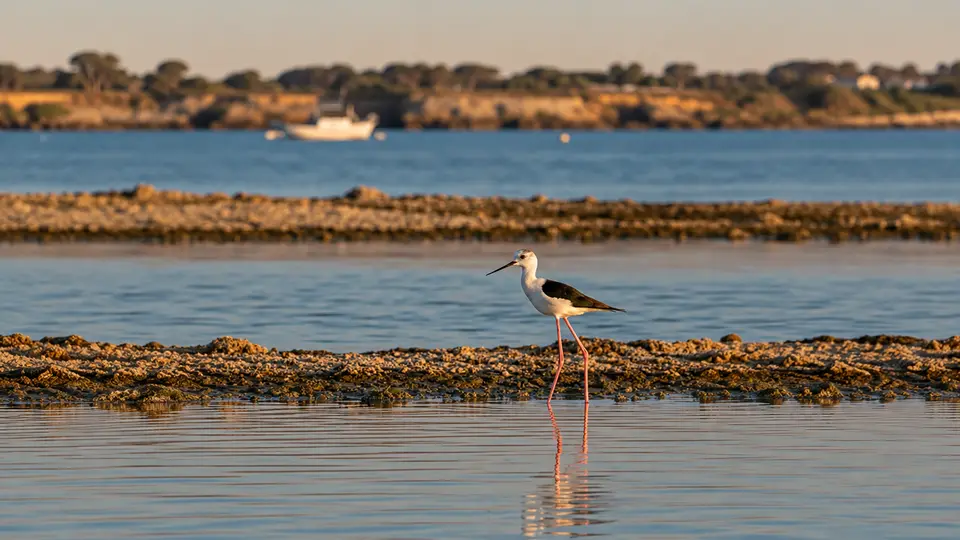
Black-winged Stilt in its natural habitat, AI illustration

Black-winged StiltHimantopus himantopusWhere and when to see them

Black-winged Stilt at a glance

The black-winged stilt is an elegant wetland bird with extraordinarily long pink legs, a straight black bill and strongly contrasting plumage. In southern Europe it occupies shallow lagoons, saltpans and flooded lowlands, sometimes nesting surprisingly close to human activity where water levels remain suitable. Its apparently fragile proportions are practical adaptations for feeding in water deeper than many small shorebirds can use. Head markings vary with age, sex, season and individual.

Behaviour & reproduction

Size
33–36 cm long
Weight
150–210 g
Lifespan
Not reliably established
Status
Least Concern

Stilts walk deliberately through shallow water, picking prey from the surface or probing soft sediment with quick bill movements. They may feed in loose groups but become conspicuously vocal around nesting areas. Pairs nest on low islands, banks or small raised patches, and adults sometimes perform distraction displays near young. Chicks leave the nest soon after hatching and feed themselves, although parents continue to guard them and provide warmth. Courtship displays involve the male preening the female's head and neck, often accompanied by soft calls. Both parents share incubation duties and vigorously defend their clutch and young from potential predators, sometimes performing dramatic aerial displays.

Top wildlife locations

Croatia wildlife habitat

Croatia

Coastal saltpans and shallow lagoons are plausible viewing habitats from public banks or designated hides. Suitable wetlands are localized, so a separate excursion may be necessary rather than observation from a harbour.

Greece wildlife habitat

Greece

Coastal lagoons, saltworks and delta margins provide plausible shore-based viewing, often from marked wetland routes. Some sites require a road excursion, and nesting islands or operational saltworks may be inaccessible.

Destinations describe the species' habitat, not guaranteed cruise stops. Some animals require an optional inland excursion or are found in restricted reserves.

Fun facts about the Black-winged Stilt

  • Its legs extend conspicuously beyond the tail during flight.
  • Newly hatched chicks can walk and collect their own food.
  • Adults may use distraction displays to draw threats away from chicks.
  • Human-managed saltpans can provide habitat when water levels and disturbance are suitable.

Best time to see the Black-winged Stilt

Spring through early autumn is generally most useful in Croatia and Greece, combining passage birds with local breeders. Numbers vary with rainfall and managed wetland water levels. Some birds winter in milder areas, but a summer breeding presence should not be assumed at every lagoon. Peak breeding activity in the Mediterranean regions typically occurs from April to July, offering the best chances to observe nesting pairs and young. Migration routes often follow coastlines and major wetland complexes, making these areas key observation points during spring and autumn.

Black-winged Stilt: season matrix by destination

Travel and observation windows vary by region. Highlighted months are an orientation for planning, not confirmed sightings or a guarantee of access.

Croatia

A broad migration and breeding-period observation window; local water conditions determine whether particular wetlands hold birds.

JanFebMarAprMayJunJulAugSepOctNovDec
Cruise ships in Croatia

Greece

Spring passage through summer and early autumn is broadly useful; residency and winter numbers differ between wetlands.

JanFebMarAprMayJunJulAugSepOctNovDec
Cruise ships in Greece

Where the Black-winged Stilt lives

Shallow freshwater and saline wetlands are used, including coastal lagoons, saltworks, marsh margins and seasonally flooded fields. Open feeding areas and sparsely vegetated nesting patches are important. Water depth is critical: both drying and sudden flooding can make otherwise suitable sites temporarily unusable. They often show a preference for water bodies with sparse, emergent vegetation, providing both cover and open foraging areas. Human-modified wetlands, such as saltpans and rice paddies, are also frequently utilized, indicating a degree of adaptability.

What the Black-winged Stilt eats

Aquatic insects and their larvae, small crustaceans, worms and molluscs form much of the diet. Prey is collected from water, mud and wet vegetation. Its fine bill suits small items, while long legs let it forage across a wider depth range than shorter-legged waders. Its diet also includes small fish fry and amphibian tadpoles when available, diversifying its protein intake. Foraging can occur both during the day and occasionally at night, particularly in moonlit conditions, to exploit abundant prey.

Species at a glance

Common name
Black-winged Stilt
Scientific name
Himantopus himantopus
Animal group
Birds
Size
33–36 cm long
Weight
150–210 g
Lifespan
Not reliably established
Status
Least Concern
Identification
Exceptionally long pink legs and a straight fine black bill separate it from avocets, which have upturned bills and blue-grey legs. Juveniles are similar to adults but have a duller plumage with brownish upperparts and a less intense pink on their legs. The stark black and white plumage of the adult is highly diagnostic, even from a distance.

Black-winged Stilt: frequently asked questions

Where can I see the Black-winged Stilt?
Croatia, Greece. Observe from wetland hides, roads or marked banks without crossing nesting islands. If adults give repeated sharp alarms or feign injury, withdraw along your approach route to avoid separating them from hidden chicks. When viewing from a boat, maintain a respectful distance to avoid flushing birds, especially if chicks are present. Look for their distinctive reflections in calm water, which can make them easier to spot from a distance.
When is the best time to see the Black-winged Stilt?
Spring through early autumn is generally most useful in Croatia and Greece, combining passage birds with local breeders. Numbers vary with rainfall and managed wetland water levels. Some birds winter in milder areas, but a summer breeding presence should not be assumed at every lagoon. Peak breeding activity in the Mediterranean regions typically occurs from April to July, offering the best chances to observe nesting pairs and young. Migration routes often follow coastlines and major wetland complexes, making these areas key observation points during spring and autumn.
How big does the Black-winged Stilt get?
33–36 cm long. Adult weight: 150–210 g. Size varies with age, sex and population.
How should I behave around the Black-winged Stilt?
Observe from wetland hides, roads or marked banks without crossing nesting islands. If adults give repeated sharp alarms or feign injury, withdraw along your approach route to avoid separating them from hidden chicks. When viewing from a boat, maintain a respectful distance to avoid flushing birds, especially if chicks are present. Look for their distinctive reflections in calm water, which can make them easier to spot from a distance.
What does the Black-winged Stilt eat?
Aquatic insects and their larvae, small crustaceans, worms and molluscs form much of the diet. Prey is collected from water, mud and wet vegetation. Its fine bill suits small items, while long legs let it forage across a wider depth range than shorter-legged waders. Its diet also includes small fish fry and amphibian tadpoles when available, diversifying its protein intake. Foraging can occur both during the day and occasionally at night, particularly in moonlit conditions, to exploit abundant prey.
Are wildlife sightings guaranteed on an adventure cruise?
No. Animals move freely and routes, weather, access restrictions and local conditions influence every outing. Confirm the actual itinerary and shore program before booking.

Compare wildlife in the same destinations

Explore other birds recorded in these destinations. Similar surroundings do not mean the animals share the same habits or viewing season.

Species comparison by animal group and destination
Black-winged StiltBlack-winged StiltAudouin's GullAudouin's GullBonelli's EagleBonelli's Eagle
Animal groupBirdsAnimal groupBirdsAnimal groupBirds
DestinationsCroatia, GreeceDestinationsCroatia, Greece, Portugal, TurkeyDestinationsGreece
All wildlife destinations
Plan your trip

Find your next wildlife adventure

Compare destinations, shore programs and dates with the animals and habitats you would love to see.

  • Naturalist-led shore excursions
  • Responsible wildlife watching
  • Small expedition ships

Newsletter

Take Blue Rides with you

Adventure cruise offers, last-minute deals and trip inspiration.

Free, unsubscribe anytime. Details: Privacy Policy

Partner with Blue Rides

Affiliate Program

Recommend adventure cruises and earn commission on every confirmed booking.

Share. Track. Earn.

Your footage, our stage

Send us your videos or pictures.

Captured remarkable nature or wildlife on your journey? Share it with us, we may feature it on Blue Rides.