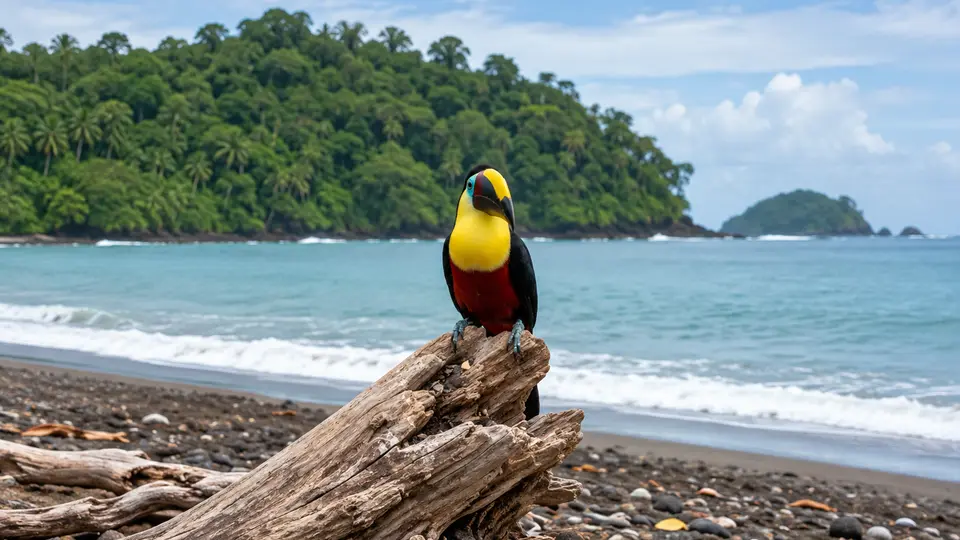
Black-mandibled Toucan in its natural habitat, AI illustration

Black-mandibled Toucan: where and when to see them

Ramphastos ambiguus

Black-mandibled Toucan at a glance

The black-mandibled toucan belongs to a large, fruit-eating toucan species with a yellow throat, black body and an imposing bill. Naming needs care in Costa Rica: its resident form is usually called the chestnut-mandibled toucan and is commonly treated as Ramphastos ambiguus swainsonii. The nominate black-mandibled form occurs farther south in northwestern South America. This profile follows the broader species treatment while distinguishing the Costa Rican form rather than implying identical bill coloration throughout.

Behaviour & reproduction

Size
47–61 cm long
Weight
580–750 g
Lifespan
Not reliably established
Status
Near Threatened

These toucans move through forest crowns in pairs or small parties, often advertising their presence with loud, carrying calls. They hop along branches, reach for fruit with the bill and sometimes toss food backward before swallowing. Nesting takes place inside tree cavities rather than in an exposed woven nest. Birds may travel between fruiting trees and investigate other birds' nests, combining a mainly fruit-based diet with opportunistic animal feeding. Social grooming is observed, with pairs or family groups often preening each other. During nesting, both parents participate in incubating the eggs and feeding the young, sharing responsibilities for their offspring's development.

Top wildlife locations

Costa Rica wildlife habitat

Costa Rica

Coastal lowland forest edges and fruiting trees offer plausible views of the chestnut-mandibled form. A forest excursion is usually required; the nominate black-mandibled form should not be expected in Costa Rica.

Adventure cruises in Costa Rica

Destinations describe the species' habitat, not guaranteed cruise stops. Some animals require an optional inland excursion or are found in restricted reserves.

Fun facts about the Black-mandibled Toucan

  • The Costa Rican form is widely known as the chestnut-mandibled toucan.
  • Its large bill has a lightweight internal structure rather than being solid bone.
  • It nests in tree cavities and does not excavate like a woodpecker.
  • Seeds carried away from parent trees can contribute to forest regeneration.

Best time to see the Black-mandibled Toucan

Watching is possible throughout the year where the Costa Rican form is resident. Drier months often make forest trails easier to use, but fruit availability and daily activity matter more than a simple seasonal peak. Early mornings usually offer better calling and movement. Peak fruiting seasons, which vary locally, generally offer the best chances for observing their feeding activity. Mornings are particularly active for foraging and social interactions before the midday heat sets in.

Black-mandibled Toucan: season matrix by destination

Travel and observation windows vary by region. Highlighted months are an orientation for planning, not confirmed sightings or a guarantee of access.

Costa Rica

These are practical drier-season travel months in much of the country, not a species breeding window; Caribbean rainfall patterns differ.

JanFebMarAprMayJunJulAugSepOctNovDec
Cruise ships in Costa Rica

Where the Black-mandibled Toucan lives

Humid tropical forest, mature secondary growth and wooded edges provide feeding and nesting habitat. Large trees supply both fruit and cavities. In Costa Rica, the chestnut-mandibled form inhabits suitable lowland and foothill forests, including some coastal forests, but not open beaches. They typically avoid disturbed areas and prefer continuous forest cover. While they can be found at elevations from sea level up to 2,400 meters, their abundance generally decreases at higher altitudes.

What the Black-mandibled Toucan eats

Fruit supplies most of the diet, especially fleshy forest fruits swallowed whole or in pieces. Insects, small vertebrates, eggs and nestlings supplement plant foods. By transporting and passing seeds, these toucans help connect fruiting trees with potential regeneration sites elsewhere in the forest. In addition to fruits, they consume a variety of invertebrates such as large insects and spiders. They are also known to prey on small reptiles and amphibians when available, demonstrating their opportunistic feeding strategy.

Species at a glance

Common name
Black-mandibled Toucan
Scientific name
Ramphastos ambiguus
Animal group
Birds
Size
47–61 cm long
Weight
580–750 g
Lifespan
Not reliably established
Status
Near Threatened
Identification
Compared with keel-billed toucans, this species is larger with a mostly two-toned bill; Costa Rican birds have chestnut rather than truly black mandibular areas. The chestnut patch on the lower mandible of the Costa Rican form is a key distinguishing feature from other toucan species in the region. Their large size, overall black plumage, and pale yellow bib also help differentiate them from smaller toucanets or aracaris.

Black-mandibled Toucan: frequently asked questions

Where can I see the Black-mandibled Toucan?
Costa Rica. Watch fruiting canopy trees from established forest paths, keeping clear of cavity nests. Do not offer food or use repeated playback; a telescope can reveal bill colour without requiring an approach beneath occupied nest trees. Listen for their distinctive yelping calls, which can often lead you to their location high in the canopy. Using binoculars is essential for detailed views of their plumage and bill patterns, especially when they are perched at a distance.
When is the best time to see the Black-mandibled Toucan?
Watching is possible throughout the year where the Costa Rican form is resident. Drier months often make forest trails easier to use, but fruit availability and daily activity matter more than a simple seasonal peak. Early mornings usually offer better calling and movement. Peak fruiting seasons, which vary locally, generally offer the best chances for observing their feeding activity. Mornings are particularly active for foraging and social interactions before the midday heat sets in.
How big does the Black-mandibled Toucan get?
47–61 cm long. Adult weight: 580–750 g. Size varies with age, sex and population.
How should I behave around the Black-mandibled Toucan?
Watch fruiting canopy trees from established forest paths, keeping clear of cavity nests. Do not offer food or use repeated playback; a telescope can reveal bill colour without requiring an approach beneath occupied nest trees. Listen for their distinctive yelping calls, which can often lead you to their location high in the canopy. Using binoculars is essential for detailed views of their plumage and bill patterns, especially when they are perched at a distance.
What does the Black-mandibled Toucan eat?
Fruit supplies most of the diet, especially fleshy forest fruits swallowed whole or in pieces. Insects, small vertebrates, eggs and nestlings supplement plant foods. By transporting and passing seeds, these toucans help connect fruiting trees with potential regeneration sites elsewhere in the forest. In addition to fruits, they consume a variety of invertebrates such as large insects and spiders. They are also known to prey on small reptiles and amphibians when available, demonstrating their opportunistic feeding strategy.
Are wildlife sightings guaranteed on an adventure cruise?
No. Animals move freely and routes, weather, access restrictions and local conditions influence every outing. Confirm the actual itinerary and shore program before booking.

Compare wildlife in the same destinations

Explore other birds recorded in these destinations. Similar surroundings do not mean the animals share the same habits or viewing season.

Species comparison by animal group and destination
Black-mandibled ToucanBlack-mandibled ToucanBlue-footed BoobyBlue-footed BoobyBrown BoobyBrown Booby
Animal groupBirdsAnimal groupBirdsAnimal groupBirds
DestinationsCosta RicaDestinationsCosta Rica, Galapagos, MexicoDestinationsCosta Rica, Cape Verde, Egypt, Fiji, Polynesia
All wildlife destinations
Plan your trip

Find your next wildlife adventure

Compare destinations, shore programs and dates with the animals and habitats you would love to see.

  • Naturalist-led shore excursions
  • Responsible wildlife watching
  • Small expedition ships

Newsletter

Take Blue Rides with you

Adventure cruise offers, last-minute deals and trip inspiration.

Free, unsubscribe anytime. Details: Privacy Policy

Partner with Blue Rides

Affiliate Program

Recommend adventure cruises and earn commission on every confirmed booking.

Share. Track. Earn.

Your footage, our stage

Send us your videos or pictures.

Captured beautiful landscapes or wildlife? Share your videos and pictures with us, we may feature them on Blue Rides.