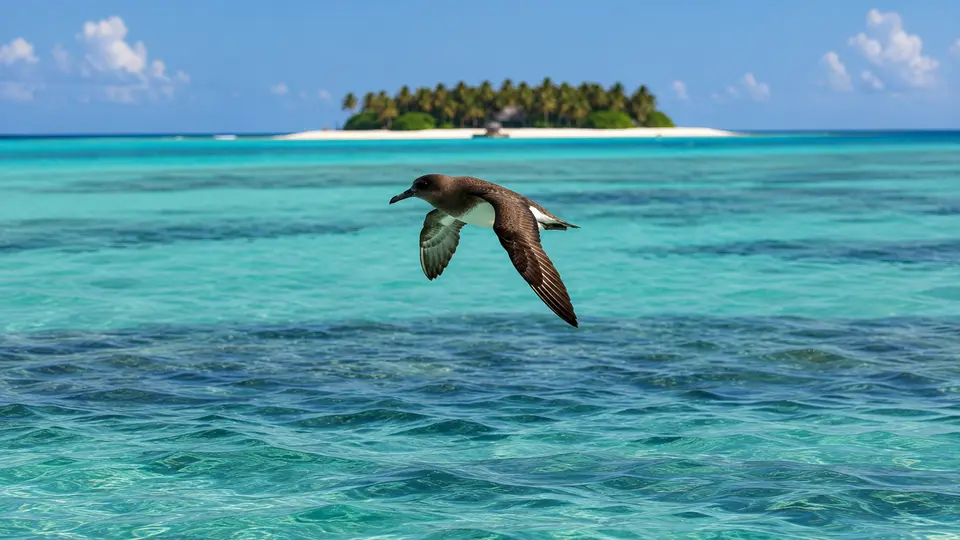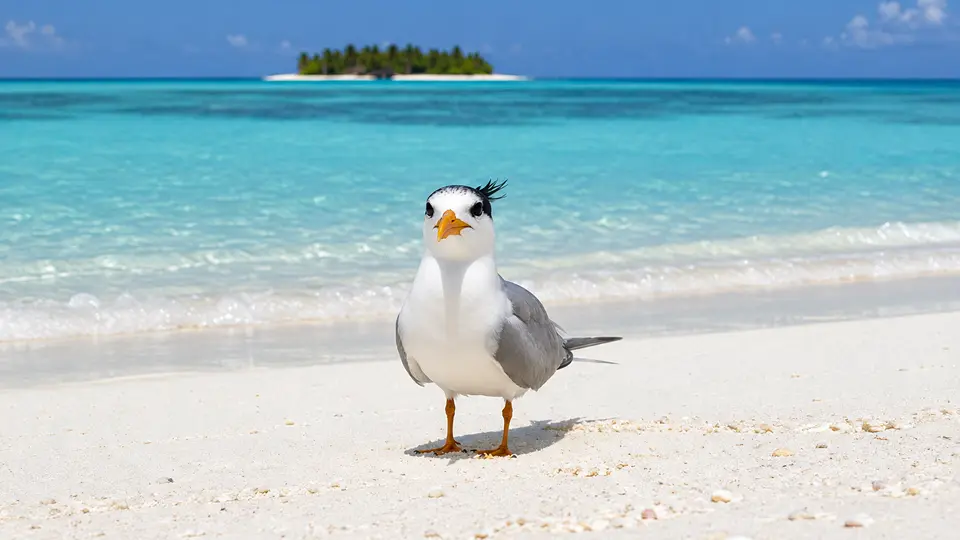
Great Crested Tern in its natural habitat, AI illustration

Great Crested TernThalasseus bergiiWhere and when to see them

Great Crested Tern at a glance

The greater crested tern is a large, elegant seabird of tropical and subtropical coasts across much of the Indian and Pacific oceans. Its pale yellow bill and shaggy black crest make adults distinctive on beaches and harbour structures. It depends on coastal fish and secure resting or nesting ground. In the Seychelles and Maldives, birds may be seen commuting offshore, resting on sand or joining feeding concentrations near the surface.

Behaviour & reproduction

Size
46–49 cm long
Weight
320–400 g
Lifespan
Not reliably established
Status
Least Concern

These terns patrol coastlines with buoyant wingbeats, searching downward before dropping sharply to seize fish. They frequently rest in groups, sometimes alongside other tern species, and become noisy around breeding colonies. Courtship includes fish presentations, while nesting pairs defend small spaces within dense aggregations. Outside breeding periods, birds can disperse considerably, so a productive sandbank on one visit may be empty on another as tides and food availability change. Courtship displays often involve elaborate aerial chases and synchronized flight patterns. They are highly colonial breeders, forming dense aggregations that can number in the hundreds or thousands of pairs. After the breeding season, birds disperse widely, sometimes undertaking significant migrations across oceanic waters.

Top wildlife locations

Seychelles wildlife habitat

Seychelles

Watch from accessible beaches and coastal viewpoints overlooking sandbars or lagoon mouths. Offshore colonies may be inaccessible or protected, so resting birds and passing flights offer more appropriate opportunities than colony approaches.

Maldives wildlife habitat

Maldives

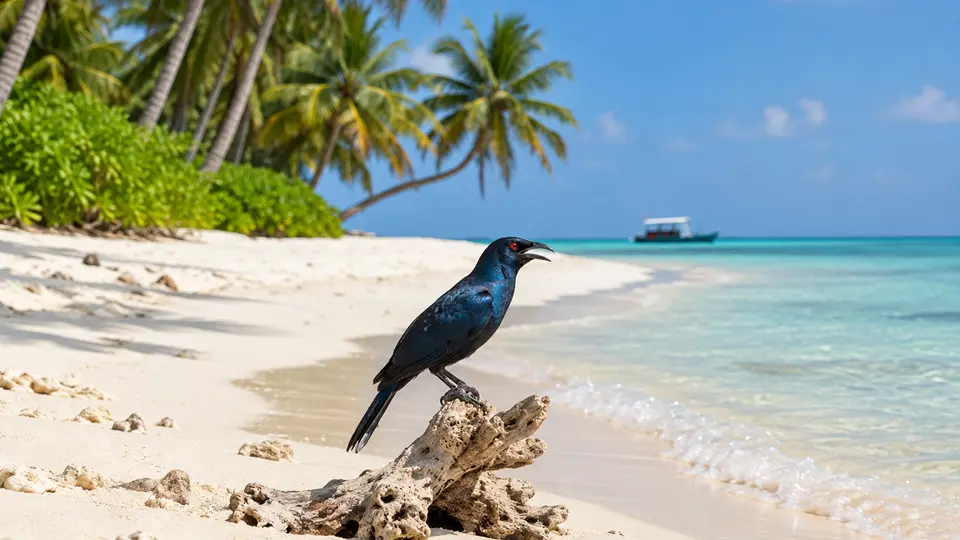
Lagoon edges, exposed sandbanks and harbour approaches provide plausible views from permitted beaches or decks. Some resting sites are inaccessible at high tide, and nesting islands should not be approached without authorization.

Destinations describe the species' habitat, not guaranteed cruise stops. Some animals require an optional inland excursion or are found in restricted reserves.

Fun facts about the Great Crested Tern

  • The crest looks especially untidy when feathers are raised at the back of the head.
  • Breeding adults have a black forehead, which becomes largely white outside breeding condition.
  • A male may offer a fish during courtship.
  • Its nest is generally a shallow scrape rather than a constructed platform.

Best time to see the Great Crested Tern

Observation is possible throughout the year in both island groups, but local numbers change with breeding movements, weather and food. Choose calmer coastal conditions for comfortable shore or deck watching. Do not assume that a country's preferred travel months correspond to tern nesting dates. While resident, peak breeding activity in the Maldives generally occurs from May to July. In the Seychelles, breeding varies but can extend from May to September, with some local variations. Look for concentrated activity and increased vocalizations during these nesting periods.

Great Crested Tern: season matrix by destination

Travel and observation windows vary by region. Highlighted months are an orientation for planning, not confirmed sightings or a guarantee of access.

Seychelles

Year-round coastal observation is plausible; local breeding schedules and sea conditions vary between islands.

JanFebMarAprMayJunJulAugSepOctNovDec
Cruise ships in Seychelles

Maldives

These generally drier travel months favor coastal watching, not a confirmed breeding or peak-abundance period.

JanFebMarAprMayJunJulAugSepOctNovDec
Cruise ships in Maldives

Where the Great Crested Tern lives

Greater crested terns use shallow coastal waters, lagoons, reef margins and sheltered bays. They rest on beaches, sandbars, rocks and harbour structures. Breeding usually requires open, sparsely vegetated ground on islands or sandbanks where disturbance and access by terrestrial predators are limited. Greater crested terns frequently forage close to shore, making them visible from land or boat. They are often seen on exposed reefs at low tide, probing for prey. In the Seychelles and Maldives, they show a strong preference for undisturbed islets for breeding success.

What the Great Crested Tern eats

Small fish dominate the diet, particularly schooling species available close to the surface. Squid and crustaceans are taken less often. Birds may exploit fish driven upward by larger predators or follow fishing activity, although such associations vary locally and are not required for feeding. They often dive from heights of 5-10 meters, plunging headfirst into the water. Parental care involves provisioning chicks with small fish for several weeks after hatching. Occasionally, they will also consume marine invertebrates like crabs and squid.

Species at a glance

Common name
Great Crested Tern
Scientific name
Thalasseus bergii
Animal group
Birds
Size
46–49 cm long
Weight
320–400 g
Lifespan
Not reliably established
Status
Least Concern
Identification
Its large size, pale yellow bill and grey upperparts distinguish it from the smaller, orange-billed lesser crested tern and the slimmer, dark-billed common tern. Adults have a distinctive shaggy black crest that extends from the crown to the nape, giving them a 'spiky' appearance. Juveniles are mottled grey and brown, lacking the distinct black cap and showing a more uniform bill color. In flight, their long, narrow wings and shallow, fluid wingbeats are characteristic.

Great Crested Tern: frequently asked questions

Where can I see the Great Crested Tern?
Seychelles, Maldives. Scan resting flocks from a beach edge or stable deck with binoculars. Keep away from nesting concentrations and avoid walking across occupied sandbanks; eggs and chicks are easily overlooked against pale ground. When viewing from a boat, approach slowly and maintain a respectful distance to avoid disturbing the birds. During shore excursions, remember to scan the water's surface for active plunge-diving, a key foraging behavior. Their large size makes them relatively easy to spot even from a distance, especially when perched.
When is the best time to see the Great Crested Tern?
Observation is possible throughout the year in both island groups, but local numbers change with breeding movements, weather and food. Choose calmer coastal conditions for comfortable shore or deck watching. Do not assume that a country's preferred travel months correspond to tern nesting dates. While resident, peak breeding activity in the Maldives generally occurs from May to July. In the Seychelles, breeding varies but can extend from May to September, with some local variations. Look for concentrated activity and increased vocalizations during these nesting periods.
How big does the Great Crested Tern get?
46–49 cm long. Adult weight: 320–400 g. Size varies with age, sex and population.
How should I behave around the Great Crested Tern?
Scan resting flocks from a beach edge or stable deck with binoculars. Keep away from nesting concentrations and avoid walking across occupied sandbanks; eggs and chicks are easily overlooked against pale ground. When viewing from a boat, approach slowly and maintain a respectful distance to avoid disturbing the birds. During shore excursions, remember to scan the water's surface for active plunge-diving, a key foraging behavior. Their large size makes them relatively easy to spot even from a distance, especially when perched.
What does the Great Crested Tern eat?
Small fish dominate the diet, particularly schooling species available close to the surface. Squid and crustaceans are taken less often. Birds may exploit fish driven upward by larger predators or follow fishing activity, although such associations vary locally and are not required for feeding. They often dive from heights of 5-10 meters, plunging headfirst into the water. Parental care involves provisioning chicks with small fish for several weeks after hatching. Occasionally, they will also consume marine invertebrates like crabs and squid.
Are wildlife sightings guaranteed on an adventure cruise?
No. Animals move freely and routes, weather, access restrictions and local conditions influence every outing. Confirm the actual itinerary and shore program before booking.

Compare wildlife in the same destinations

Explore other birds recorded in these destinations. Similar surroundings do not mean the animals share the same habits or viewing season.

Species comparison by animal group and destination
Great Crested TernGreat Crested TernAsian koelAsian koelAudubon's shearwaterAudubon's shearwater
Animal groupBirdsAnimal groupBirdsAnimal groupBirds
DestinationsSeychelles, MaldivesDestinationsMaldivesDestinationsMaldives
All wildlife destinations
Plan your trip

Find your next wildlife adventure

Compare destinations, shore programs and dates with the animals and habitats you would love to see.

  • Naturalist-led shore excursions
  • Responsible wildlife watching
  • Small expedition ships

Newsletter

Take Blue Rides with you

Adventure cruise offers, last-minute deals and trip inspiration.

Free, unsubscribe anytime. Details: Privacy Policy

Partner with Blue Rides

Affiliate Program

Recommend adventure cruises and earn commission on every confirmed booking.

Share. Track. Earn.

Your footage, our stage

Send us your videos or pictures.

Captured remarkable nature or wildlife on your journey? Share it with us, we may feature it on Blue Rides.