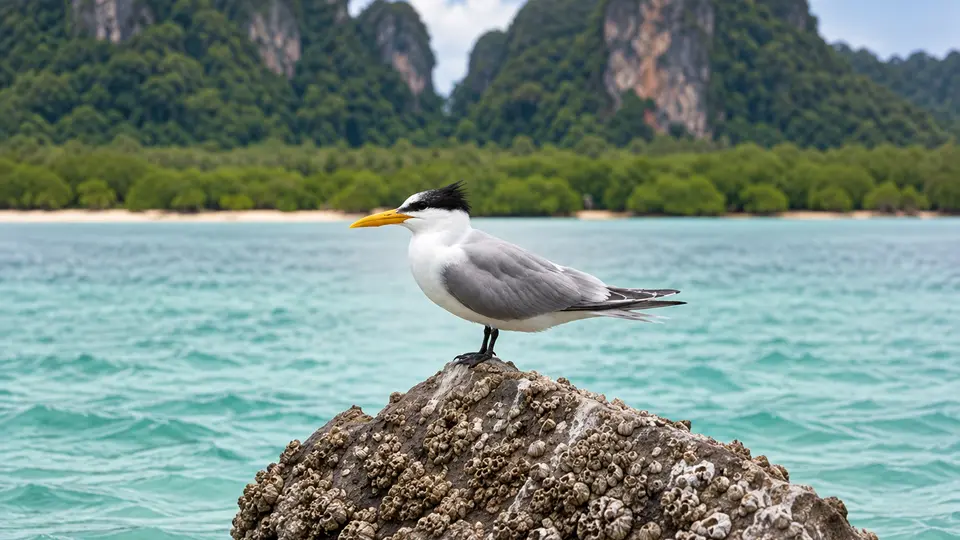
Great crested tern in its natural habitat, AI illustration
Size43-48 cm longLifespanNot reliably establishedStatusLeast Concern

Great crested tern: where and when to see them

Thalasseus bergii

Great crested tern at a glance

The great crested tern is a large coastal tern with pale gray upperparts, white underparts and a long yellow bill. Its shaggy black crest gives resting adults a distinctive swept-back appearance. Distributed around much of the tropical and subtropical Indian and western Pacific oceans, it favors marine coasts rather than inland wetlands. In Southeast Asia, local presence depends on island habitat, seasonal movements and the availability of small fish.

Behaviour & reproduction

Size
43-48 cm long
Weight
300-450 g
Lifespan
Not reliably established
Status
Least Concern

Great crested terns patrol coastal waters with elastic wingbeats, scanning downward before dropping sharply to seize fish. They often rest together on sand spits, rocks or quiet beaches, sometimes mixing with other terns. Breeding occurs in dense ground colonies, where neighbors defend small spaces around their eggs. Adults carry fish crosswise in the bill, and food presentation plays a role in courtship as well as feeding dependent young. Courtship displays often involve aerial chases and fish presentations, with the male offering fish to the female. They are colonial breeders, sometimes forming mixed colonies with other tern species, and their nests are simple scrapes on the ground, often with minimal lining.

Top wildlife locations

Thailand wildlife habitat

Thailand

Andaman coastal headlands, quiet sandy bays and viewpoints overlooking offshore rocks provide plausible habitat. Distribution is localized, and nesting islets may be inaccessible; a general beach visit should not imply likely sightings.

Adventure cruises in Thailand
Vietnam wildlife habitat

Vietnam

Watch from coastal headlands or beaches overlooking offshore sandbars and rocky islets. The species is localized and may be uncommon, while potential breeding islands can be restricted or beyond ordinary shore access.

Adventure cruises in Vietnam

Destinations describe the species' habitat, not guaranteed cruise stops. Some animals require an optional inland excursion or are found in restricted reserves.

Fun facts about the Great crested tern

  • Its black crest becomes more ragged-looking when raised.
  • Most pairs lay a single egg.
  • The forehead becomes noticeably whiter outside breeding condition.
  • Adults can recognize their chicks within crowded colonies.

Best time to see the Great crested tern

For Thailand's Andaman coast, November through April generally offers easier shore travel. Vietnam requires coast-specific planning because monsoon patterns differ substantially. These are practical travel considerations, not a single breeding calendar, and local tern numbers can fluctuate independently of fair weather. The Great Crested Tern is a resident breeder across much of its Southeast Asian range, although local populations may undertake short migratory movements or dispersal. Nesting generally occurs during the dry season or early monsoon, with exact timing varying by latitude and local conditions.

Great crested tern: season matrix by destination

Travel and observation windows vary by region. Highlighted months are an orientation for planning, not confirmed sightings or a guarantee of access.

Thailand

This is an Andaman fair-weather travel window, not a verified local breeding or occurrence schedule; Gulf coast conditions differ.

JanFebMarAprMayJunJulAugSepOctNovDec
Cruise ships in Thailand

Vietnam

Vietnam spans contrasting monsoon regions, and no specific coastal locality is supplied to support a reliable shore-observation window.

JanFebMarAprMayJunJulAugSepOctNovDec
Cruise ships in Vietnam

Where the Great crested tern lives

The species uses shallow coastal seas, reef-fringed islands, estuaries and sandy bays. Bare sand, shell banks and low rocky islands can support colonies or roosts. Suitable shore viewpoints overlook open feeding water without requiring entry onto sensitive nesting or resting sites. They are highly adaptable to human presence and are frequently seen in harbors, near fishing villages, and even around aquaculture operations. These terns are rarely found far from the coast, typically remaining within 20 kilometers of the shore.

What the Great crested tern eats

Small fish are the principal food, especially schooling species captured close to the surface. Squid, crustaceans and occasional other marine animals supplement the diet. Birds may exploit fish driven upward by larger predators or take suitable scraps around fishing activity. Foraging is typically done by plunge-diving from heights of 5 to 15 meters, often targeting shoals of fish visible from above. While they primarily hunt live prey, they are opportunistic and may scavenge discards from fishing boats, especially in busy marine areas.

Species at a glance

Common name
Great crested tern
Scientific name
Thalasseus bergii
Animal group
Birds
Size
43-48 cm long
Weight
300-450 g
Lifespan
Not reliably established
Status
Least Concern
Identification
Compared with the lesser crested tern, it is larger and heavier-billed, with a yellow rather than usually orange bill and generally darker gray upperparts. Juveniles are distinguishable by their mottled brown upperparts, dark bill, and less defined black crest, which gradually develops over their first year. In flight, their long, narrow wings and typical tern shape, coupled with their size, help differentiate them from smaller tern species.

Great crested tern: frequently asked questions

Where can I see the Great crested tern?
Thailand, Vietnam. Study resting flocks through binoculars from above the tide line, without advancing until birds stand or call. Avoid nesting sandbanks and exposed rocks, where eggs are camouflaged and waves can cut off access. Their loud, raucous calls, often described as 'kerr-ick' or 'kirr-ik', are a distinctive sound of coastal areas and can often betray their presence before they are seen. When observed from a vessel, look for them following fishing boats or circling over areas where fish are schooling.
When is the best time to see the Great crested tern?
For Thailand's Andaman coast, November through April generally offers easier shore travel. Vietnam requires coast-specific planning because monsoon patterns differ substantially. These are practical travel considerations, not a single breeding calendar, and local tern numbers can fluctuate independently of fair weather. The Great Crested Tern is a resident breeder across much of its Southeast Asian range, although local populations may undertake short migratory movements or dispersal. Nesting generally occurs during the dry season or early monsoon, with exact timing varying by latitude and local conditions.
How big does the Great crested tern get?
43-48 cm long. Adult weight: 300-450 g. Size varies with age, sex and population.
How should I behave around the Great crested tern?
Study resting flocks through binoculars from above the tide line, without advancing until birds stand or call. Avoid nesting sandbanks and exposed rocks, where eggs are camouflaged and waves can cut off access. Their loud, raucous calls, often described as 'kerr-ick' or 'kirr-ik', are a distinctive sound of coastal areas and can often betray their presence before they are seen. When observed from a vessel, look for them following fishing boats or circling over areas where fish are schooling.
What does the Great crested tern eat?
Small fish are the principal food, especially schooling species captured close to the surface. Squid, crustaceans and occasional other marine animals supplement the diet. Birds may exploit fish driven upward by larger predators or take suitable scraps around fishing activity. Foraging is typically done by plunge-diving from heights of 5 to 15 meters, often targeting shoals of fish visible from above. While they primarily hunt live prey, they are opportunistic and may scavenge discards from fishing boats, especially in busy marine areas.
Are wildlife sightings guaranteed on an adventure cruise?
No. Animals move freely and routes, weather, access restrictions and local conditions influence every outing. Confirm the actual itinerary and shore programme before booking.

Compare wildlife in the same destinations

Explore other birds recorded in these destinations. Similar surroundings do not mean the animals share the same habits or viewing season.

Species comparison by animal group and destination
Great crested ternGreat crested ternBlack-faced spoonbillBlack-faced spoonbillBrahminy kiteBrahminy kite
Animal groupBirdsAnimal groupBirdsAnimal groupBirds
DestinationsThailand, VietnamDestinationsVietnamDestinationsIndonesia, Thailand, Vietnam
All wildlife destinations
Plan your trip

Find your next wildlife adventure

Compare destinations, shore programmes and dates with the animals and habitats you would love to see.

  • Naturalist-led shore excursions
  • Responsible wildlife watching
  • Small expedition ships

Newsletter

Take Blue Rides with you

Adventure cruise offers, last-minute deals and trip inspiration.

Free, unsubscribe anytime. Details: Privacy Policy

Partner with Blue Rides

Affiliate Program

Recommend adventure cruises and earn commission on every confirmed booking.

Share. Track. Earn.