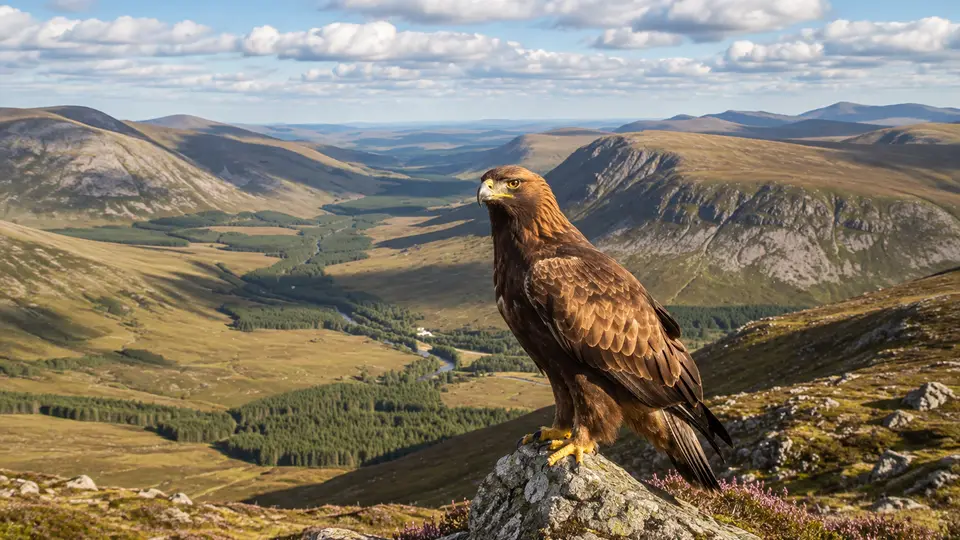
Golden Eagle in its natural habitat, AI illustration

Golden Eagle: where and when to see them

Aquila chrysaetos

Golden Eagle at a glance

The golden eagle is a powerful raptor of open mountains, moorland and other expansive landscapes across the Northern Hemisphere. In Scotland, it is especially associated with the Highlands and western islands, where large territories encompass rugged slopes and open hunting ground. Adults are dark brown with a golden nape rather than an entirely golden body. Its global status masks local pressures, including illegal persecution, disturbance and changes in prey and habitat management.

Behaviour & reproduction

Size
80-93 cm long; 1.9-2.3 m wingspan
Weight
3-6.5 kg
Lifespan
20-30 years
Status
Least Concern

Pairs maintain large territories and may use several alternative nests over successive years. They soar on rising air, glide along ridges and hunt by watching from perches or searching low over open slopes. Courtship can include dramatic undulating flights. Both adults contribute to raising young, though females perform most incubation. Young eagles disperse widely before establishing territories, and immature birds may spend several years wandering through suitable landscapes beyond their natal area. Courtship displays, often seen in late winter and early spring, include spectacular sky-dancing with high dives and ascents. Both parents are involved in incubating the eggs and feeding the chicks, though the female spends more time at the nest. Young eagles fledge around 10-11 weeks old but remain dependent on their parents for several more weeks, learning vital hunting skills.

Top wildlife locations

Scotland wildlife habitat

Scotland

Western coastal roads and island viewpoints overlooking rugged hills can provide distant views. Elsewhere an inland upland excursion is needed; occupied nest cliffs are sensitive and must not be approached.

Adventure cruises in Scotland

Destinations describe the species' habitat, not guaranteed cruise stops. Some animals require an optional inland excursion or are found in restricted reserves.

Fun facts about the Golden Eagle

  • Pairs often maintain several alternative nests within one territory.
  • Young birds commonly show white patches in the wings and at the tail base.
  • The golden coloring is concentrated on the nape and rear crown.
  • Repeated additions can turn a long-used nest into a substantial structure.

Best time to see the Golden Eagle

Golden eagles can be observed in Scotland throughout the year. Spring may bring conspicuous territorial displays, while summer offers long daylight for scanning uplands. Weather and visibility are decisive: persistent low cloud can hide ridges, and breeding birds must be watched from distant public viewpoints. Winter months, while often colder, can offer excellent eagle sightings against snow-covered landscapes, especially as they may be more visible searching for food. Early mornings or late afternoons often provide the best light for photography and observation. Migratory golden eagles from Scandinavia sometimes augment the Scottish population during colder months, though this is less common for resident breeders.

Golden Eagle: season matrix by destination

Travel and observation windows vary by region. Highlighted months are an orientation for planning, not confirmed sightings or a guarantee of access.

Scotland

This window favors daylight and practical upland travel, not exclusive occurrence; resident birds remain year-round and weather strongly affects visibility.

JanFebMarAprMayJunJulAugSepOctNovDec
Cruise ships in Scotland

Where the Golden Eagle lives

Scottish habitat includes upland moor, mountains, deer forest and rugged island terrain, with nesting on cliffs or occasionally trees. Open ground supports hunting, while extensive disturbance or unsuitable forestry can reduce habitat quality. Coastal viewpoints work where shorelines overlook nearby hills and ridges. In Scotland, these eagles typically range across areas with good visibility for hunting and nesting sites protected from human interference. They require extensive, undisturbed home ranges, often encompassing hundreds of square kilometres, to support their hunting needs. Deforestation and intensive land management can fragment their preferred open moorland and mountainous habitats.

What the Golden Eagle eats

Rabbits, hares and medium-sized birds are important prey in many territories, with composition varying locally. Eagles also take carrion, especially when live prey is difficult to obtain. Their hunting is opportunistic, and prey availability influences territory size and breeding performance. In coastal regions, young seabirds and marine carrion can supplement their diet, especially during periods of scarce terrestrial prey. Larger prey such as red grouse, mountain hares, and young deer are also taken, demonstrating their predatory prowess. Food availability directly impacts the number of young successfully fledged.

Species at a glance

Common name
Golden Eagle
Scientific name
Aquila chrysaetos
Animal group
Birds
Size
80-93 cm long; 1.9-2.3 m wingspan
Weight
3-6.5 kg
Lifespan
20-30 years
Status
Least Concern
Identification
Compared with the white-tailed eagle, it has a smaller projecting head, a longer tail and narrower wings, with adults lacking a white tail. Adults display a dark brown body plumage with a distinctive golden-brown wash on the nape and hindneck, which is a key identification feature. Immature birds show prominent white patches at the base of the primary flight feathers and a white tail with a broad dark terminal band, which gradually diminishes over several years. Their majestic broad wings are held in a slight dihedral (V-shape) when soaring, a characteristic flight profile.

Golden Eagle: frequently asked questions

Where can I see the Golden Eagle?
Scotland. Scan ridges from public roads or established paths using binoculars or a telescope. Never approach an occupied nest or publish its precise location; Scottish nesting eagles receive special protection, and disturbance can cause breeding failure. When viewing from cruise ships or shore excursions, look for birds soaring high above sea cliffs or distant mountain ranges, often silhouetted against the sky. Binoculars are essential for distant sightings, and a spotting scope will greatly enhance details of perched birds or those soaring at altitude. Be mindful of changing weather conditions which can rapidly obscure views of mountain raptors.
When is the best time to see the Golden Eagle?
Golden eagles can be observed in Scotland throughout the year. Spring may bring conspicuous territorial displays, while summer offers long daylight for scanning uplands. Weather and visibility are decisive: persistent low cloud can hide ridges, and breeding birds must be watched from distant public viewpoints. Winter months, while often colder, can offer excellent eagle sightings against snow-covered landscapes, especially as they may be more visible searching for food. Early mornings or late afternoons often provide the best light for photography and observation. Migratory golden eagles from Scandinavia sometimes augment the Scottish population during colder months, though this is less common for resident breeders.
How big does the Golden Eagle get?
80-93 cm long; 1.9-2.3 m wingspan. Adult weight: 3-6.5 kg. Size varies with age, sex and population.
How should I behave around the Golden Eagle?
Scan ridges from public roads or established paths using binoculars or a telescope. Never approach an occupied nest or publish its precise location; Scottish nesting eagles receive special protection, and disturbance can cause breeding failure. When viewing from cruise ships or shore excursions, look for birds soaring high above sea cliffs or distant mountain ranges, often silhouetted against the sky. Binoculars are essential for distant sightings, and a spotting scope will greatly enhance details of perched birds or those soaring at altitude. Be mindful of changing weather conditions which can rapidly obscure views of mountain raptors.
What does the Golden Eagle eat?
Rabbits, hares and medium-sized birds are important prey in many territories, with composition varying locally. Eagles also take carrion, especially when live prey is difficult to obtain. Their hunting is opportunistic, and prey availability influences territory size and breeding performance. In coastal regions, young seabirds and marine carrion can supplement their diet, especially during periods of scarce terrestrial prey. Larger prey such as red grouse, mountain hares, and young deer are also taken, demonstrating their predatory prowess. Food availability directly impacts the number of young successfully fledged.
Are wildlife sightings guaranteed on an adventure cruise?
No. Animals move freely and routes, weather, access restrictions and local conditions influence every outing. Confirm the actual itinerary and shore program before booking.

Compare wildlife in the same destinations

Explore other birds recorded in these destinations. Similar surroundings do not mean the animals share the same habits or viewing season.

Species comparison by animal group and destination
Golden EagleGolden EagleAtlantic PuffinAtlantic PuffinBlack GuillemotBlack Guillemot
Animal groupBirdsAnimal groupBirdsAnimal groupBirds
DestinationsScotlandDestinationsNew England, Norway, Scotland, ArcticDestinationsNew England, Norway, Scotland
All wildlife destinations
Plan your trip

Find your next wildlife adventure

Compare destinations, shore programs and dates with the animals and habitats you would love to see.

  • Naturalist-led shore excursions
  • Responsible wildlife watching
  • Small expedition ships

Newsletter

Take Blue Rides with you

Adventure cruise offers, last-minute deals and trip inspiration.

Free, unsubscribe anytime. Details: Privacy Policy

Partner with Blue Rides

Affiliate Program

Recommend adventure cruises and earn commission on every confirmed booking.

Share. Track. Earn.

Your footage, our stage

Send us your videos or pictures.

Captured beautiful landscapes or wildlife? Share your videos and pictures with us, we may feature them on Blue Rides.