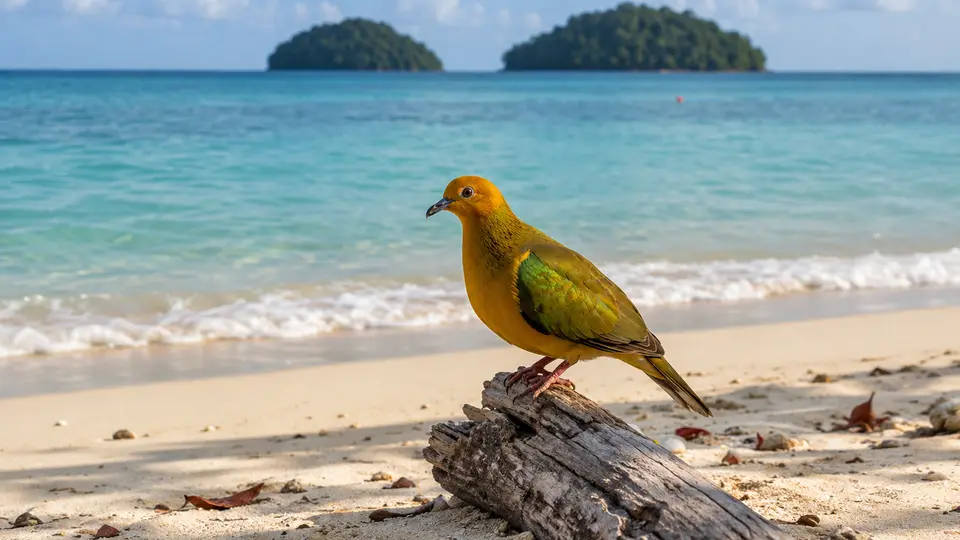
Golden dove in its natural habitat, AI illustration
SizeAbout 20 cm longLifespanNot reliably establishedStatusLeast Concern

Golden dove: where and when to see them

Ptilinopus luteovirens

Golden dove at a glance

The golden dove, also called the golden fruit dove, is endemic to Fiji. Its name describes the striking male, whose golden body plumage contrasts with a paler head; females are predominantly green and much less conspicuous. Despite the male's bright appearance, these small pigeons can be difficult to locate among sunlit leaves. They belong to a distinctive Fijian group of fruit doves and depend on wooded habitats containing suitable fruiting trees.

Behaviour & reproduction

Size
About 20 cm long
Weight
Not reliably established
Lifespan
Not reliably established
Status
Least Concern

Golden doves spend much of their time in the canopy, where they perch quietly and move between fruiting branches. Birds are more often found singly or in small associations than in large, conspicuous flocks. Their calls can reveal an otherwise hidden individual, but dense foliage may prevent a clear view. Like other fruit doves, they swallow small fruits whole and use relatively brief flights to move through wooded habitat. When startled, Golden Doves typically fly short distances to another nearby branch rather than making long, conspicuous flights. Their quiet, solitary nature makes them challenging subjects for observation, even in areas where they are relatively common.

Top wildlife locations

Fiji wildlife habitat

Fiji

Wooded foothills and forest trails on Viti Levu offer plausible viewing, usually requiring an inland excursion from the coast. Beach-only visits are unsuitable, and the species is absent from many Fijian islands.

Adventure cruises in Fiji
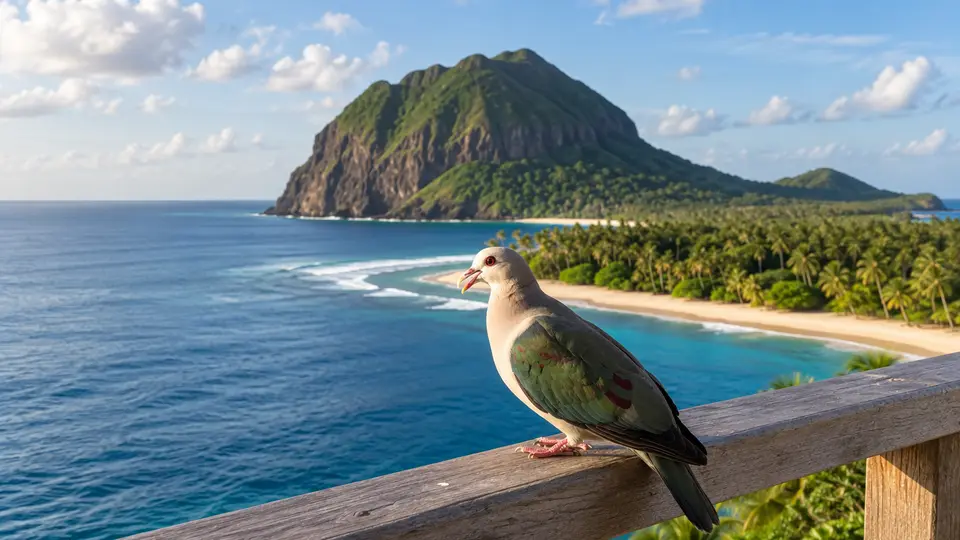
Destinations describe the species' habitat, not guaranteed cruise stops. Some animals require an optional inland excursion or are found in restricted reserves.

Fun facts about the Golden dove

  • Only males have the extensive golden plumage that gives the species its name.
  • It is found naturally only in Fiji.
  • Male body feathers have an unusually elongated, textured appearance.
  • It is closely related to Fiji's orange dove and whistling dove.

Best time to see the Golden dove

Forest observation is possible year-round, with the generally drier May-to-October period often making walking and listening easier. Local fruiting conditions influence where birds feed. This travel window should not be treated as a confirmed breeding peak, and island-specific guidance is important. The breeding season, while not strictly confined, often shows increased activity during the wetter months when food resources may be more abundant. Observing birds during the dry season can be more fruitful due to less dense undergrowth and more predictable fruit availability.

Golden dove: season matrix by destination

Travel and observation windows vary by region. Highlighted months are an orientation for planning, not confirmed sightings or a guarantee of access.

Fiji

These generally drier months favor forest access; they do not establish breeding timing or guarantee birds at a particular fruiting tree.

JanFebMarAprMayJunJulAugSepOctNovDec
Cruise ships in Fiji

Where the Golden dove lives

The species inhabits forest and wooded secondary growth within its Fijian range, including Viti Levu and associated islands. Fruiting trees and adequate canopy cover are important. Open beaches are unsuitable, and the presence of forest does not imply occurrence on every island. They are rarely found in coastal scrub or mangrove forests, preferring more mature, closed-canopy forest. The species shows a strong preference for primary and older secondary growth forests, indicating a reliance on stable, undisturbed ecosystems.

What the Golden dove eats

Small fleshy fruits and berries form the principal diet, taken directly from trees and shrubs. The bird's gape limits which fruits it can swallow. Its feeding connects it to seasonal fruit production and contributes to seed movement through the forest canopy landscape. Despite their bright plumage, they are often difficult to spot as they forage quietly among the leaves. Their feeding habits are crucial for seed dispersal, helping to maintain forest diversity and regeneration across their range.

Species at a glance

Common name
Golden dove
Scientific name
Ptilinopus luteovirens
Animal group
Birds
Size
About 20 cm long
Weight
Not reliably established
Lifespan
Not reliably established
Status
Least Concern
Identification
The male's golden-yellow body and pale greenish head distinguish it from Fiji's orange and whistling fruit doves, while green females require careful attention to locality and field marks. Male Golden Doves are unmistakable with their bright, almost iridescent golden-yellow plumage contrasting with a pale green head. Female Golden Doves, with their mostly green plumage, can be distinguished from other fruit doves by subtle variations in green tones and the lack of other strong markings.

Golden dove: frequently asked questions

Where can I see the Golden dove?
Fiji. Use a local bird guide on established forest trails and scan fruiting crowns quietly. Avoid playback and branch shaking, and do not leave paths to pursue a calling bird, especially near fragile forest vegetation or concealed nests. Listen for their distinctive, low hooting calls, which are often the first sign of their presence in dense forest. Binoculars are essential for spotting these camouflaged birds high in the canopy.
When is the best time to see the Golden dove?
Forest observation is possible year-round, with the generally drier May-to-October period often making walking and listening easier. Local fruiting conditions influence where birds feed. This travel window should not be treated as a confirmed breeding peak, and island-specific guidance is important. The breeding season, while not strictly confined, often shows increased activity during the wetter months when food resources may be more abundant. Observing birds during the dry season can be more fruitful due to less dense undergrowth and more predictable fruit availability.
How big does the Golden dove get?
About 20 cm long. Adult weight: Not reliably established. Size varies with age, sex and population.
How should I behave around the Golden dove?
Use a local bird guide on established forest trails and scan fruiting crowns quietly. Avoid playback and branch shaking, and do not leave paths to pursue a calling bird, especially near fragile forest vegetation or concealed nests. Listen for their distinctive, low hooting calls, which are often the first sign of their presence in dense forest. Binoculars are essential for spotting these camouflaged birds high in the canopy.
What does the Golden dove eat?
Small fleshy fruits and berries form the principal diet, taken directly from trees and shrubs. The bird's gape limits which fruits it can swallow. Its feeding connects it to seasonal fruit production and contributes to seed movement through the forest canopy landscape. Despite their bright plumage, they are often difficult to spot as they forage quietly among the leaves. Their feeding habits are crucial for seed dispersal, helping to maintain forest diversity and regeneration across their range.
Are wildlife sightings guaranteed on an adventure cruise?
No. Animals move freely and routes, weather, access restrictions and local conditions influence every outing. Confirm the actual itinerary and shore programme before booking.

Compare wildlife in the same destinations

Explore other birds recorded in these destinations. Similar surroundings do not mean the animals share the same habits or viewing season.

Species comparison by animal group and destination
Golden doveGolden doveBarking imperial pigeonBarking imperial pigeonBrown BoobyBrown Booby
Animal groupBirdsAnimal groupBirdsAnimal groupBirds
DestinationsFijiDestinationsFijiDestinationsCosta Rica, Cape Verde, Egypt, Fiji, Polynesia
All wildlife destinations
Plan your trip

Find your next wildlife adventure

Compare destinations, shore programmes and dates with the animals and habitats you would love to see.

  • Naturalist-led shore excursions
  • Responsible wildlife watching
  • Small expedition ships

Newsletter

Take Blue Rides with you

Adventure cruise offers, last-minute deals and trip inspiration.

Free, unsubscribe anytime. Details: Privacy Policy

Partner with Blue Rides

Affiliate Program

Recommend adventure cruises and earn commission on every confirmed booking.

Share. Track. Earn.