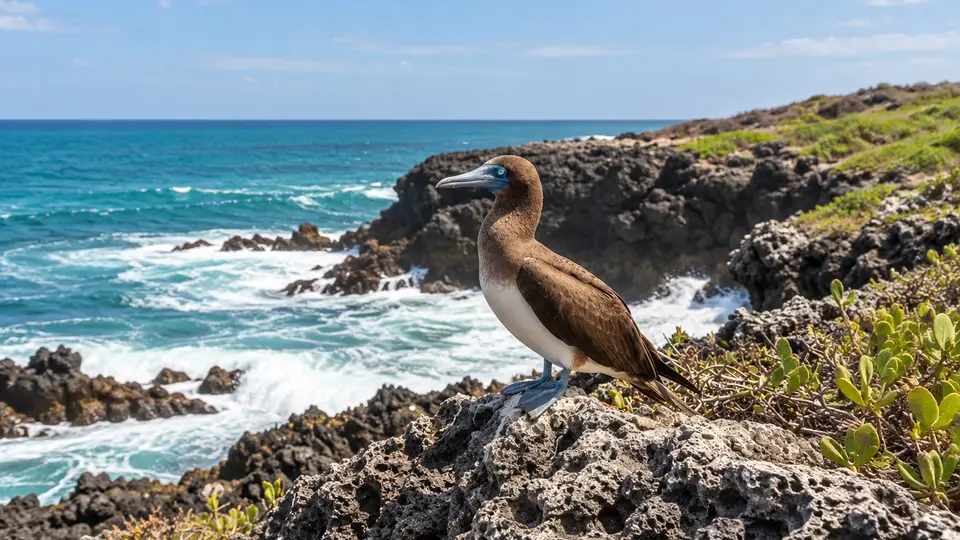
Crab-plover in its natural habitat, AI illustration

Crab-plover: where and when to see them

Dromas ardeola

Crab-plover at a glance

The crab-plover is a striking black-and-white shorebird of the western Indian Ocean and adjacent seas. Its heavy black bill is adapted to tackling crabs, while long legs carry it across exposed tidal flats. Despite its name, it belongs to its own family rather than the typical plover family. Its unusual nesting system involves burrows in coastal sand, making breeding colonies particularly vulnerable to trampling and other disturbance.

Behaviour & reproduction

Size
38–41 cm long
Weight
230–330 g
Lifespan
Not reliably established
Status
Least Concern

Crab-plovers often feed and roost socially, following the tidal cycle between productive flats and safe resting places. They seize crabs and manipulate or strike larger prey before swallowing it. Breeding birds excavate burrows in dense colonies, where warm sand contributes substantially to egg incubation. Young remain dependent on adults after leaving the nest, and begging juveniles may accompany feeding groups well beyond the immediate nesting area. Courtship displays involve aerial chases and mutual preening, often leading to pair bonding before burrow excavation. Both parents share incubation duties, taking turns to maintain the egg temperature, which is supplemented by solar heat in the sand. Fledglings remain with their parents for an extended period, learning foraging techniques and often joining larger post-breeding aggregations.

Top wildlife locations

Egypt wildlife habitat

Egypt

Southern Red Sea tidal flats and sheltered sandy shores provide plausible habitat, but distribution is localized. Breeding islands can be restricted or inaccessible; ordinary coastal visits should not assume colony access or sightings.

Adventure cruises in Egypt
Seychelles wildlife habitat

Seychelles

Accessible tidal flats and sheltered lagoon shores on suitable islands can support nonbreeding birds. Occurrence is uneven across the archipelago, and remote outer-island habitat may be inaccessible during ordinary shore visits.

Adventure cruises in Seychelles

Destinations describe the species' habitat, not guaranteed cruise stops. Some animals require an optional inland excursion or are found in restricted reserves.

Fun facts about the Crab-plover

  • It is the only living member of the family Dromadidae.
  • It nests in excavated sand burrows rather than open scrapes.
  • Warm nesting sand supplies much of the heat needed by the egg.
  • Adults continue feeding dependent young after they leave the burrow.

Best time to see the Crab-plover

In Seychelles, October to April is a useful broad window for nonbreeding visitors, though some birds remain outside it. Egyptian Red Sea occurrence is more localized and can involve breeding areas. Tide and authorized access are critical, and colony seasons should not guide intrusive visits. In the Seychelles, large non-breeding flocks often gather on specific sand flats and lagoons during the northern winter. The Egyptian Red Sea coast, particularly around offshore islands and sheltered bays, can host significant breeding colonies during the spring and summer months. Peak movements and concentrations along these routes are strongly influenced by monsoon patterns and food availability.

Crab-plover: season matrix by destination

Travel and observation windows vary by region. Highlighted months are an orientation for planning, not confirmed sightings or a guarantee of access.

Egypt

A reliable general shore-viewing window is unsupported without a specific accessible locality; regional breeding records do not establish public viewing opportunities.

JanFebMarAprMayJunJulAugSepOctNovDec
Cruise ships in Egypt

Seychelles

This is a broad nonbreeding visitor window, not a Seychelles nesting season; island occupancy and weather remain variable.

JanFebMarAprMayJunJulAugSepOctNovDec
Cruise ships in Seychelles

Where the Crab-plover lives

The species uses tropical and subtropical tidal mudflats, sandflats, sheltered lagoons and reef-associated shores. Breeding requires suitable sandy ground for burrows, commonly on islands or isolated coasts. Nonbreeding birds can occupy accessible estuaries far from their nesting colonies. This species is primarily coastal, rarely found far from marine or estuarine environments. While widespread across the Indian Ocean, population densities are often localized to specific large tidal flats or island groups. Breeding colonies are typically located on low-lying sandy islands or isolated sandy spits, often in arid coastal regions.

What the Crab-plover eats

Crabs are the principal prey, handled with the bird's strong, pointed bill. Other crustaceans, molluscs and small marine animals are also taken. Feeding success depends on tidal exposure and prey availability, so apparently suitable high-water beaches may serve mainly as roosts. They often wade in shallow water or run across exposed sand to pursue their prey. Crab-plovers are known to wash their food items in water before consumption, especially larger or particularly sandy crabs. Their diet can also include small fish when conditions allow, showcasing opportunistic feeding strategies.

Species at a glance

Common name
Crab-plover
Scientific name
Dromas ardeola
Animal group
Birds
Size
38–41 cm long
Weight
230–330 g
Lifespan
Not reliably established
Status
Least Concern
Identification
Its large black crab-cracking bill, white head and body, black back and long grey legs distinguish it from oystercatchers and ordinary plovers. Juveniles are distinguished by dusky brown mottling on the back and wings, gradually acquiring adult plumage over their first year. In flight, the strong black and white contrast of their wings is a key identifying feature, making them stand out against other shorebirds. Their unique long, robust black bill is proportionally larger than any other plover, aiding in recognition even at a distance.

Crab-plover: frequently asked questions

Where can I see the Crab-plover?
Egypt, Seychelles. Use a telescope from the edge of an exposed flat or a distant roost viewpoint. Never walk across suspected nesting sand, where burrow roofs can collapse, and avoid pushing resting flocks toward the water. When viewing from a boat, maintain a respectful distance to avoid flushing birds, especially from roosting sites. Focus on observing their characteristic feeding gait and interactions within social groups on broad tidal expanses. Early morning and late afternoon are often the most active feeding times and offer the best light for photography.
When is the best time to see the Crab-plover?
In Seychelles, October to April is a useful broad window for nonbreeding visitors, though some birds remain outside it. Egyptian Red Sea occurrence is more localized and can involve breeding areas. Tide and authorized access are critical, and colony seasons should not guide intrusive visits. In the Seychelles, large non-breeding flocks often gather on specific sand flats and lagoons during the northern winter. The Egyptian Red Sea coast, particularly around offshore islands and sheltered bays, can host significant breeding colonies during the spring and summer months. Peak movements and concentrations along these routes are strongly influenced by monsoon patterns and food availability.
How big does the Crab-plover get?
38–41 cm long. Adult weight: 230–330 g. Size varies with age, sex and population.
How should I behave around the Crab-plover?
Use a telescope from the edge of an exposed flat or a distant roost viewpoint. Never walk across suspected nesting sand, where burrow roofs can collapse, and avoid pushing resting flocks toward the water. When viewing from a boat, maintain a respectful distance to avoid flushing birds, especially from roosting sites. Focus on observing their characteristic feeding gait and interactions within social groups on broad tidal expanses. Early morning and late afternoon are often the most active feeding times and offer the best light for photography.
What does the Crab-plover eat?
Crabs are the principal prey, handled with the bird's strong, pointed bill. Other crustaceans, molluscs and small marine animals are also taken. Feeding success depends on tidal exposure and prey availability, so apparently suitable high-water beaches may serve mainly as roosts. They often wade in shallow water or run across exposed sand to pursue their prey. Crab-plovers are known to wash their food items in water before consumption, especially larger or particularly sandy crabs. Their diet can also include small fish when conditions allow, showcasing opportunistic feeding strategies.
Are wildlife sightings guaranteed on an adventure cruise?
No. Animals move freely and routes, weather, access restrictions and local conditions influence every outing. Confirm the actual itinerary and shore programme before booking.

Compare wildlife in the same destinations

Explore other birds recorded in these destinations. Similar surroundings do not mean the animals share the same habits or viewing season.

Species comparison by animal group and destination
Crab-ploverCrab-ploverBridled TernBridled TernBrown BoobyBrown Booby
Animal groupBirdsAnimal groupBirdsAnimal groupBirds
DestinationsEgypt, SeychellesDestinationsSeychellesDestinationsCosta Rica, Cape Verde, Egypt, Fiji, Polynesia
All wildlife destinations
Plan your trip

Find your next wildlife adventure

Compare destinations, shore programmes and dates with the animals and habitats you would love to see.

  • Naturalist-led shore excursions
  • Responsible wildlife watching
  • Small expedition ships

Newsletter

Take Blue Rides with you

Adventure cruise offers, last-minute deals and trip inspiration.

Free, unsubscribe anytime. Details: Privacy Policy

Partner with Blue Rides

Affiliate Program

Recommend adventure cruises and earn commission on every confirmed booking.

Share. Track. Earn.