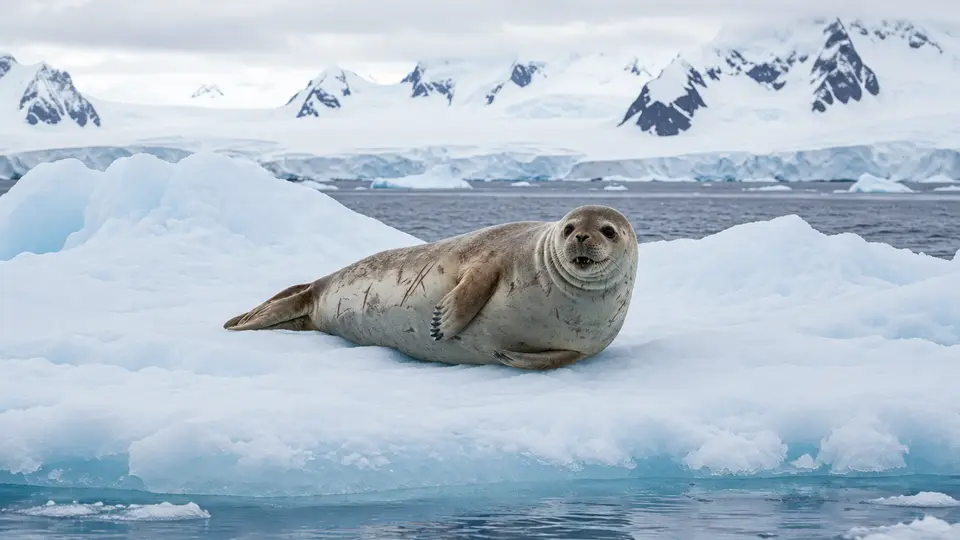
Crabeater Seal in its natural habitat, AI illustration
Size2.2–2.6 m longLifespan20–30 yearsStatusLeast Concern

Crabeater Seal: where and when to see them

Lobodon carcinophaga

Crabeater Seal at a glance

The crabeater seal is an Antarctic pack-ice specialist whose misleading name conceals a diet dominated by krill. Pale adults often rest on drifting floes, bringing them within distant deck-viewing range when ice and routes align. Their specialized teeth form an effective sieve for small prey. Although widespread around Antarctica, they depend on a changing sea-ice environment, and population estimates remain difficult because much of their habitat is remote and constantly moving.

Behaviour & reproduction

Size
2.2–2.6 m long
Weight
200–300 kg
Lifespan
20–30 years
Status
Least Concern

Crabeater seals alternate feeding at sea with resting on pack ice, sometimes lying alone and sometimes in loose gatherings. During breeding, a female, her pup and an attending male may form a temporary group on a floe. Mothers nurse their pups for only a few weeks before weaning. Many adults bear long scars from leopard seal attacks survived when young, while killer whales are another important predator. Pups are born with a soft, woolly, light brown lanugo coat that is shed after a few weeks. These seals are known for their strong swimming ability and can cover considerable distances when foraging, often diving to moderate depths to feed on krill swarms.

Top wildlife locations

Antarctica wildlife habitat

Antarctica

Pack ice beside permitted vessel routes offers the most plausible distant deck views. Shore opportunities require nearby occupied floes and are incidental; breeding ice is not a standard landing habitat.

Adventure cruises in Antarctica
Destinations describe the species' habitat, not guaranteed cruise stops. Some animals require an optional inland excursion or are found in restricted reserves.

Fun facts about the Crabeater Seal

  • Its lobed cheek teeth function as a krill-retaining sieve.
  • The common name does not describe its actual staple food.
  • Many adults carry scars from leopard seal attacks earlier in life.
  • Females give birth on sea ice rather than at permanent terrestrial rookeries.

Best time to see the Crabeater Seal

November to March is the practical Antarctic visitor window for distant deck or occasional shore observations. Ice distribution and permitted routes govern opportunities, not a guaranteed seal season. The spring pupping period does not necessarily coincide with accessible or appropriate visitor viewing. The presence of suitable ice habitat for resting and molting is a key factor influencing their distribution, often dictating where they can be observed. While krill abundance is high during the austral summer, their distribution can be patchy, leading to local variations in seal numbers.

Crabeater Seal: season matrix by destination

Travel and observation windows vary by region. Highlighted months are an orientation for planning, not confirmed sightings or a guarantee of access.

Antarctica

These are practical summer travel months, not a claim of peak breeding or predictable encounters; annual ice conditions strongly affect access.

JanFebMarAprMayJunJulAugSepOctNovDec
Cruise ships in Antarctica

Where the Crabeater Seal lives

The species is strongly associated with Antarctic pack ice rather than permanent land-based colonies. Floating floes provide resting, moulting and breeding platforms near feeding waters. Shore observations are incidental where ice lies close to land; most practical viewing is from a distant vessel deck. Though generally avoiding land, individuals occasionally haul out on ice shelves or remote islands within their range. Their circumpolar distribution means they are found throughout the Antarctic pack ice zone, from coastal waters to the deep ocean.

What the Crabeater Seal eats

Antarctic krill makes up the overwhelming majority of the diet, with small quantities of fish or other prey occasionally recorded. Multi-cusped cheek teeth interlock to retain krill while water escapes. Despite the common name, true crabs are not a normal dietary staple. Remarkably, crabeater seals possess the most complex teeth of any pinniped, specially adapted for filtering krill from vast quantities of water. An adult seal can consume several hundred kilograms of krill per day, making them one of the most significant krill consumers in the Southern Ocean.

Species at a glance

Common name
Crabeater Seal
Scientific name
Lobodon carcinophaga
Animal group
Mammals
Size
2.2–2.6 m long
Weight
200–300 kg
Lifespan
20–30 years
Status
Least Concern
Identification
Its relatively slender muzzle and pale coat distinguish it from the blunt-faced Weddell seal and the much larger-headed leopard seal, although distant identifications can be difficult. Adult Crabeaters typically have a pale, often yellowish-white coat, which can appear quite clean after molting. Look for their distinctive elongated, somewhat 'dog-like' muzzle, which is a key distinguishing feature from other Antarctic seals.

Crabeater Seal: frequently asked questions

Where can I see the Crabeater Seal?
Antarctica. Watch resting seals from a distant deck or an authorized shore position, leaving their route to water clear. Never approach occupied floes or separate adults and pups; an alert, lifting head signals that more space is needed. When viewing from a ship, look for individuals or small groups hauled out on ice floes, often near areas of open water. Observing them requires patience and a good pair of binoculars, as they blend remarkably well with the icy environment.
When is the best time to see the Crabeater Seal?
November to March is the practical Antarctic visitor window for distant deck or occasional shore observations. Ice distribution and permitted routes govern opportunities, not a guaranteed seal season. The spring pupping period does not necessarily coincide with accessible or appropriate visitor viewing. The presence of suitable ice habitat for resting and molting is a key factor influencing their distribution, often dictating where they can be observed. While krill abundance is high during the austral summer, their distribution can be patchy, leading to local variations in seal numbers.
How big does the Crabeater Seal get?
2.2–2.6 m long. Adult weight: 200–300 kg. Size varies with age, sex and population.
How should I behave around the Crabeater Seal?
Watch resting seals from a distant deck or an authorized shore position, leaving their route to water clear. Never approach occupied floes or separate adults and pups; an alert, lifting head signals that more space is needed. When viewing from a ship, look for individuals or small groups hauled out on ice floes, often near areas of open water. Observing them requires patience and a good pair of binoculars, as they blend remarkably well with the icy environment.
What does the Crabeater Seal eat?
Antarctic krill makes up the overwhelming majority of the diet, with small quantities of fish or other prey occasionally recorded. Multi-cusped cheek teeth interlock to retain krill while water escapes. Despite the common name, true crabs are not a normal dietary staple. Remarkably, crabeater seals possess the most complex teeth of any pinniped, specially adapted for filtering krill from vast quantities of water. An adult seal can consume several hundred kilograms of krill per day, making them one of the most significant krill consumers in the Southern Ocean.
Are wildlife sightings guaranteed on an adventure cruise?
No. Animals move freely and routes, weather, access restrictions and local conditions influence every outing. Confirm the actual itinerary and shore programme before booking.

Compare wildlife in the same destinations

Explore other mammals recorded in these destinations. Similar surroundings do not mean the animals share the same habits or viewing season.

Species comparison by animal group and destination
Crabeater SealCrabeater SealAntarctic Fur SealAntarctic Fur SealBlue WhaleBlue Whale
Animal groupMammalsAnimal groupMammalsAnimal groupMammals
DestinationsAntarcticaDestinationsAntarcticaDestinationsMexico, Norway, Portugal, Antarctica, Arctic, Maldives, New Zealand
All wildlife destinations
Plan your trip

Find your next wildlife adventure

Compare destinations, shore programmes and dates with the animals and habitats you would love to see.

  • Naturalist-led shore excursions
  • Responsible wildlife watching
  • Small expedition ships

Newsletter

Take Blue Rides with you

Adventure cruise offers, last-minute deals and trip inspiration.

Free, unsubscribe anytime. Details: Privacy Policy

Partner with Blue Rides

Affiliate Program

Recommend adventure cruises and earn commission on every confirmed booking.

Share. Track. Earn.