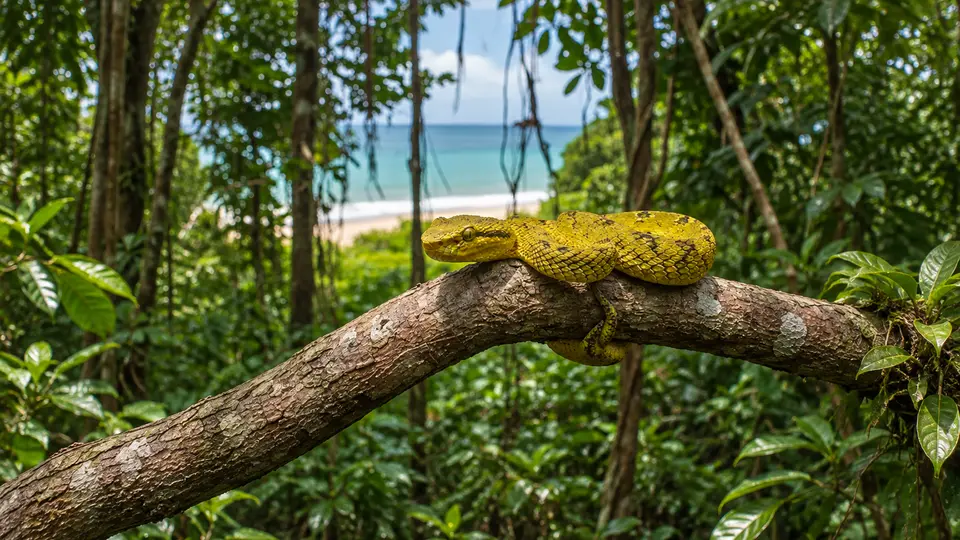
Eyelash Viper in its natural habitat, AI illustration
SizeNot reliably establishedLifespanNot reliably establishedStatusCheck current assessment

Eyelash Viper: where and when to see them

Bothriechis schlegelii

Eyelash Viper at a glance

Bothriechis schlegelii is a venomous arboreal pit viper within the eyelash-viper complex, named for raised scales above the eyes. Its taxonomy is important here: recent revisions divide the former widespread species into several geographically restricted species, and Costa Rican populations are assigned other names under that treatment. Consequently, older Costa Rican records labelled schlegelii do not securely establish the narrowly defined species there. Measurements and conservation summaries from the former broad concept should not be transferred uncritically.

Behaviour & reproduction

Size
Not reliably established
Weight
Not reliably established
Lifespan
Not reliably established
Status
Check current assessment

Eyelash vipers are ambush predators that may remain coiled on a branch or leaf for long periods, relying on concealment rather than continuous pursuit. Heat-sensitive facial pits assist in detecting warm-blooded prey. A prehensile tail anchors the body among vegetation, and activity is often nocturnal. Females bear live young. These general traits characterize the complex, but detailed ecological findings from Costa Rica cannot automatically be assigned to narrowly defined Bothriechis schlegelii. Beyond ambush predation, these vipers are known to exhibit caudal luring, wiggling their brightly colored tail tip to attract small prey. Their prehensile tail allows them to anchor firmly, often coiling around branches or vines in an 'S' shape, ready to strike. While generally nocturnal, they may also be observed basking during the day.

Top wildlife locations

Costa Rica wildlife habitat

Costa Rica

Coastal rainforest vegetation supports related eyelash vipers, usually requiring a guided forest excursion. Under recent splits, these are not Bothriechis schlegelii sensu stricto, so this destination should be flagged for catalog correction.

Adventure cruises in Costa Rica

Destinations describe the species' habitat, not guaranteed cruise stops. Some animals require an optional inland excursion or are found in restricted reserves.

Fun facts about the Eyelash Viper

  • The eyelash structures are modified scales, not hairs.
  • Facial pits detect infrared radiation associated with warm objects.
  • A prehensile tail helps secure the snake among branches.
  • Recent taxonomic splits make many older photographs and records require reidentification.

Best time to see the Eyelash Viper

There is no defensible Costa Rican observation season for narrowly defined Bothriechis schlegelii. Locally occurring relatives may be active throughout the year in humid forest, but rainfall-related activity does not resolve their identity. Confirm the taxonomic treatment before attaching any seasonal wildlife claims. For the *Bothriechis schlegelii* complex in Costa Rica, observations are possible year-round, especially in areas with consistent rainfall and high humidity. While some sources suggest increased activity during the wet season due to more abundant prey, this is not specific to the narrowly defined species.

Eyelash Viper: season matrix by destination

Travel and observation windows vary by region. Highlighted months are an orientation for planning, not confirmed sightings or a guarantee of access.

Costa Rica

A seasonal window is unsupported because the supplied destination conflicts with the species' restricted taxonomic treatment.

JanFebMarAprMayJunJulAugSepOctNovDec
Cruise ships in Costa Rica

Where the Eyelash Viper lives

Under recent restricted treatments, this species is associated with humid forest in northwestern South America, particularly Colombia, rather than Costa Rica. Vegetation above the ground provides hunting positions. Older descriptions spanning Central America combine populations now assigned to multiple species by some authorities. The species as currently understood prefers primary or mature secondary humid forest, often in lower montane or premontane zones. It is typically found at elevations ranging from sea level up to 1,500 meters, utilizing both arboreal and terrestrial microhabitats.

What the Eyelash Viper eats

Reported prey within the eyelash-viper complex includes frogs, lizards, small mammals and birds, with prey choice influenced by snake size and local availability. Exact dietary proportions for narrowly defined Bothriechis schlegelii remain insufficiently documented, so Costa Rican feeding records require taxonomic checking. In the broader 'eyelash viper complex,' prey is usually swallowed headfirst, with the flexible jaws accommodating surprisingly large meals. While specific data for *Bothriechis schlegelii sensu stricto* is scarce, close relatives in Central America exhibit a diet heavily skewed towards frogs and lizards in juvenile stages, shifting to birds and small mammals as adults.

Species at a glance

Common name
Eyelash Viper
Scientific name
Bothriechis schlegelii
Animal group
Reptiles
Size
Not reliably established
Weight
Not reliably established
Lifespan
Not reliably established
Status
Check current assessment
Identification
Raised eyelash-like scales identify the complex, but colour alone cannot distinguish schlegelii from recently separated relatives, and locality plus expert assessment are essential. Key identification features for *Bothriechis schlegelii* (s.s.) include a relatively small head with prominent supraocular scales forming the 'eyelashes' and a robust body. Coloration is highly variable, ranging from bright yellow to green, pink, or brown, and can include mottled or banded patterns.

Eyelash Viper: frequently asked questions

Where can I see the Eyelash Viper?
Costa Rica. If any eyelash viper is noticed from a permitted forest path, stop well short and alert the guide. Never touch branches near it, handle it or attempt repositioning; a bite requires urgent professional medical care. Always maintain a safe distance of several body lengths from any viper. Guides are trained to locate these camouflaged snakes without disturbing their natural behavior or posing a risk to guests. Flash photography should be avoided to prevent stressing the animal or affecting its natural activity patterns.
When is the best time to see the Eyelash Viper?
There is no defensible Costa Rican observation season for narrowly defined Bothriechis schlegelii. Locally occurring relatives may be active throughout the year in humid forest, but rainfall-related activity does not resolve their identity. Confirm the taxonomic treatment before attaching any seasonal wildlife claims. For the *Bothriechis schlegelii* complex in Costa Rica, observations are possible year-round, especially in areas with consistent rainfall and high humidity. While some sources suggest increased activity during the wet season due to more abundant prey, this is not specific to the narrowly defined species.
How big does the Eyelash Viper get?
Not reliably established. Adult weight: Not reliably established. Size varies with age, sex and population.
How should I behave around the Eyelash Viper?
If any eyelash viper is noticed from a permitted forest path, stop well short and alert the guide. Never touch branches near it, handle it or attempt repositioning; a bite requires urgent professional medical care. Always maintain a safe distance of several body lengths from any viper. Guides are trained to locate these camouflaged snakes without disturbing their natural behavior or posing a risk to guests. Flash photography should be avoided to prevent stressing the animal or affecting its natural activity patterns.
What does the Eyelash Viper eat?
Reported prey within the eyelash-viper complex includes frogs, lizards, small mammals and birds, with prey choice influenced by snake size and local availability. Exact dietary proportions for narrowly defined Bothriechis schlegelii remain insufficiently documented, so Costa Rican feeding records require taxonomic checking. In the broader 'eyelash viper complex,' prey is usually swallowed headfirst, with the flexible jaws accommodating surprisingly large meals. While specific data for *Bothriechis schlegelii sensu stricto* is scarce, close relatives in Central America exhibit a diet heavily skewed towards frogs and lizards in juvenile stages, shifting to birds and small mammals as adults.
Are wildlife sightings guaranteed on an adventure cruise?
No. Animals move freely and routes, weather, access restrictions and local conditions influence every outing. Confirm the actual itinerary and shore programme before booking.

Compare wildlife in the same destinations

Explore other reptiles recorded in these destinations. Similar surroundings do not mean the animals share the same habits or viewing season.

Species comparison by animal group and destination
Eyelash ViperEyelash ViperAmerican CrocodileAmerican CrocodileCommon BasiliskCommon Basilisk
Animal groupReptilesAnimal groupReptilesAnimal groupReptiles
DestinationsCosta RicaDestinationsCosta Rica, FloridaDestinationsCosta Rica
All wildlife destinations
Plan your trip

Find your next wildlife adventure

Compare destinations, shore programmes and dates with the animals and habitats you would love to see.

  • Naturalist-led shore excursions
  • Responsible wildlife watching
  • Small expedition ships

Newsletter

Take Blue Rides with you

Adventure cruise offers, last-minute deals and trip inspiration.

Free, unsubscribe anytime. Details: Privacy Policy

Partner with Blue Rides

Affiliate Program

Recommend adventure cruises and earn commission on every confirmed booking.

Share. Track. Earn.