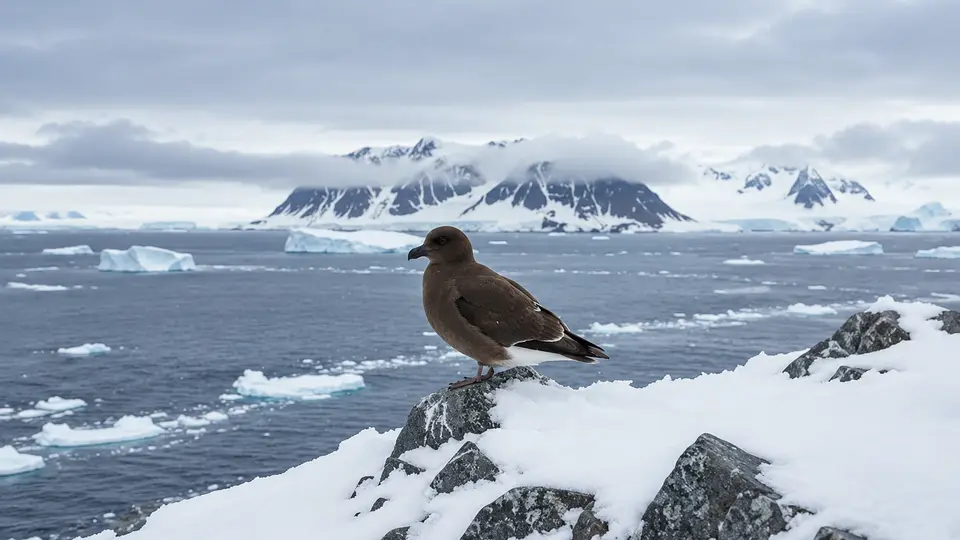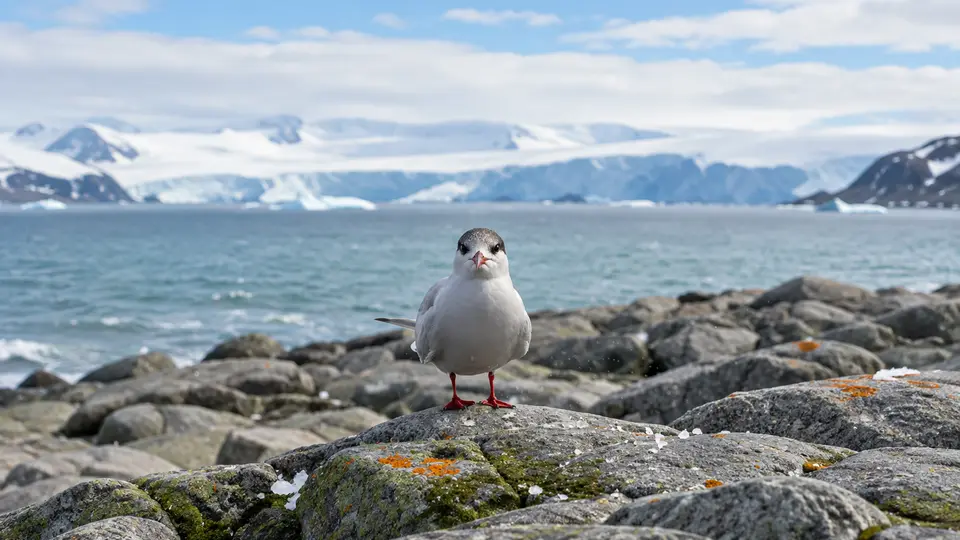
Antarctic Tern in its natural habitat, AI illustration

Antarctic TernSterna vittataWhere and when to see them

Antarctic Tern at a glance

The Antarctic tern is a pale seabird with a black cap, red bill and deeply forked tail, breeding around the Southern Ocean. Its range includes Antarctic and subantarctic islands, with regional populations differing in seasonal movements. It shares some waters with the Arctic tern but does not make that species' regular pole-to-pole migration. Coastal observers may notice its sharp calls and hovering flight before recognizing the finer identification features.

Behaviour & reproduction

Size
31-38 cm body length
Weight
150-180 g
Lifespan
Not reliably established
Status
Least Concern

Pairs nest on the ground in small colonies or loose groups, using shallow scrapes among stones or sparse vegetation. Adults vigorously defend nesting areas, calling and swooping at intruders. At feeding sites, they hover, dip and plunge for small marine prey. Some populations remain near breeding islands, while others disperse toward southern continental coasts. Breeding schedules vary substantially across the species' broad latitudinal range and should not be generalized globally. Pairs often engage in elaborate courtship displays, including aerial chases and fish-carrying rituals. During the breeding season, they are highly vocal, using a variety of calls for alarm and communication within the colony.

Top wildlife locations

Antarctica wildlife habitat

Antarctica

Ice-free gravel shores and rocky coastal terraces around the Peninsula region provide suitable habitat. Observe from approved routes; small nesting groups can be inconspicuous, and some islands remain inaccessible or protected.
Destinations describe the species' habitat, not guaranteed cruise stops. Some animals require an optional inland excursion or are found in restricted reserves.

Fun facts about the Antarctic Tern

  • Its scientific epithet vittata refers to a banded or striped appearance.
  • Some populations stay near their breeding islands year-round.
  • Nests are simple ground scrapes rather than built platforms.
  • Adults can recognize and vigorously challenge potential nest predators.

Best time to see the Antarctic Tern

For Antarctic coastal travel, November through March is the practical observation period. Breeding activity in southern colonies largely falls within austral summer, but timing differs among islands. Visiting Arctic terns may also be present, so season alone is not a reliable identification tool. The austral summer is the primary breeding season, with egg-laying usually occurring from November to December and chicks fledging by February. While observing from deck, look for birds following the ship, especially during their migratory periods.

Antarctic Tern: season matrix by destination

Travel and observation windows vary by region. Highlighted months are an orientation for planning, not confirmed sightings or a guarantee of access.

Antarctica

The window reflects accessible austral-summer conditions; local breeding dates differ, and visiting Arctic terns complicate identification.

JanFebMarAprMayJunJulAugSepOctNovDec
Cruise ships in Antarctica

Where the Antarctic Tern lives

Nesting habitat includes gravel beaches, rocky coastal terraces and sparsely vegetated ground on Southern Ocean islands and parts of the Antarctic Peninsula region. Birds feed in nearby coastal waters, sheltered bays and tidal channels, and may roost on rocks or beaches outside breeding. They are often seen in areas with pack ice or drifting ice floes during the non-breeding season. Their distribution can extend to the subantarctic islands and as far north as South Africa and Australia during migration.

What the Antarctic Tern eats

Small fish and crustaceans, including Antarctic krill in southern waters, form the main diet. Birds detect prey from the air and take it close to the surface. Local prey availability influences whether they feed singly, in loose groups or around concentrated food patches. In addition to fish and crustaceans, they also consume marine worms and squid. Foraging behavior often involves shallow dives from a hovering position, typically no deeper than one meter.

Species at a glance

Common name
Antarctic Tern
Scientific name
Sterna vittata
Animal group
Birds
Size
31-38 cm body length
Weight
150-180 g
Lifespan
Not reliably established
Status
Least Concern
Identification
Compared with nonbreeding Arctic terns in Antarctic waters, breeding Antarctic terns usually show a full black cap, red bill and grayer underparts, though immature birds require care. The adult's red bill often has a dark tip, which can be a useful distinguishing feature. Compared to Arctic terns, Antarctic terns typically have shorter legs and a slightly more robust body.

Antarctic Tern: frequently asked questions

Where can I see the Antarctic Tern?
Antarctica. Remain outside nesting gravel and retreat if birds repeatedly alarm-call or swoop. Eggs and chicks are easily overlooked among stones; observe feeding birds from established coastal routes instead of crossing apparent open ground. When observing from the ship, watch for their characteristic buoyant flight and hovering over water. Their striking black cap and long forked tail are often visible at a distance.
When is the best time to see the Antarctic Tern?
For Antarctic coastal travel, November through March is the practical observation period. Breeding activity in southern colonies largely falls within austral summer, but timing differs among islands. Visiting Arctic terns may also be present, so season alone is not a reliable identification tool. The austral summer is the primary breeding season, with egg-laying usually occurring from November to December and chicks fledging by February. While observing from deck, look for birds following the ship, especially during their migratory periods.
How big does the Antarctic Tern get?
31-38 cm body length. Adult weight: 150-180 g. Size varies with age, sex and population.
How should I behave around the Antarctic Tern?
Remain outside nesting gravel and retreat if birds repeatedly alarm-call or swoop. Eggs and chicks are easily overlooked among stones; observe feeding birds from established coastal routes instead of crossing apparent open ground. When observing from the ship, watch for their characteristic buoyant flight and hovering over water. Their striking black cap and long forked tail are often visible at a distance.
What does the Antarctic Tern eat?
Small fish and crustaceans, including Antarctic krill in southern waters, form the main diet. Birds detect prey from the air and take it close to the surface. Local prey availability influences whether they feed singly, in loose groups or around concentrated food patches. In addition to fish and crustaceans, they also consume marine worms and squid. Foraging behavior often involves shallow dives from a hovering position, typically no deeper than one meter.
Are wildlife sightings guaranteed on an adventure cruise?
No. Animals move freely and routes, weather, access restrictions and local conditions influence every outing. Confirm the actual itinerary and shore program before booking.

Compare wildlife in the same destinations

Explore other birds recorded in these destinations. Similar surroundings do not mean the animals share the same habits or viewing season.

Species comparison by animal group and destination
Antarctic TernAntarctic TernAdélie PenguinAdélie PenguinAntarctic PetrelAntarctic Petrel
Animal groupBirdsAnimal groupBirdsAnimal groupBirds
DestinationsAntarcticaDestinationsAntarcticaDestinationsAntarctica
All wildlife destinations
Plan your trip

Find your next wildlife adventure

Compare destinations, shore programs and dates with the animals and habitats you would love to see.

  • Naturalist-led shore excursions
  • Responsible wildlife watching
  • Small expedition ships

Newsletter

Take Blue Rides with you

Adventure cruise offers, last-minute deals and trip inspiration.

Free, unsubscribe anytime. Details: Privacy Policy

Partner with Blue Rides

Affiliate Program

Recommend adventure cruises and earn commission on every confirmed booking.

Share. Track. Earn.

Your footage, our stage

Send us your videos or pictures.

Captured remarkable nature or wildlife on your journey? Share it with us, we may feature it on Blue Rides.