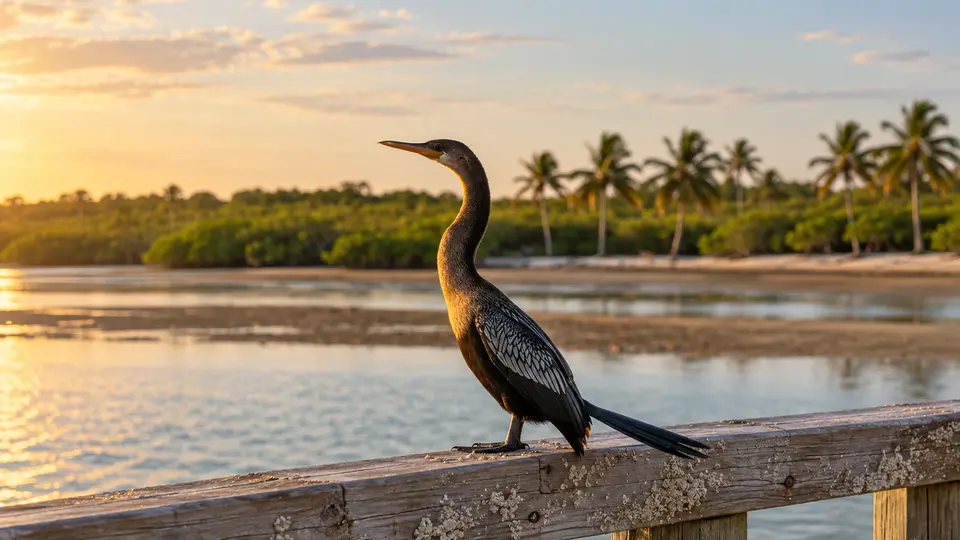
Anhinga in its natural habitat, AI illustration

Anhinga: where and when to see them

Anhinga anhinga

Anhinga at a glance

The anhinga is a long-necked waterbird of warm American wetlands, particularly familiar around Florida’s freshwater marshes and ponds. Its slender, pointed bill is used to spear fish, while its long tail and patterned wings give perched birds a distinctive silhouette. Often called the snakebird, it may swim with little more than its head and neck showing. Although dependent on aquatic prey, it is readily observed from dry land when resting, nesting or spreading its wings.

Behaviour & reproduction

Size
75-95 cm long
Weight
1.0-1.4 kg
Lifespan
Not reliably established
Status
Least Concern

Anhingas frequently perch on exposed branches with their wings spread, helping dry the plumage and regulate heat. Their feathers resist water less effectively than those of many other waterbirds, aiding low buoyancy during pursuit of fish. After securing prey, a bird manipulates it into position for swallowing headfirst. Breeding birds nest in trees or shrubs near water, sometimes alongside other colonial waterbirds. They also soar on rising warm air, holding the long tail conspicuously spread. Anhingas frequently perch on exposed branches with their wings spread, helping dry the plumage and regulate heat. Their feathers resist water less effectively than those of many other waterbirds, aiding low buoyancy during pursuit of fish. After securing prey, a bird manipulates it into position for swallowing headfirst. Breeding birds nest in trees or shrubs near water, sometimes alongside other colonial waterbirds. They also soar on rising warm air, holding the long tail conspicuously spread. When disturbed at a nest, anhingas may stretch their neck and bill towards the intruder, sometimes regurgitating food or striking with their bill as a defense mechanism.

Top wildlife locations

Florida wildlife habitat

Florida

Freshwater marsh boardwalks, wooded pond margins and managed wetland overlooks offer views of perched or nesting anhingas. An inland excursion may be needed from the coast, and water levels influence which sites are productive.

Adventure cruises in Florida
Destinations describe the species' habitat, not guaranteed cruise stops. Some animals require an optional inland excursion or are found in restricted reserves.

Fun facts about the Anhinga

  • Snakebird refers to its habit of swimming with mainly the neck visible.
  • Females have a tan head and neck, unlike the darker adult male.
  • Its scientific name derives from an Indigenous Brazilian name for the bird.
  • It can soar high above wetlands using rising warm air.

Best time to see the Anhinga

Anhingas are present in Florida throughout the year. November through April generally offers comfortable wetland walks, and breeding displays may become visible at established colonies during late winter and spring. Local water depth, fish availability and nesting schedules affect observation opportunities. Anhingas are present in Florida throughout the year. November through April generally offers comfortable wetland walks, and breeding displays may become visible at established colonies during late winter and spring. Local water depth, fish availability and nesting schedules affect observation opportunities. Their breeding season typically peaks from March to May in Florida, when elaborate courtship displays and nesting activity are most observable. During cooler months, anhingas may be more conspicuous as they seek sunny perches to warm up after foraging dives.

Anhinga: season matrix by destination

Travel and observation windows vary by region. Highlighted months are an orientation for planning, not confirmed sightings or a guarantee of access.

Florida

These months favour comfortable shore-based wetland visits; anhingas are resident year-round, and local breeding activity varies among colonies.

JanFebMarAprMayJunJulAugSepOctNovDec
Cruise ships in Florida

Where the Anhinga lives

Sheltered freshwater wetlands with fish, nearby perches and nesting vegetation are ideal. Anhingas use marshes, swamps, ponds, slow rivers and canals, sometimes entering brackish areas. Open branches over water and wooded wetland margins are especially useful features for shore-based observation. Sheltered freshwater wetlands with fish, nearby perches and nesting vegetation are ideal. Anhingas use marshes, swamps, ponds, slow rivers and canals, sometimes entering brackish areas. Open branches over water and wooded wetland margins are especially useful features for shore-based observation. While primarily found in freshwater, they may occasionally forage in coastal estuaries or mangrove channels, especially during high tides. Their presence indicates a healthy aquatic ecosystem capable of supporting a diverse fish population.

What the Anhinga eats

Fish make up most of the diet, with occasional crustaceans and other aquatic animals. The sharp bill pins or spears prey rather than gripping it with a hooked tip. Captured fish must then be repositioned so they can be swallowed headfirst. Fish make up most of the diet, with occasional crustaceans and other aquatic animals. The sharp bill pins or spears prey rather than gripping it with a hooked tip. Captured fish must then be repositioned so they can be swallowed headfirst. Anhingas are pursuit divers, using their slender bodies and webbed feet to actively chase and capture prey underwater. They primarily target small to medium-sized, slow-moving fish species that are easy to spear.

Species at a glance

Common name
Anhinga
Scientific name
Anhinga anhinga
Animal group
Birds
Size
75-95 cm long
Weight
1.0-1.4 kg
Lifespan
Not reliably established
Status
Least Concern
Identification
Its straight dagger-like bill and long fan-shaped tail distinguish it from cormorants, which have a hooked bill tip and usually a shorter-looking neck. Its straight dagger-like bill and long fan-shaped tail distinguish it from cormorants, which have a hooked bill tip and usually a shorter-looking neck. Adult males are largely glossy black with silvery streaks on the upper back and wings, while females and immatures have a brownish head, neck, and chest. The distinct S-shaped curve of its long neck in flight, combined with its long tail, also helps differentiate it from other waterbirds.

Anhinga: frequently asked questions

Where can I see the Anhinga?
Florida. Use wetland boardwalks to watch perched birds without crowding them or approaching nest trees. Keep clear of banks where alligators may be concealed, and never offer fish or attempt to free a hooked bird without trained help. Use wetland boardwalks to watch perched birds without crowding them or approaching nest trees. Keep clear of banks where alligators may be concealed, and never offer fish or attempt to free a hooked bird without trained help. From a boat, maintain a respectful distance to avoid disturbing foraging or nesting individuals. Binoculars are essential for observing details of their plumage and unique feeding behaviors from a safe distance.
When is the best time to see the Anhinga?
Anhingas are present in Florida throughout the year. November through April generally offers comfortable wetland walks, and breeding displays may become visible at established colonies during late winter and spring. Local water depth, fish availability and nesting schedules affect observation opportunities. Anhingas are present in Florida throughout the year. November through April generally offers comfortable wetland walks, and breeding displays may become visible at established colonies during late winter and spring. Local water depth, fish availability and nesting schedules affect observation opportunities. Their breeding season typically peaks from March to May in Florida, when elaborate courtship displays and nesting activity are most observable. During cooler months, anhingas may be more conspicuous as they seek sunny perches to warm up after foraging dives.
How big does the Anhinga get?
75-95 cm long. Adult weight: 1.0-1.4 kg. Size varies with age, sex and population.
How should I behave around the Anhinga?
Use wetland boardwalks to watch perched birds without crowding them or approaching nest trees. Keep clear of banks where alligators may be concealed, and never offer fish or attempt to free a hooked bird without trained help. Use wetland boardwalks to watch perched birds without crowding them or approaching nest trees. Keep clear of banks where alligators may be concealed, and never offer fish or attempt to free a hooked bird without trained help. From a boat, maintain a respectful distance to avoid disturbing foraging or nesting individuals. Binoculars are essential for observing details of their plumage and unique feeding behaviors from a safe distance.
What does the Anhinga eat?
Fish make up most of the diet, with occasional crustaceans and other aquatic animals. The sharp bill pins or spears prey rather than gripping it with a hooked tip. Captured fish must then be repositioned so they can be swallowed headfirst. Fish make up most of the diet, with occasional crustaceans and other aquatic animals. The sharp bill pins or spears prey rather than gripping it with a hooked tip. Captured fish must then be repositioned so they can be swallowed headfirst. Anhingas are pursuit divers, using their slender bodies and webbed feet to actively chase and capture prey underwater. They primarily target small to medium-sized, slow-moving fish species that are easy to spear.
Are wildlife sightings guaranteed on an adventure cruise?
No. Animals move freely and routes, weather, access restrictions and local conditions influence every outing. Confirm the actual itinerary and shore program before booking.

Compare wildlife in the same destinations

Explore other birds recorded in these destinations. Similar surroundings do not mean the animals share the same habits or viewing season.

Species comparison by animal group and destination
AnhingaAnhingaBald EagleBald EagleBrown PelicanBrown Pelican
Animal groupBirdsAnimal groupBirdsAnimal groupBirds
DestinationsFloridaDestinationsAlaska, Florida, New EnglandDestinationsCosta Rica, Florida, Galapagos, Mexico
All wildlife destinations
Plan your trip

Find your next wildlife adventure

Compare destinations, shore programs and dates with the animals and habitats you would love to see.

  • Naturalist-led shore excursions
  • Responsible wildlife watching
  • Small expedition ships

Newsletter

Take Blue Rides with you

Adventure cruise offers, last-minute deals and trip inspiration.

Free, unsubscribe anytime. Details: Privacy Policy

Partner with Blue Rides

Affiliate Program

Recommend adventure cruises and earn commission on every confirmed booking.

Share. Track. Earn.