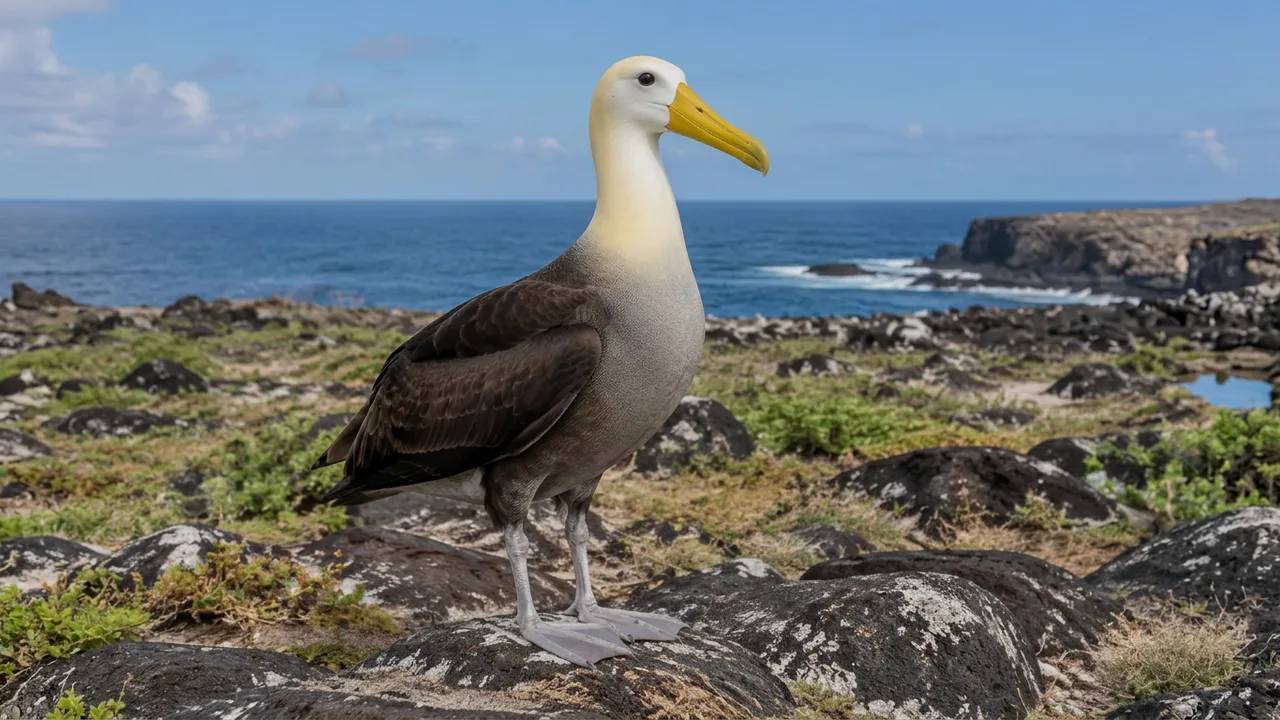
Waved Albatross in its natural habitat, AI illustration

Waved Albatross: where and when to see them

Phoebastria irrorata

Waved Albatross at a glance

The waved albatross is a tropical member of a family more often associated with cold, windy oceans. Almost the entire breeding population nests on Española in the Galápagos, making this single island exceptionally important to its survival. A cream-coloured head, heavy yellow bill and finely patterned body give adults a distinctive appearance. Outside the breeding season, birds disperse over productive eastern Pacific waters, particularly off Ecuador and Peru, where fisheries pose substantial risks.

Behaviour & reproduction

Size
80–90 cm body length; 2.2–2.5 m wingspan
Weight
2.5–4 kg
Lifespan
Not reliably established
Status
Critically Endangered

Pairs perform conspicuous courtship routines that combine bill clacking, skyward pointing, bowing and deliberate foot movements. Birds walk between nest areas and open coastal departure points, sometimes appearing awkward on land despite their accomplished flight. Each pair lays one egg, which may be shifted during incubation rather than remaining in a substantial nest. Adults alternate attendance and feeding trips, while growing chicks eventually gather in loose groups within the colony. Pairs maintain lifelong bonds, returning to the same nesting site year after year. The single egg is incubated by both parents for approximately two months, with shifts lasting several days.

Top wildlife locations

Galapagos wildlife habitat

Galapagos

Authorised visitor trails on Española can overlook open coastal nesting habitat. Access requires permitted, guided visits, and other islands generally offer poor prospects; birds are largely absent from colonies outside the breeding period.
Destinations describe the species' habitat, not guaranteed cruise stops. Some animals require an optional inland excursion or are found in restricted reserves.

Fun facts about the Waved Albatross

  • Almost all breeding takes place on Española.
  • Its courtship includes rapid bill clattering.
  • Pairs sometimes move their single egg considerable distances during incubation.
  • It is the only albatross that breeds entirely within the tropics.

Best time to see the Waved Albatross

April to December broadly overlaps colony attendance on Española, with courtship especially noticeable early in that period and chicks present later. Timing varies among birds and years. January to March generally offers poor prospects for seeing adults ashore because most are away at sea. The arrival of adults in March for courtship and egg-laying marks the beginning of the breeding season. Peak chick activity and fledging occur in December and January, after which adults disperse.

Waved Albatross: season matrix by destination

Travel and observation windows vary by region. Highlighted months are an orientation for planning, not confirmed sightings or a guarantee of access.

Galapagos

These months broadly match colony attendance, but individual timing, park access and itinerary conditions vary.

JanFebMarAprMayJunJulAugSepOctNovDec
Cruise ships in Galapagos

Where the Waved Albatross lives

Breeding habitat consists of open, dry ground with sparse vegetation on Española, including areas close to coastal cliffs. At sea, the species uses productive tropical eastern Pacific waters. Suitable colony terrain is limited, and access is confined to authorised visitor routes. Habitat choice emphasizes flat areas for takeoff and landing, often close to cliff edges providing updrafts for launching into flight. Their pelagic foraging range extends across the Humboldt Current into the waters off Ecuador and Peru.

What the Waved Albatross eats

Waved albatrosses eat squid, fish and crustaceans obtained mainly near the sea surface. They forage over productive waters well beyond the nesting island and may scavenge. Fishing bait and discarded catch can attract them into dangerous contact with hooks and lines. Prey is typically consumed on the surface or just below, though shallow dives have been documented. They often feed nocturnally, locating prey by sight or smell.

Species at a glance

Common name
Waved Albatross
Scientific name
Phoebastria irrorata
Animal group
Birds
Size
80–90 cm body length; 2.2–2.5 m wingspan
Weight
2.5–4 kg
Lifespan
Not reliably established
Status
Critically Endangered
Identification
The creamy head, massive yellow bill and finely waved brown-and-white body distinguish it from other albatrosses, which are exceptional visitors to the Galápagos. Juveniles are similar to adults but have a grayer head and neck, gradually acquiring the creamy adult plumage. The sheer size of their bill is a key feature, even from a distance.

Waved Albatross: frequently asked questions

Where can I see the Waved Albatross?
Galapagos. Remain on authorised guided trails and give walking birds priority, particularly near departure areas and nests. Never prompt a display or block a bird's path. Follow park distances, even when apparently unconcerned adults stand near visitors. Be aware of their ungainly gait on land, which can make them seem more approachable than they are. Keep an eye out for birds gliding effortlessly along cliff faces, utilizing updrafts for energy-efficient flight.
When is the best time to see the Waved Albatross?
April to December broadly overlaps colony attendance on Española, with courtship especially noticeable early in that period and chicks present later. Timing varies among birds and years. January to March generally offers poor prospects for seeing adults ashore because most are away at sea. The arrival of adults in March for courtship and egg-laying marks the beginning of the breeding season. Peak chick activity and fledging occur in December and January, after which adults disperse.
How big does the Waved Albatross get?
80–90 cm body length; 2.2–2.5 m wingspan. Adult weight: 2.5–4 kg. Size varies with age, sex and population.
How should I behave around the Waved Albatross?
Remain on authorised guided trails and give walking birds priority, particularly near departure areas and nests. Never prompt a display or block a bird's path. Follow park distances, even when apparently unconcerned adults stand near visitors. Be aware of their ungainly gait on land, which can make them seem more approachable than they are. Keep an eye out for birds gliding effortlessly along cliff faces, utilizing updrafts for energy-efficient flight.
What does the Waved Albatross eat?
Waved albatrosses eat squid, fish and crustaceans obtained mainly near the sea surface. They forage over productive waters well beyond the nesting island and may scavenge. Fishing bait and discarded catch can attract them into dangerous contact with hooks and lines. Prey is typically consumed on the surface or just below, though shallow dives have been documented. They often feed nocturnally, locating prey by sight or smell.
Are wildlife sightings guaranteed on an adventure cruise?
No. Animals move freely and routes, weather, access restrictions and local conditions influence every outing. Confirm the actual itinerary and shore program before booking.

Compare wildlife in the same destinations

Explore other birds recorded in these destinations. Similar surroundings do not mean the animals share the same habits or viewing season.

Species comparison by animal group and destination
Waved AlbatrossWaved AlbatrossAmerican FlamingoAmerican FlamingoBarn OwlBarn Owl
Animal groupBirdsAnimal groupBirdsAnimal groupBirds
DestinationsGalapagosDestinationsGalapagos, MexicoDestinationsGalapagos
All wildlife destinations
Plan your trip

Find your next wildlife adventure

Compare destinations, shore programs and dates with the animals and habitats you would love to see.

  • Naturalist-led shore excursions
  • Responsible wildlife watching
  • Small expedition ships

Newsletter

Take Blue Rides with you

Adventure cruise offers, last-minute deals and trip inspiration.

Free, unsubscribe anytime. Details: Privacy Policy

Partner with Blue Rides

Affiliate Program

Recommend adventure cruises and earn commission on every confirmed booking.

Share. Track. Earn.

Your footage, our stage

Send us your videos or pictures.

Captured remarkable nature or wildlife on your journey? Share it with us, we may feature it on Blue Rides.