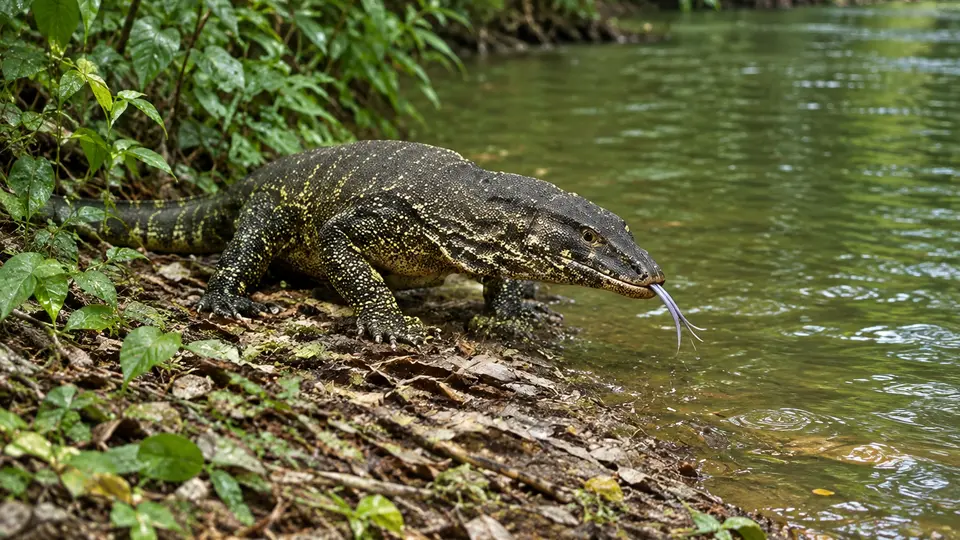
Water monitor in its natural habitatAI-modified

Water monitorVaranus salvatorWhere and when to see them

Water monitor at a glance

The Asian water monitor is a large, adaptable lizard associated with wetlands across much of southern and southeastern Asia. Its muscular tail, strong limbs and forked tongue suit a life spent searching both banks and water margins for food. Some populations tolerate busy towns where canals and vegetated refuges remain available. Despite this adaptability, animals face capture, road mortality and persecution, and unusually large specimens should not be mistaken for typical adults.

Behaviour & reproduction

Size
1–2 m (3.3–6.6 ft) total length
Weight
5–20 kg (11–44 lb)
Lifespan
Not reliably established
Status
Least Concern

Water monitors usually become active as temperatures rise, basking before setting out to forage. They investigate crevices, muddy banks and accumulated debris with repeated tongue flicks, using chemical information to locate food. When threatened, they commonly retreat into water or dense cover, but a cornered animal can bite, scratch and lash its tail. They also climb well, and smaller individuals often use branches as resting places or escape routes. Water monitors are skilled swimmers, using their powerful, laterally compressed tail for propulsion through water. They are also adept climbers, often seeking elevated positions in trees to rest, bask, or avoid predators.

Top wildlife locations

Thailand wildlife habitatAI-modified

Thailand

Mangrove margins, estuarine banks and some urban park lakes provide plausible viewing from public paths. Occurrence is local rather than universal, and an inland wetland excursion may offer better opportunities than exposed beaches.

Vietnam wildlife habitatAI-modified

Vietnam

Southern mangrove creeks and lowland wetland banks offer plausible habitat, but wild water monitors can be elusive where hunted. An inland or estuarine excursion is usually needed rather than a conventional beach visit.

Destinations describe the species' habitat, not guaranteed cruise stops. Some animals require an optional inland excursion or are found in restricted reserves.

Fun facts about the Water monitor

  • Its forked tongue carries chemical samples to a sensory organ in the mouth.
  • The flattened tail supplies much of its swimming propulsion.
  • Young animals generally show brighter pale spotting than large adults.
  • It can exploit urban canals when refuge and food remain available.

Best time to see the Water monitor

Warm conditions permit activity throughout much of the year in Thailand and southern Vietnam. Relatively dry months can make bank-side walking and visibility easier, although local monsoons differ. Morning basking periods are often useful; extreme midday heat can reduce visible activity. In southern Thailand and Vietnam, the dry season (typically November to April) offers clearer waters for potential sightings from boat decks or shorelines. However, their activity patterns are primarily driven by temperature, making them visible on warm, sunny days regardless of the specific month.

Water monitor: season matrix by destination

Travel and observation windows vary by region. Highlighted months are an orientation for planning, not confirmed sightings or a guarantee of access.

Thailand

A broadly practical walking window in much of Thailand; regional rainfall differs and monitors can be active year-round.

JanFebMarAprMayJunJulAugSepOctNovDec
Cruise ships in Thailand

Vietnam

This reflects generally drier access in southern Vietnam, not a national wildlife season or confirmed local occurrence.

JanFebMarAprMayJunJulAugSepOctNovDec
Cruise ships in Vietnam

Where the Water monitor lives

Mangroves, estuaries, riverbanks, marshes and canals provide suitable habitat where shelter and food are available. Water monitors also occupy reservoirs and some urban wetlands. Coastal occurrence depends on local habitat continuity, while heavily developed or persecuted populations may be difficult to observe. Water monitors are semi-aquatic and often found near permanent water sources, even in highly modified landscapes like agricultural areas. Their extensive range extends across South and Southeast Asia, from India and Sri Lanka through the Indochinese peninsula and into Indonesia.

What the Water monitor eats

These opportunistic carnivores eat fish, crabs, frogs, reptiles, birds, eggs and small mammals, as well as carrion. They may investigate human food waste, but feeding them encourages unsafe habituation. Prey choice changes with body size and locally available resources. Juvenile monitors primarily consume insects and smaller invertebrates, gradually shifting to larger prey as they grow. They are known to raid bird nests for eggs and chicks, showcasing their adaptability to different food sources.

Species at a glance

Common name
Water monitor
Scientific name
Varanus salvator
Animal group
Reptiles
Size
1–2 m (3.3–6.6 ft) total length
Weight
5–20 kg (11–44 lb)
Lifespan
Not reliably established
Status
Least Concern
Identification
A long laterally compressed tail, elongated neck and dark body with pale spots distinguish Asian water monitors from the stockier, shorter-tailed terrestrial monitors most likely to cause confusion. Adults can reach impressive lengths, often exceeding two meters, making them one of the world's largest lizard species. Their body coloration can vary geographically, but typically features a dark gray to black base with yellowish spots or ocelli that may fade with age.

Water monitor: frequently asked questions

Where can I see the Water monitor?
Thailand, Vietnam. Watch from paths or raised banks, leaving an unobstructed route to water. Do not feed, corner or approach a basking monitor for photographs. Its bite, claws and powerful tail can cause serious injuries at close range. From a distance, look for their distinctive long neck and head raised above the water as they swim or float. Binoculars are highly recommended for observing these wary reptiles from a safe distance, especially when they are basking on riverbanks.
When is the best time to see the Water monitor?
Warm conditions permit activity throughout much of the year in Thailand and southern Vietnam. Relatively dry months can make bank-side walking and visibility easier, although local monsoons differ. Morning basking periods are often useful; extreme midday heat can reduce visible activity. In southern Thailand and Vietnam, the dry season (typically November to April) offers clearer waters for potential sightings from boat decks or shorelines. However, their activity patterns are primarily driven by temperature, making them visible on warm, sunny days regardless of the specific month.
How big does the Water monitor get?
1–2 m (3.3–6.6 ft) total length. Adult weight: 5–20 kg (11–44 lb). Size varies with age, sex and population.
How should I behave around the Water monitor?
Watch from paths or raised banks, leaving an unobstructed route to water. Do not feed, corner or approach a basking monitor for photographs. Its bite, claws and powerful tail can cause serious injuries at close range. From a distance, look for their distinctive long neck and head raised above the water as they swim or float. Binoculars are highly recommended for observing these wary reptiles from a safe distance, especially when they are basking on riverbanks.
What does the Water monitor eat?
These opportunistic carnivores eat fish, crabs, frogs, reptiles, birds, eggs and small mammals, as well as carrion. They may investigate human food waste, but feeding them encourages unsafe habituation. Prey choice changes with body size and locally available resources. Juvenile monitors primarily consume insects and smaller invertebrates, gradually shifting to larger prey as they grow. They are known to raid bird nests for eggs and chicks, showcasing their adaptability to different food sources.
Are wildlife sightings guaranteed on an adventure cruise?
No. Animals move freely and routes, weather, access restrictions and local conditions influence every outing. Confirm the actual itinerary and shore program before booking.

Compare wildlife in the same destinations

Explore other reptiles recorded in these destinations. Similar surroundings do not mean the animals share the same habits or viewing season.

Species comparison by animal group and destination
Water monitorAI-modifiedWater monitorBanded sea kraitAI-modifiedBanded sea kraitGreen Sea TurtleAI-modifiedGreen Sea Turtle
Animal groupReptilesAnimal groupReptilesAnimal groupReptiles
DestinationsThailand, VietnamDestinationsIndonesia, VietnamDestinationsCosta Rica, Florida, Galapagos, Mexico, Cape Verde, Egypt, Greece, Seychelles, Turkey, Indonesia, Maldives, Thailand, Vietnam, Australia, Fiji, Polynesia
Scientific nameVaranus salvatorScientific nameScientific name
All wildlife destinations
AI-modified
Plan your trip

Find your next wildlife adventure

Compare destinations, shore programs and dates with the animals and habitats you would love to see.

  • Naturalist-led shore excursions
  • Responsible wildlife watching
  • Small expedition ships