Green Sea TurtleChelonia mydasWhere and when to see them
Green Sea Turtle at a glance
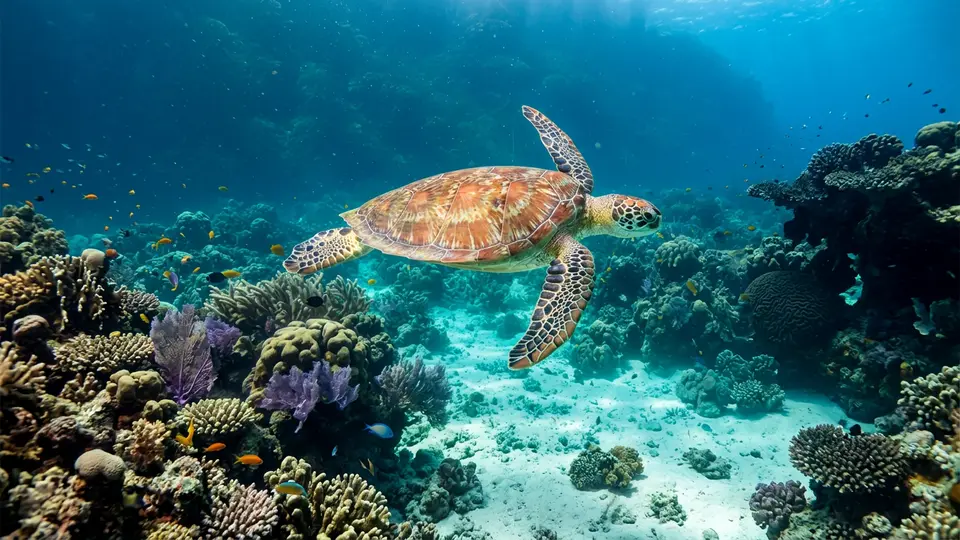
The green sea turtle is a large marine reptile found in tropical and subtropical seas worldwide. Adults often feed in shallow coastal habitats, but females come ashore only to nest, and males generally remain at sea. Its common name refers to the color of body fat rather than the shell. Coastal development, accidental capture, illegal harvest and climate-related changes affect populations differently, so regional nesting trends should not be mistaken for a global assessment.
Behaviour & reproduction
Size
80–120 cm (31.5–47.2 in) shell length
Weight
100–180 kg (220–397 lb)
Lifespan
Not reliably established
Status
Check current assessment
Green turtles travel between feeding grounds and nesting regions, sometimes covering great distances. Females usually nest at night, digging a body pit and egg chamber before covering the clutch and returning to sea. Several clutches may be laid during one breeding season, followed by years without nesting. At sea, turtles surface to breathe and rest between feeding bouts. Some populations also bask ashore, but that behavior is not universal. Green turtles travel between feeding grounds and nesting regions, sometimes covering great distances. Females usually nest at night, digging a body pit and egg chamber before covering the clutch and returning to sea. Several clutches may be laid during one breeding season, followed by years without nesting. At sea, turtles surface to breathe and rest between feeding bouts. Some populations also bask ashore, but that behavior is not universal. Males also migrate to breeding grounds but do not come ashore. They often return to the same nesting beaches where they were born, a behavior known as natal homing.
Top wildlife locations
AI-modified
Costa Rica
Caribbean nesting beaches, especially within the Tortuguero region, offer regulated shore observation. Reaching them usually requires a dedicated excursion, and nighttime access must follow local guiding rules rather than independent beach searching.
Atlantic sandy beaches support nesting, while distant surfacing may be visible from coastal viewpoints. Nesting walks are tightly managed, green turtle encounters are not assured, and closed beach sections must be respected.
Authorized coastal trails and permitted decks can overlook sheltered bays used by turtles. Nesting beaches have strict access rules, and visitors must not leave marked routes or assume every beach permits landing.
Caribbean beaches and selected Pacific coastal bays provide suitable habitat, but populations and access differ greatly. Use authorized beach programs or public viewpoints; nesting areas may be closed, and distant coastal sightings remain uncertain.
Sheltered coastal feeding habitats may hold green turtles, but they are not the archipelago's principal nesting turtle. Distant shore views are uncommon, and loggerhead nesting excursions should not be advertised as green turtle opportunities.
Red Sea bays with seagrass provide feeding habitat, potentially overlooked from permitted shore viewpoints or decks. Surfacing views are uncertain, and important nesting islands may be protected or inaccessible to ordinary visitors.
Destinations describe the species' habitat, not guaranteed cruise stops. Some animals require an optional inland excursion or are found in restricted reserves.
Fun facts about the Green Sea Turtle
The name refers to greenish fat, not a consistently green shell.
Females can lay several separate clutches in a nesting season.
Incubation temperature influences the sex of developing hatchlings.
Some populations bask on land, although most shore appearances involve nesting.
Best time to see the Green Sea Turtle
There is no single season across this wide destination list. Nesting calendars differ between coastlines and populations, while feeding areas may hold turtles year-round. Use locally verified nesting guidance for authorized beach visits; ordinary travel windows below describe practical coastal watching, not guaranteed nesting. There is no single season across this wide destination list. Nesting calendars differ between coastlines and populations, while feeding areas may hold turtles year-round. Use locally verified nesting guidance for authorized beach visits; ordinary travel windows below describe practical coastal watching, not guaranteed nesting. Warmer months generally offer higher chances for nesting activity in many regions. Migration to breeding grounds often precedes the nesting season.
Green Sea Turtle: season matrix by destination
Travel and observation windows vary by region. Highlighted months are an orientation for planning, not confirmed sightings or a guarantee of access.
Costa Rica
This window broadly matches Tortuguero green turtle nesting; other Costa Rican coasts have different patterns.
Adults commonly use coastal bays, lagoons and seagrass habitats, while younger turtles pass through oceanic habitats before settling nearer shore. Nesting requires accessible sandy beaches above ordinary high water. Shore observers may see distant surfacing turtles, but clear water alone does not ensure visibility. Adults commonly use coastal bays, lagoons and seagrass habitats, while younger turtles pass through oceanic habitats before settling nearer shore. Nesting requires accessible sandy beaches above ordinary high water. Shore observers may see distant surfacing turtles, but clear water alone does not ensure visibility. They often prefer foraging grounds sheltered from strong currents. Critical nursery habitats for hatchlings and juveniles can include sargassum rafts in the open ocean.
What the Green Sea Turtle eats
Many adults feed mainly on seagrasses and marine algae, helping shape coastal grazing habitats. Diet varies geographically, and animal material can remain important in some populations. Young turtles are more omnivorous, taking small invertebrates and other available foods during their early marine life. Many adults feed mainly on seagrasses and marine algae, helping shape coastal grazing habitats. Diet varies geographically, and animal material can remain important in some populations. Young turtles are more omnivorous, taking small invertebrates and other available foods during their early marine life. This herbivorous diet distinguishes adults from most other sea turtle species. Their finely serrated jaws are well adapted for cutting plant material.
Species at a glance
Common name
Green Sea Turtle
Scientific name
Chelonia mydas
Animal group
Reptiles
Size
80–120 cm (31.5–47.2 in) shell length
Weight
100–180 kg (220–397 lb)
Lifespan
Not reliably established
Status
Check current assessment
Identification
Compared with hawksbills and loggerheads, it has one pair of prefrontal scales, a relatively small rounded head and a smooth-edged shell without overlapping scutes. Compared with hawksbills and loggerheads, it has one pair of prefrontal scales, a relatively small rounded head and a smooth-edged shell without overlapping scutes. The carapace coloration typically ranges from olive to black, often with mottled patterns. Its four large, non-overlapping scutes on each side of the carapace are a key distinguishing feature.
Green Sea Turtle: frequently asked questions
Where can I see the Green Sea Turtle?
Costa Rica, Florida, Galapagos, Mexico, Cape Verde, Egypt, Greece, Seychelles, Turkey, Indonesia, Maldives, Thailand, Vietnam, Australia, Fiji, Polynesia. Watch surfacing turtles only from shore or a stable deck. On nesting beaches, follow authorized guides, remain behind females and avoid lights, flash and hatchling handling. Never block a turtle's route to the sea. Watch surfacing turtles only from shore or a stable deck. On nesting beaches, follow authorized guides, remain behind females and avoid lights, flash and hatchling handling. Never block a turtle's route to the sea. Maintaining a respectful distance is crucial to avoid disturbing their natural behaviors. From a boat, observe calmly and avoid sudden movements or loud noises.
When is the best time to see the Green Sea Turtle?
There is no single season across this wide destination list. Nesting calendars differ between coastlines and populations, while feeding areas may hold turtles year-round. Use locally verified nesting guidance for authorized beach visits; ordinary travel windows below describe practical coastal watching, not guaranteed nesting. There is no single season across this wide destination list. Nesting calendars differ between coastlines and populations, while feeding areas may hold turtles year-round. Use locally verified nesting guidance for authorized beach visits; ordinary travel windows below describe practical coastal watching, not guaranteed nesting. Warmer months generally offer higher chances for nesting activity in many regions. Migration to breeding grounds often precedes the nesting season.
How big does the Green Sea Turtle get?
80–120 cm (31.5–47.2 in) shell length. Adult weight: 100–180 kg (220–397 lb). Size varies with age, sex and population.
How should I behave around the Green Sea Turtle?
Watch surfacing turtles only from shore or a stable deck. On nesting beaches, follow authorized guides, remain behind females and avoid lights, flash and hatchling handling. Never block a turtle's route to the sea. Watch surfacing turtles only from shore or a stable deck. On nesting beaches, follow authorized guides, remain behind females and avoid lights, flash and hatchling handling. Never block a turtle's route to the sea. Maintaining a respectful distance is crucial to avoid disturbing their natural behaviors. From a boat, observe calmly and avoid sudden movements or loud noises.
What does the Green Sea Turtle eat?
Many adults feed mainly on seagrasses and marine algae, helping shape coastal grazing habitats. Diet varies geographically, and animal material can remain important in some populations. Young turtles are more omnivorous, taking small invertebrates and other available foods during their early marine life. Many adults feed mainly on seagrasses and marine algae, helping shape coastal grazing habitats. Diet varies geographically, and animal material can remain important in some populations. Young turtles are more omnivorous, taking small invertebrates and other available foods during their early marine life. This herbivorous diet distinguishes adults from most other sea turtle species. Their finely serrated jaws are well adapted for cutting plant material.
Are wildlife sightings guaranteed on an adventure cruise?
No. Animals move freely and routes, weather, access restrictions and local conditions influence every outing. Confirm the actual itinerary and shore program before booking.
Compare wildlife in the same destinations
Explore other reptiles recorded in these destinations. Similar surroundings do not mean the animals share the same habits or viewing season.
Species comparison by animal group and destination