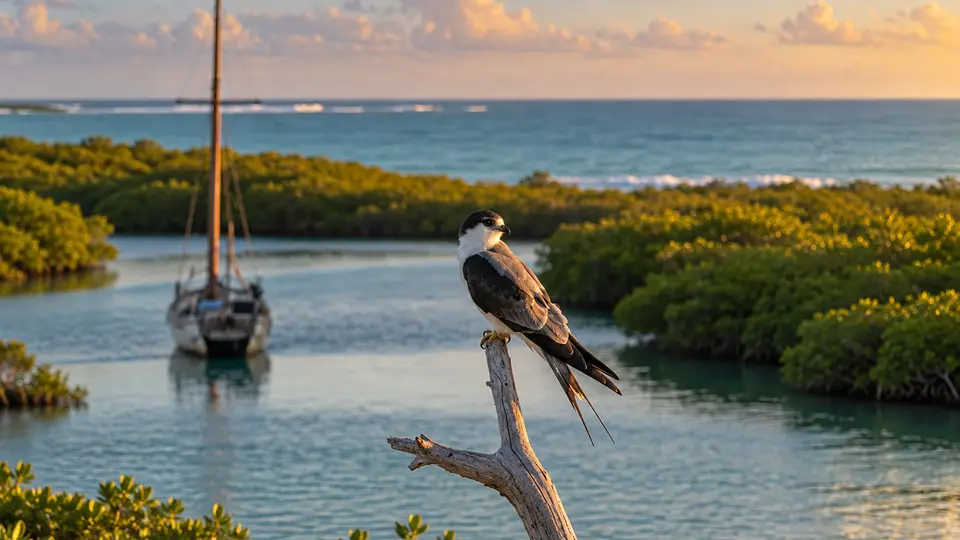
Swallow-tailed Kite in its natural habitat, AI illustration

Swallow-tailed KiteElanoides forficatusWhere and when to see them

Swallow-tailed Kite at a glance

The swallow-tailed kite is an exceptionally graceful raptor, with a white head and body, black wings and a long, deeply forked tail. Florida supports an important part of its United States breeding population. Birds spend much of the day airborne, searching over forests, wetlands and open edges. Despite their conspicuous silhouette, they depend on suitable nesting trees and extensive feeding landscapes, making protection of connected wetland and woodland mosaics important.

Behaviour & reproduction

Size
50–65 cm long; 1.1–1.4 m wingspan
Weight
370–600 g
Lifespan
Not reliably established
Status
Least Concern

These kites steer with frequent twists of the forked tail, often gliding with little visible effort. They take insects in flight and pluck small animals from foliage without landing. Pairs nest high in trees, while nonbreeding birds may gather at communal roosts. Before migration, large feeding and roosting aggregations can form. Florida breeders migrate south toward South America, leaving the state largely without the species during the northern winter months. They are highly graceful flyers, often seen soaring effortlessly on thermals, sometimes in groups. These kites are known for their social foraging, often hunting cooperatively in open fields before settling into communal roosts for the night.

Top wildlife locations

Florida wildlife habitat

Florida

Coastal freshwater wetlands and wooded river margins can provide shore-based skywatching. Inland excursions often offer better habitat than beaches; sightings vary with migration timing, weather and the distribution of feeding birds.
Destinations describe the species' habitat, not guaranteed cruise stops. Some animals require an optional inland excursion or are found in restricted reserves.

Fun facts about the Swallow-tailed Kite

  • The tail acts as a highly maneuverable rudder during flight.
  • Adults frequently eat insect prey without landing.
  • Florida birds undertake long migrations to South America.
  • Premigratory gatherings can include hundreds of individuals.

Best time to see the Swallow-tailed Kite

March through August is the main Florida observation period, spanning arrival, nesting and premigratory gatherings. Some birds arrive earlier or leave later. Late summer concentrations can be impressive, but locations change and sensitive communal roosts should not be approached or publicized. Early migrants can sometimes be seen in late February in southern Florida, indicating the start of their return journey. Peak nesting activity occurs from April to June, followed by the fledging of young by mid-summer.

Swallow-tailed Kite: season matrix by destination

Travel and observation windows vary by region. Highlighted months are an orientation for planning, not confirmed sightings or a guarantee of access.

Florida

This window broadly matches Florida's breeding-season presence and premigratory period, rather than year-round occurrence.

JanFebMarAprMayJunJulAugSepOctNovDec
Cruise ships in Florida

Where the Swallow-tailed Kite lives

In Florida, suitable habitat combines tall nesting trees with wooded wetlands, river corridors, pine stands and nearby feeding openings. Coastal lowlands can support birds where these features coincide. Treeless beaches and densely developed waterfronts are much less useful than adjacent forested landscapes. They show a strong preference for old-growth forests with tall emergent trees, often near water bodies like cypress swamps or floodplains. The presence of open foraging areas adjacent to dense woodlands is also crucial for successful breeding and feeding.

What the Swallow-tailed Kite eats

Large insects are frequent prey, especially when adults feed themselves. Frogs, lizards, small snakes, nestling birds and other small vertebrates are also taken, particularly for growing chicks. Food is often seized from foliage, and insects may be eaten while the kite remains airborne. Aerial insects like dragonflies, cicadas, and grasshoppers are particularly important during their breeding season. They are highly agile hunters, often plucking prey with their talons while performing intricate aerial maneuvers.

Species at a glance

Common name
Swallow-tailed Kite
Scientific name
Elanoides forficatus
Animal group
Birds
Size
50–65 cm long; 1.1–1.4 m wingspan
Weight
370–600 g
Lifespan
Not reliably established
Status
Least Concern
Identification
Its very long forked tail and white head distinguish it from the shorter-tailed, gray-headed Mississippi kite. Their brilliant white underparts contrast sharply with their iridescent black back and wings, making them conspicuous against the sky. The deeply forked tail, a key feature, is longer and more pointed than any other raptor found in Florida.

Swallow-tailed Kite: frequently asked questions

Where can I see the Swallow-tailed Kite?
Florida. Scan above forest edges from public trails or safe pull-offs. Keep away from nest trees and communal roosts, and never stop in traffic or trespass to follow a low-flying bird. While on cruise excursions, scanning open skies above cypress domes or along riverbanks can reveal these elegant raptors. Binoculars are highly recommended to appreciate their distinctive flight and foraging techniques.
When is the best time to see the Swallow-tailed Kite?
March through August is the main Florida observation period, spanning arrival, nesting and premigratory gatherings. Some birds arrive earlier or leave later. Late summer concentrations can be impressive, but locations change and sensitive communal roosts should not be approached or publicized. Early migrants can sometimes be seen in late February in southern Florida, indicating the start of their return journey. Peak nesting activity occurs from April to June, followed by the fledging of young by mid-summer.
How big does the Swallow-tailed Kite get?
50–65 cm long; 1.1–1.4 m wingspan. Adult weight: 370–600 g. Size varies with age, sex and population.
How should I behave around the Swallow-tailed Kite?
Scan above forest edges from public trails or safe pull-offs. Keep away from nest trees and communal roosts, and never stop in traffic or trespass to follow a low-flying bird. While on cruise excursions, scanning open skies above cypress domes or along riverbanks can reveal these elegant raptors. Binoculars are highly recommended to appreciate their distinctive flight and foraging techniques.
What does the Swallow-tailed Kite eat?
Large insects are frequent prey, especially when adults feed themselves. Frogs, lizards, small snakes, nestling birds and other small vertebrates are also taken, particularly for growing chicks. Food is often seized from foliage, and insects may be eaten while the kite remains airborne. Aerial insects like dragonflies, cicadas, and grasshoppers are particularly important during their breeding season. They are highly agile hunters, often plucking prey with their talons while performing intricate aerial maneuvers.
Are wildlife sightings guaranteed on an adventure cruise?
No. Animals move freely and routes, weather, access restrictions and local conditions influence every outing. Confirm the actual itinerary and shore program before booking.

Compare wildlife in the same destinations

Explore other birds recorded in these destinations. Similar surroundings do not mean the animals share the same habits or viewing season.

Species comparison by animal group and destination
Swallow-tailed KiteSwallow-tailed KiteAnhingaAnhingaBald EagleBald Eagle
Animal groupBirdsAnimal groupBirdsAnimal groupBirds
DestinationsFloridaDestinationsFloridaDestinationsAlaska, Florida, New England
All wildlife destinations
Plan your trip

Find your next wildlife adventure

Compare destinations, shore programs and dates with the animals and habitats you would love to see.

  • Naturalist-led shore excursions
  • Responsible wildlife watching
  • Small expedition ships

Newsletter

Take Blue Rides with you

Adventure cruise offers, last-minute deals and trip inspiration.

Free, unsubscribe anytime. Details: Privacy Policy

Partner with Blue Rides

Affiliate Program

Recommend adventure cruises and earn commission on every confirmed booking.

Share. Track. Earn.

Your footage, our stage

Send us your videos or pictures.

Captured remarkable nature or wildlife on your journey? Share it with us, we may feature it on Blue Rides.