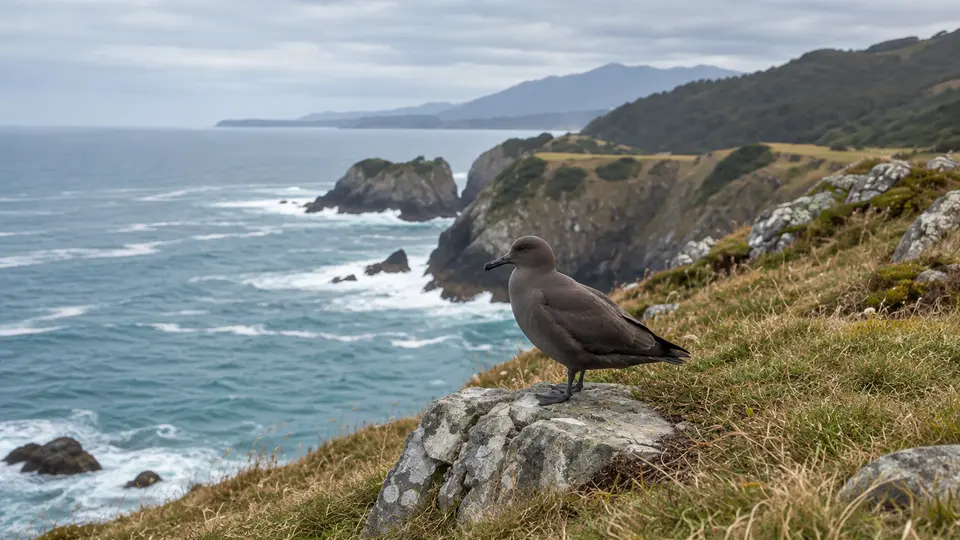
Sooty shearwater in its natural habitat, AI illustration
Size40-51 cm longLifespanNot reliably establishedStatusNear Threatened

Sooty shearwater: where and when to see them

Ardenna grisea

Sooty shearwater at a glance

The sooty shearwater is a dark, long-winged seabird whose annual movements link New Zealand breeding islands with distant North Pacific feeding grounds. Known in New Zealand as tītī, it has deep cultural importance, including customary harvest traditions associated with southern breeding islands. Its apparently effortless passage above waves conceals an energetically demanding life. Birds return to land to breed in burrows, while most feeding and migration take place far beyond the shoreline.

Behaviour & reproduction

Size
40-51 cm long
Weight
650-1,000 g
Lifespan
Not reliably established
Status
Near Threatened

At sea, sooty shearwaters alternate quick wingbeats with low glides, banking to use wind above the waves. Feeding birds may gather in large flocks where prey concentrates. Around breeding colonies they usually come ashore after dark, reducing exposure to predators, and locate burrows using calls and scent cues. Partners share incubation and chick provisioning. Long-distance migration follows broad ocean circuits rather than a simple direct commute between nesting and nonbreeding areas. These shearwaters undertake one of the longest migrations of any animal, circumnavigating the Pacific Ocean annually in a figure-eight pattern. Pairs typically maintain the same burrow year after year, demonstrating strong site fidelity.

Top wildlife locations

New Zealand wildlife habitat

New Zealand

Exposed coastal headlands can provide distant views of passing flocks, especially near southern breeding regions. Many nesting islands are restricted or inaccessible; ordinary shore watching should not depend on entering a colony.

Adventure cruises in New Zealand

Destinations describe the species' habitat, not guaranteed cruise stops. Some animals require an optional inland excursion or are found in restricted reserves.

Fun facts about the Sooty shearwater

  • Tracking studies have documented annual journeys exceeding 60,000 kilometers.
  • The Māori name tītī is widely used for this species.
  • Each breeding attempt normally involves a single egg.
  • Adults can find their own burrows in crowded colonies at night.

Best time to see the Sooty shearwater

October through April broadly overlaps New Zealand's breeding presence and offers opportunities to watch passing birds from suitable headlands. Passage intensity depends on wind, prey and locality. Colony attendance is mainly nocturnal, so the breeding calendar does not guarantee visible birds from shore. Prime viewing from a vessel's deck occurs during their migratory movements, particularly when they pass through nutrient-rich waters. Early morning or late afternoon can offer excellent light for spotting these birds at sea.

Sooty shearwater: season matrix by destination

Travel and observation windows vary by region. Highlighted months are an orientation for planning, not confirmed sightings or a guarantee of access.

New Zealand

This broadly matches breeding-season presence in New Zealand; daylight coastal visibility still depends strongly on locality, wind and feeding movements.

JanFebMarAprMayJunJulAugSepOctNovDec
Cruise ships in New Zealand

Where the Sooty shearwater lives

Breeding habitat consists of burrowable ground on coastal islands and some mainland sites, often beneath grass, scrub or forest. Outside the nesting burrow, the species is marine, ranging from productive continental-shelf waters to the open ocean. Coastal headlands can intercept passing flocks. Though widespread, the species faces habitat loss in some areas due to human development and introduced predators. Some New Zealand colonies are protected, allowing these birds to thrive in specific coastal sanctuaries.

What the Sooty shearwater eats

Small fish, squid and crustaceans are the principal foods, taken at the surface or pursued below it using the wings. Diet changes with region and prey availability. Adults carry energy-rich food back to chicks after feeding trips that may cover substantial distances. They often dive to depths of 10 to 20 meters, though can reach 60-70 meters, using their powerful wings for propulsion. Feeding aggregations can be significant, sometimes involving thousands of birds converging on a food source.

Species at a glance

Common name
Sooty shearwater
Scientific name
Ardenna grisea
Animal group
Birds
Size
40-51 cm long
Weight
650-1,000 g
Lifespan
Not reliably established
Status
Near Threatened
Identification
Compared with short-tailed shearwater, it generally shows a longer bill and more conspicuous silvery underwing panels, though distant birds can be difficult to separate. Note their uniformly dark plumage which can appear browner in some light, contrasting with the paler underwing that is a key ID feature. Pay attention to their flight style, as their stiff-winged glides are characteristic and help distinguish them from other similar-sized seabirds.

Sooty shearwater: frequently asked questions

Where can I see the Sooty shearwater?
New Zealand. Use a telescope from a secure headland or watch distant flocks from a vessel's deck. Stay on marked colony paths because burrows collapse easily, and avoid lights or flash around returning birds. When viewing from a vessel, scan the horizon for large rafts of birds resting on the water, which often indicates a feeding area. Listen for their distinctive 'kek-kek-kek' calls at dusk near breeding sites, as they fly in to their burrows.
When is the best time to see the Sooty shearwater?
October through April broadly overlaps New Zealand's breeding presence and offers opportunities to watch passing birds from suitable headlands. Passage intensity depends on wind, prey and locality. Colony attendance is mainly nocturnal, so the breeding calendar does not guarantee visible birds from shore. Prime viewing from a vessel's deck occurs during their migratory movements, particularly when they pass through nutrient-rich waters. Early morning or late afternoon can offer excellent light for spotting these birds at sea.
How big does the Sooty shearwater get?
40-51 cm long. Adult weight: 650-1,000 g. Size varies with age, sex and population.
How should I behave around the Sooty shearwater?
Use a telescope from a secure headland or watch distant flocks from a vessel's deck. Stay on marked colony paths because burrows collapse easily, and avoid lights or flash around returning birds. When viewing from a vessel, scan the horizon for large rafts of birds resting on the water, which often indicates a feeding area. Listen for their distinctive 'kek-kek-kek' calls at dusk near breeding sites, as they fly in to their burrows.
What does the Sooty shearwater eat?
Small fish, squid and crustaceans are the principal foods, taken at the surface or pursued below it using the wings. Diet changes with region and prey availability. Adults carry energy-rich food back to chicks after feeding trips that may cover substantial distances. They often dive to depths of 10 to 20 meters, though can reach 60-70 meters, using their powerful wings for propulsion. Feeding aggregations can be significant, sometimes involving thousands of birds converging on a food source.
Are wildlife sightings guaranteed on an adventure cruise?
No. Animals move freely and routes, weather, access restrictions and local conditions influence every outing. Confirm the actual itinerary and shore programme before booking.

Compare wildlife in the same destinations

Explore other birds recorded in these destinations. Similar surroundings do not mean the animals share the same habits or viewing season.

Species comparison by animal group and destination
Sooty shearwaterSooty shearwaterAustralasian gannetAustralasian gannetBar-tailed godwitBar-tailed godwit
Animal groupBirdsAnimal groupBirdsAnimal groupBirds
DestinationsNew ZealandDestinationsNew ZealandDestinationsAustralia, New Zealand
All wildlife destinations
Plan your trip

Find your next wildlife adventure

Compare destinations, shore programmes and dates with the animals and habitats you would love to see.

  • Naturalist-led shore excursions
  • Responsible wildlife watching
  • Small expedition ships

Newsletter

Take Blue Rides with you

Adventure cruise offers, last-minute deals and trip inspiration.

Free, unsubscribe anytime. Details: Privacy Policy

Partner with Blue Rides

Affiliate Program

Recommend adventure cruises and earn commission on every confirmed booking.

Share. Track. Earn.