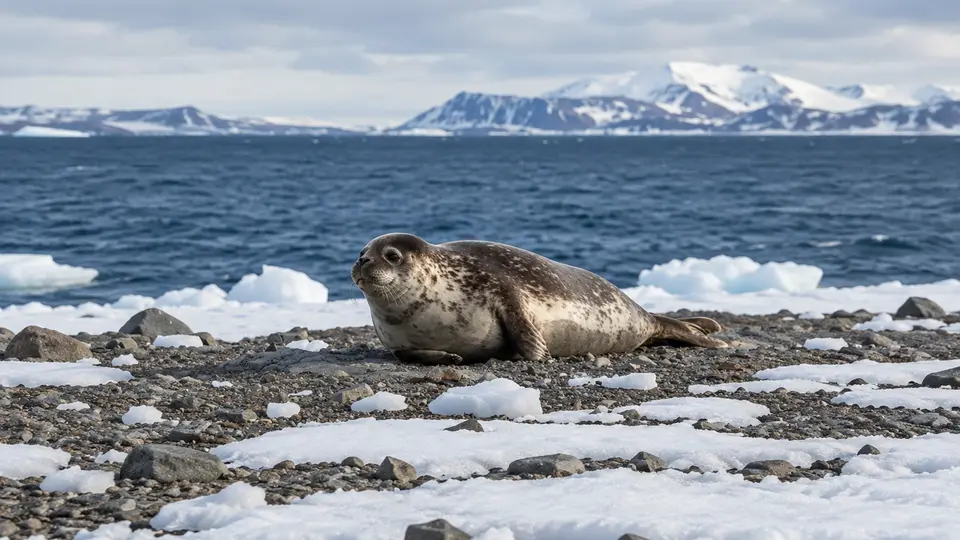
Ribbon Seal in its natural habitat, AI illustration

Ribbon Seal: where and when to see them

Histriophoca fasciata

Ribbon Seal at a glance

The ribbon seal is a North Pacific ice-associated seal whose adults develop striking pale bands around the neck, torso and foreflipper bases. Adult males usually show the strongest contrast, while females are generally paler. Its main range lies in the Bering and Okhotsk seas, extending seasonally into adjacent waters. Although included in Arctic wildlife catalogs, it is not a widespread circumpolar species and is rarely a realistic shore-viewing target.

Behaviour & reproduction

Size
1.5-1.8 m long
Weight
70-100 kg
Lifespan
20-30 years in the wild
Status
Least Concern

Ribbon seals gather on seasonal sea ice for birth, nursing, mating and the annual molt, but they are generally less densely social than some other ice seals. Pups are born with a pale woolly coat and develop swimming independence rapidly after weaning. During the ice-free part of the year, animals spend long periods at sea. On ice, they can move with surprisingly quick, sinuous motions using alternating foreflipper strokes. Ribbon seals are generally solitary outside of breeding and molting periods. While on ice, they can be quite alert and often slip into the water quickly if disturbed.

Top wildlife locations

Arctic wildlife habitat

Arctic

Only the Pacific Arctic margin offers plausible range overlap, mainly around remote seasonal ice. Shore sightings are exceptional; distant deck observation may be possible, but breeding habitat is usually inaccessible.

Adventure cruises in Arctic

Destinations describe the species' habitat, not guaranteed cruise stops. Some animals require an optional inland excursion or are found in restricted reserves.

Fun facts about the Ribbon Seal

  • Adult males generally have darker backgrounds and more contrasting bands than females.
  • The characteristic adult bands are not fully developed in newborn pups.
  • The species has an unusual internal air sac associated with the trachea, whose function remains uncertain.
  • Its range is centered on the North Pacific, not the entire Arctic Ocean.

Best time to see the Ribbon Seal

Spring is the principal season for animals resting on ice during reproduction and molt, but access to this remote habitat is highly constrained. Summer Arctic travel does not automatically overlap visible ribbon seals. No broad, dependable shore-based viewing season can be recommended. Late spring and early summer expeditions in the Bering Sea may offer fleeting chances to spot them on melting ice floes. Their deep-water foraging habits during ice-free months make them particularly difficult to locate reliably.

Ribbon Seal: season matrix by destination

Travel and observation windows vary by region. Highlighted months are an orientation for planning, not confirmed sightings or a guarantee of access.

Arctic

The generic Arctic destination cannot support a credible viewing window: spring ice attendance and practical visitor access rarely align, and most Arctic regions lie outside the range.

JanFebMarAprMayJunJulAugSepOctNovDec
Cruise ships in Arctic

Where the Ribbon Seal lives

The species favors seasonal pack ice over the North Pacific continental shelf and nearby deeper waters. Broken ice near the ice edge is important during spring. Once the ice retreats, seals become more pelagic, making accessible coastal haul-outs an unreliable observation prospect. They are primarily an offshore species, rarely found near land except during severe storms. The Bering and Okhotsk Seas are key parts of their range, with some individuals occasionally seen in the Chukchi Sea.

What the Ribbon Seal eats

Ribbon seals eat fish, squid and crustaceans, with prey varying by age and region. Pollock and other schooling fishes can be important. Young animals tend to consume smaller prey, while adults exploit a broader range of resources across shelf and deeper-water habitats. Their diet shifts seasonally, reflecting the availability of prey in different water columns. Important deep-water prey includes Pacific cod and various cephalopod species.

Species at a glance

Common name
Ribbon Seal
Scientific name
Histriophoca fasciata
Animal group
Marine life
Size
1.5-1.8 m long
Weight
70-100 kg
Lifespan
20-30 years in the wild
Status
Least Concern
Identification
Adults differ from ringed and spotted seals in their broad pale ribbonlike bands rather than numerous small rings or spots, although juveniles lack the full adult pattern. The adult's distinctive dark brown or black body with four broad, white or yellowish ribbons is unmistakable. These ribbons encircle the neck, foreflippers, and posterior body.

Ribbon Seal: frequently asked questions

Where can I see the Ribbon Seal?
Arctic. Restrict viewing to distant deck or shore observations if an animal happens to be visible. Do not approach occupied ice, separate mothers and pups or interpret a resting seal's stillness as permission to move closer. Use binoculars or a spotting scope for any distant sightings, maintaining a respectful distance to avoid disturbance. Note the date, time, and location of any observation, as these sightings are valuable to researchers.
When is the best time to see the Ribbon Seal?
Spring is the principal season for animals resting on ice during reproduction and molt, but access to this remote habitat is highly constrained. Summer Arctic travel does not automatically overlap visible ribbon seals. No broad, dependable shore-based viewing season can be recommended. Late spring and early summer expeditions in the Bering Sea may offer fleeting chances to spot them on melting ice floes. Their deep-water foraging habits during ice-free months make them particularly difficult to locate reliably.
How big does the Ribbon Seal get?
1.5-1.8 m long. Adult weight: 70-100 kg. Size varies with age, sex and population.
How should I behave around the Ribbon Seal?
Restrict viewing to distant deck or shore observations if an animal happens to be visible. Do not approach occupied ice, separate mothers and pups or interpret a resting seal's stillness as permission to move closer. Use binoculars or a spotting scope for any distant sightings, maintaining a respectful distance to avoid disturbance. Note the date, time, and location of any observation, as these sightings are valuable to researchers.
What does the Ribbon Seal eat?
Ribbon seals eat fish, squid and crustaceans, with prey varying by age and region. Pollock and other schooling fishes can be important. Young animals tend to consume smaller prey, while adults exploit a broader range of resources across shelf and deeper-water habitats. Their diet shifts seasonally, reflecting the availability of prey in different water columns. Important deep-water prey includes Pacific cod and various cephalopod species.
Are wildlife sightings guaranteed on an adventure cruise?
No. Animals move freely and routes, weather, access restrictions and local conditions influence every outing. Confirm the actual itinerary and shore programme before booking.

Compare wildlife in the same destinations

Explore other marine life recorded in these destinations. Similar surroundings do not mean the animals share the same habits or viewing season.

Species comparison by animal group and destination
Ribbon SealRibbon SealBeluga WhaleBeluga WhaleFin WhaleFin Whale
Animal groupMarine lifeAnimal groupMarine lifeAnimal groupMarine life
DestinationsArcticDestinationsNorway, ArcticDestinationsMexico, New England, Croatia, Greece, Norway, Portugal, Antarctica, Arctic
All wildlife destinations
Plan your trip

Find your next wildlife adventure

Compare destinations, shore programmes and dates with the animals and habitats you would love to see.

  • Naturalist-led shore excursions
  • Responsible wildlife watching
  • Small expedition ships

Newsletter

Take Blue Rides with you

Adventure cruise offers, last-minute deals and trip inspiration.

Free, unsubscribe anytime. Details: Privacy Policy

Partner with Blue Rides

Affiliate Program

Recommend adventure cruises and earn commission on every confirmed booking.

Share. Track. Earn.