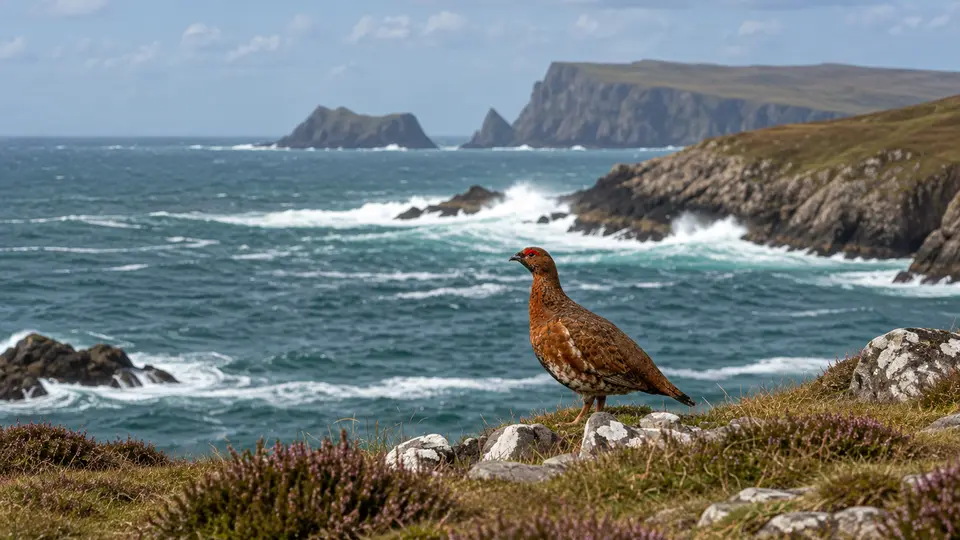
Red Grouse in its natural habitat, AI illustration

Red Grouse: where and when to see them

Lagopus scotica

Red Grouse at a glance

Red grouse are heather-associated gamebirds of Britain and Ireland, especially characteristic of Scottish moorland. Their rounded bodies, feathered legs and rich brown plumage suit a life close to the ground in cool, exposed country. Unlike many northern relatives, they retain dark plumage through winter. Long treated as a subspecies of willow ptarmigan, they are now recognized as a separate species by some major authorities, making older conservation listings and scientific names worth checking carefully.

Behaviour & reproduction

Size
Length 37–42 cm
Weight
550–750 g
Lifespan
Not reliably established
Status
Check current assessment

Males establish territories and advertise with loud, accelerating calls, sometimes delivered during short display flights. Pairs nest on the ground, where the female incubates well-camouflaged eggs in vegetation. Chicks leave the nest soon after hatching and feed themselves under parental supervision. Outside breeding, birds may gather into loose groups. Their first response to danger is often to crouch motionless, followed by a sudden, noisy burst of low flight. Courtship rituals involve the male chasing the female while uttering a distinctive 'go-back, go-back' call. During strong winds, grouse may seek shelter in depressions or behind larger heather clumps, often facing into the wind to minimize heat loss.

Top wildlife locations

Scotland wildlife habitat

Scotland

Heather-covered coastal moors and nearby uplands offer plausible viewing from public paths. Many suitable areas require an inland excursion, and access may be affected by estate operations, nesting birds or severe weather.

Adventure cruises in Scotland

Destinations describe the species' habitat, not guaranteed cruise stops. Some animals require an optional inland excursion or are found in restricted reserves.

Fun facts about the Red Grouse

  • Dense feathers cover the legs and extend onto the feet.
  • Males display bright red combs above their eyes.
  • Chicks are mobile shortly after hatching.
  • Its taxonomic treatment has shifted between species and subspecies.

Best time to see the Red Grouse

Red grouse are resident, so suitable moorland can be productive in any month. Spring brings territorial calling, while late summer may reveal family groups. Autumn and winter access requires attention to weather, estate activities and local restrictions, particularly during the shooting season. Prime viewing opportunities for active birds are typically during early morning or late afternoon when they are most actively feeding and displaying. Winter months can offer good sightings of larger coveys against a snow-dusted landscape, making them stand out more clearly.

Red Grouse: season matrix by destination

Travel and observation windows vary by region. Highlighted months are an orientation for planning, not confirmed sightings or a guarantee of access.

Scotland

A practical daylight and access window for resident birds; spring calling differs from autumn shooting-season considerations.

JanFebMarAprMayJunJulAugSepOctNovDec
Cruise ships in Scotland

Where the Red Grouse lives

Heather moorland is the defining habitat, particularly where a varied vegetation structure provides feeding shoots, nesting cover and shelter. Birds occur from upland slopes to some coastal moors. They are generally absent from closed woodland, intensive farmland and heavily developed coastal ground. While widespread, red grouse are most abundant in areas with a mosaic of young, palatable heather and taller, older stands for shelter. Their distribution is closely linked to suitable heather moorland below 600 meters, which provides optimal conditions for breeding and feeding.

What the Red Grouse eats

Heather shoots, buds and flowers dominate the adult diet, with other moorland plants contributing seasonally. Young chicks take insects and other small invertebrates, which supply protein during rapid growth. Grit swallowed into the gizzard helps grind tough plant material before digestion. In addition to heather, red grouse occasionally supplement their diet with berries like crowberry and blaeberry, especially in late summer and autumn. Chicks also consume a variety of small spiders and beetles, which are crucial for their early development and protein intake.

Species at a glance

Common name
Red Grouse
Scientific name
Lagopus scotica
Animal group
Birds
Size
Length 37–42 cm
Weight
550–750 g
Lifespan
Not reliably established
Status
Check current assessment
Identification
Red grouse remain reddish-brown in winter, unlike rock ptarmigan, and lack the conspicuous white wings shown by willow ptarmigan in flight. The male red grouse is distinguished by its bright red combs above the eyes, which become more prominent during the breeding season. Both sexes have dark brown or black legs and feet, and a short, dark tail that is rarely fanned.

Red Grouse: frequently asked questions

Where can I see the Red Grouse?
Scotland. Use established moorland paths and scan ahead rather than walking through heather to flush birds. Keep dogs closely controlled, especially during nesting, and follow estate notices so observation does not conflict with shooting or land management. When observing, look for signs of their presence such as droppings on paths or characteristic V-shaped browse marks on heather shoots. A good pair of binoculars is essential for spotting their camouflaged forms amongst the heather from a distance.
When is the best time to see the Red Grouse?
Red grouse are resident, so suitable moorland can be productive in any month. Spring brings territorial calling, while late summer may reveal family groups. Autumn and winter access requires attention to weather, estate activities and local restrictions, particularly during the shooting season. Prime viewing opportunities for active birds are typically during early morning or late afternoon when they are most actively feeding and displaying. Winter months can offer good sightings of larger coveys against a snow-dusted landscape, making them stand out more clearly.
How big does the Red Grouse get?
Length 37–42 cm. Adult weight: 550–750 g. Size varies with age, sex and population.
How should I behave around the Red Grouse?
Use established moorland paths and scan ahead rather than walking through heather to flush birds. Keep dogs closely controlled, especially during nesting, and follow estate notices so observation does not conflict with shooting or land management. When observing, look for signs of their presence such as droppings on paths or characteristic V-shaped browse marks on heather shoots. A good pair of binoculars is essential for spotting their camouflaged forms amongst the heather from a distance.
What does the Red Grouse eat?
Heather shoots, buds and flowers dominate the adult diet, with other moorland plants contributing seasonally. Young chicks take insects and other small invertebrates, which supply protein during rapid growth. Grit swallowed into the gizzard helps grind tough plant material before digestion. In addition to heather, red grouse occasionally supplement their diet with berries like crowberry and blaeberry, especially in late summer and autumn. Chicks also consume a variety of small spiders and beetles, which are crucial for their early development and protein intake.
Are wildlife sightings guaranteed on an adventure cruise?
No. Animals move freely and routes, weather, access restrictions and local conditions influence every outing. Confirm the actual itinerary and shore program before booking.

Compare wildlife in the same destinations

Explore other birds recorded in these destinations. Similar surroundings do not mean the animals share the same habits or viewing season.

Species comparison by animal group and destination
Red GrouseRed GrouseAtlantic PuffinAtlantic PuffinBlack GuillemotBlack Guillemot
Animal groupBirdsAnimal groupBirdsAnimal groupBirds
DestinationsScotlandDestinationsNew England, Norway, Scotland, ArcticDestinationsNew England, Norway, Scotland
All wildlife destinations
Plan your trip

Find your next wildlife adventure

Compare destinations, shore programs and dates with the animals and habitats you would love to see.

  • Naturalist-led shore excursions
  • Responsible wildlife watching
  • Small expedition ships

Newsletter

Take Blue Rides with you

Adventure cruise offers, last-minute deals and trip inspiration.

Free, unsubscribe anytime. Details: Privacy Policy

Partner with Blue Rides

Affiliate Program

Recommend adventure cruises and earn commission on every confirmed booking.

Share. Track. Earn.