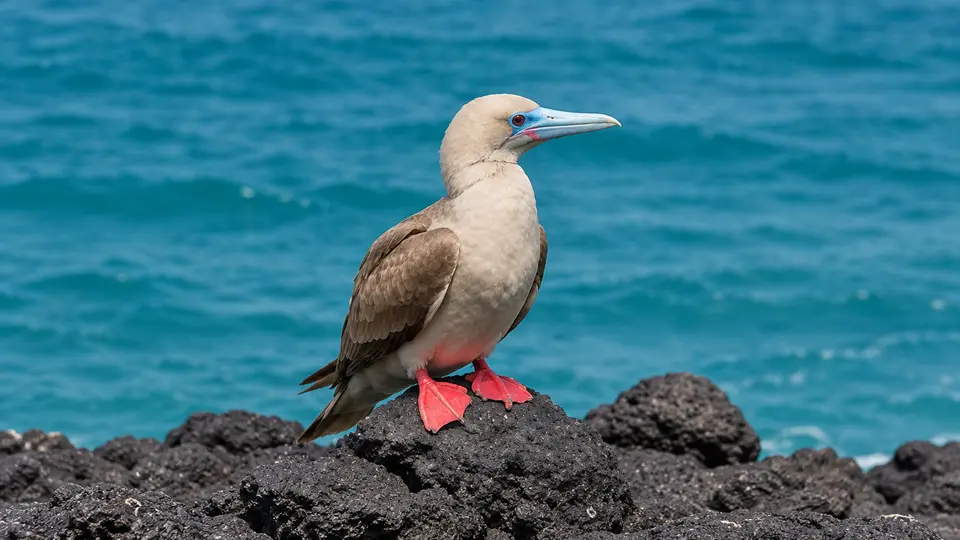
Red-footed Booby in its natural habitat, AI illustration

Red-footed Booby: where and when to see them

Sula sula

Red-footed Booby at a glance

Red-footed boobies are slender tropical seabirds whose vivid feet contrast with blue-toned bills and variable plumage. Adults may be mostly white, mostly brown or intermediate, so colour alone can mislead observers. Unlike many related boobies, they usually build nests in trees or shrubs. Their breeding colonies are scattered across tropical oceans, often on remote islands, while feeding trips carry them far beyond land into waters rarely visible from ordinary shore viewpoints.

Behaviour & reproduction

Size
Length 64–76 cm
Weight
0.85–1.1 kg
Lifespan
Not reliably established
Status
Least Concern

Pairs occupy small nesting spaces in crowded trees and shrubs, using twigs to construct platforms above the ground. Both parents incubate the single egg with their feet and later feed the chick. Birds commute between colonies and offshore feeding areas, often travelling considerable distances. They capture prey with aerial plunges and sometimes take flying fish above the surface. Colony approaches can reveal agile landings on branches despite their fully webbed feet. Courtship displays involve the male presenting nesting material to the female and both birds engaging in bill-clapping. Juveniles often have a dusky brown plumage, gradually acquiring adult coloration over several months.

Top wildlife locations

Galapagos wildlife habitat

Galapagos

Authorized trails beside coastal nesting scrub can provide views where itineraries include suitable colonies. Access is regulated, not every visitor site supports this species, and birds should be watched without leaving marked routes.

Adventure cruises in Galapagos
Mexico wildlife habitat

Mexico

Remote tropical Pacific islands offer the most plausible colony or coastal flight views. Many sites are inaccessible or tightly regulated, and sightings from ordinary mainland shores are uncommon rather than an expected excursion feature.

Adventure cruises in Mexico
Seychelles wildlife habitat

Seychelles

Outer-island coastal woodland and colony flight paths provide plausible shore or deck observation. Important colonies can be remote, protected and unavailable to routine visitors, so access must be checked before planning a visit.

Adventure cruises in Seychelles
Australia wildlife habitat

Australia

Tropical offshore islands and wooded coral cays provide potential coastal views, especially in remote territories. Most mainland shore visits are unsuitable, and colony access may require special logistics or remain prohibited for protection.

Adventure cruises in Australia
Fiji wildlife habitat

Fiji

Offshore wooded islets and exposed coastal flight paths offer possible views, usually away from busy mainland beaches. Colony access may be restricted or impractical, and local guidance is needed to identify realistic shore opportunities.

Adventure cruises in Fiji
Polynesia wildlife habitat

Polynesia

Wooded atolls and remote island colonies offer plausible shoreline or deck views. The region is extensive, many colonies are inaccessible, and ordinary resort beaches should not be assumed to have nearby nesting birds.

Adventure cruises in Polynesia

Destinations describe the species' habitat, not guaranteed cruise stops. Some animals require an optional inland excursion or are found in restricted reserves.

Fun facts about the Red-footed Booby

  • It is the smallest living booby species.
  • Brown and white adults can occur in the same colony.
  • Parents warm their egg using vascularized foot webs.
  • Its webbed feet can grip branches well enough for tree nesting.

Best time to see the Red-footed Booby

There is no single breeding season across this widespread species. Some colonies have prolonged or overlapping nesting cycles, while others show stronger local peaks. Select travel dates using destination weather and current colony information, keeping those practical windows separate from claims about nesting. Breeding success can be highly variable year to year, influenced by oceanographic conditions like El Niño events affecting food availability. Visitors might observe breeding activities year-round in some equatorial destinations, but peak activity can vary regionally.

Red-footed Booby: season matrix by destination

Travel and observation windows vary by region. Highlighted months are an orientation for planning, not confirmed sightings or a guarantee of access.

Galapagos

Travel occurs year-round and some colonies have extended breeding activity; route permissions and local attendance determine opportunities.

JanFebMarAprMayJunJulAugSepOctNovDec
Cruise ships in Galapagos

Mexico

A practical window for parts of Pacific Mexico, not evidence of attendance at any particular colony.

JanFebMarAprMayJunJulAugSepOctNovDec
Cruise ships in Mexico

Seychelles

Intermonsoon months can favour sea travel; nesting schedules vary among islands and are not implied by these dates.

JanFebMarAprMayJunJulAugSepOctNovDec
Cruise ships in Seychelles

Australia

Australia spans widely separated tropical regions with different weather and colony schedules; no defensible single shore-observation window applies.

JanFebMarAprMayJunJulAugSepOctNovDec
Cruise ships in Australia

Fiji

Generally drier travel months, not a confirmed nesting season or assurance of birds at accessible shores.

JanFebMarAprMayJunJulAugSepOctNovDec
Cruise ships in Fiji

Polynesia

Polynesia covers multiple climate zones and colony calendars; an island-specific travel window is needed.

JanFebMarAprMayJunJulAugSepOctNovDec
Cruise ships in Polynesia

Where the Red-footed Booby lives

Breeding islands typically provide coastal woodland, shrubs or mangroves, although occasional nests occur on lower vegetation or other supports. The surrounding feeding habitat is warm tropical ocean. Suitable colonies may be isolated, protected or inaccessible even where the species occurs within a destination. They are often found on remote oceanic islands and cays, avoiding islands with terrestrial predators. Colonies are typically found on the leeward side of islands, providing shelter from strong winds.

What the Red-footed Booby eats

Flying fish, other small fishes and squid dominate the diet. Prey is taken near the sea surface, often where larger marine predators drive schooling animals upward. The species' relatively light build and long wings support extensive searches across nutrient-poor tropical waters. Prey is typically consumed on the wing, with fish often swallowed headfirst. They sometimes forage in association with tuna or dolphins, which herd schools of fish closer to the surface.

Species at a glance

Common name
Red-footed Booby
Scientific name
Sula sula
Animal group
Birds
Size
Length 64–76 cm
Weight
0.85–1.1 kg
Lifespan
Not reliably established
Status
Least Concern
Identification
Adults combine red feet, a pale bluish bill and a slim body, unlike the heavier masked booby or the blue-footed booby with blue feet. The most common morph in the Pacific is white-bodied, but a dark-brown morph is frequent in some regions, particularly the Caribbean. The distinct red feet are present in all morphs, making it a reliable field mark.

Red-footed Booby: frequently asked questions

Where can I see the Red-footed Booby?
Galapagos, Mexico, Seychelles, Australia, Fiji, Polynesia. Watch from approved paths, coastal viewpoints or deck, leaving nesting trees undisturbed. Never stand beneath an occupied branch for close photographs or encourage flight. Keep food secured, and maintain enough distance that adults continue resting or tending chicks. Their nests are often visible from a distance as small platforms of twigs high in trees. When observing a colony, listen for their characteristic grunts and squawks, which contribute to the lively atmosphere.
When is the best time to see the Red-footed Booby?
There is no single breeding season across this widespread species. Some colonies have prolonged or overlapping nesting cycles, while others show stronger local peaks. Select travel dates using destination weather and current colony information, keeping those practical windows separate from claims about nesting. Breeding success can be highly variable year to year, influenced by oceanographic conditions like El Niño events affecting food availability. Visitors might observe breeding activities year-round in some equatorial destinations, but peak activity can vary regionally.
How big does the Red-footed Booby get?
Length 64–76 cm. Adult weight: 0.85–1.1 kg. Size varies with age, sex and population.
How should I behave around the Red-footed Booby?
Watch from approved paths, coastal viewpoints or deck, leaving nesting trees undisturbed. Never stand beneath an occupied branch for close photographs or encourage flight. Keep food secured, and maintain enough distance that adults continue resting or tending chicks. Their nests are often visible from a distance as small platforms of twigs high in trees. When observing a colony, listen for their characteristic grunts and squawks, which contribute to the lively atmosphere.
What does the Red-footed Booby eat?
Flying fish, other small fishes and squid dominate the diet. Prey is taken near the sea surface, often where larger marine predators drive schooling animals upward. The species' relatively light build and long wings support extensive searches across nutrient-poor tropical waters. Prey is typically consumed on the wing, with fish often swallowed headfirst. They sometimes forage in association with tuna or dolphins, which herd schools of fish closer to the surface.
Are wildlife sightings guaranteed on an adventure cruise?
No. Animals move freely and routes, weather, access restrictions and local conditions influence every outing. Confirm the actual itinerary and shore program before booking.

Compare wildlife in the same destinations

Explore other birds recorded in these destinations. Similar surroundings do not mean the animals share the same habits or viewing season.

Species comparison by animal group and destination
Red-footed BoobyRed-footed BoobyAmerican FlamingoAmerican FlamingoAustralian pelicanAustralian pelican
Animal groupBirdsAnimal groupBirdsAnimal groupBirds
DestinationsGalapagos, Mexico, Seychelles, Australia, Fiji, PolynesiaDestinationsGalapagos, MexicoDestinationsAustralia
All wildlife destinations
Plan your trip

Find your next wildlife adventure

Compare destinations, shore programs and dates with the animals and habitats you would love to see.

  • Naturalist-led shore excursions
  • Responsible wildlife watching
  • Small expedition ships

Newsletter

Take Blue Rides with you

Adventure cruise offers, last-minute deals and trip inspiration.

Free, unsubscribe anytime. Details: Privacy Policy

Partner with Blue Rides

Affiliate Program

Recommend adventure cruises and earn commission on every confirmed booking.

Share. Track. Earn.

Your footage, our stage

Send us your videos or pictures.

Captured beautiful landscapes or wildlife? Share your videos and pictures with us, we may feature them on Blue Rides.