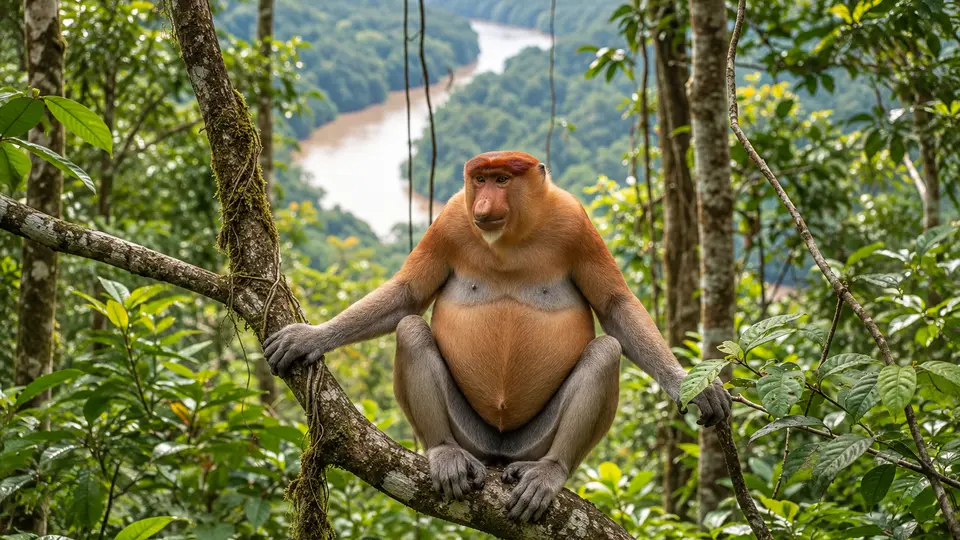
Proboscis monkey in its natural habitat, AI illustration

Proboscis monkeyNasalis larvatusWhere and when to see them

Proboscis monkey at a glance

The proboscis monkey is a Bornean primate closely associated with rivers, mangroves and swamp forests. Adult males have exceptionally enlarged noses, while females and younger animals have smaller, upturned noses. Its reddish-brown back, pale limbs and rounded abdomen give it an unmistakable appearance. The large abdomen houses a specialized digestive system for processing leafy food. Forest clearance, hunting and fragmentation have reduced populations, especially where riverbank forests have been converted or isolated.

Behaviour & reproduction

Size
53–76 cm head-body length
Weight
7–22 kg
Lifespan
Not reliably established
Status
Endangered

Proboscis monkeys usually live in groups containing one adult male and several females with offspring, alongside separate all-male groups. Several groups may gather near evening sleeping trees beside rivers. They spend much of the day feeding, resting and moving through the canopy. Strong swimmers, they sometimes cross channels between feeding areas. Vocal calls, postures and conspicuous male noses contribute to social communication, while riverside sleeping sites influence their daily movements. Male proboscis monkeys often emit a distinctive 'honk' call when disturbed or as a warning to their group. They exhibit strong sexual dimorphism, with males being significantly larger than females and possessing the most prominent noses.

Top wildlife locations

Indonesia wildlife habitat

Indonesia

Indonesian Borneo supports riverine and mangrove populations visible from authorized riverbanks or boat decks. An inland or estuary excursion is generally required; this monkey does not occur naturally across Indonesia's other major islands.
Destinations describe the species' habitat, not guaranteed cruise stops. Some animals require an optional inland excursion or are found in restricted reserves.

Fun facts about the Proboscis monkey

  • The species occurs naturally only on Borneo.
  • Males have much larger noses than females.
  • Its chambered stomach supports microbial fermentation of leaves.
  • Partially webbed feet help this unusually capable primate swimmer.

Best time to see the Proboscis monkey

Proboscis monkeys can be observed throughout the year where suitable riverine forest remains. Relatively drier periods can simplify travel in parts of Indonesian Borneo, but rainfall varies considerably. Early morning and late afternoon usually suit observation better than midday heat. The dry season, typically from May to September in many parts of Indonesian Borneo, can offer slightly more predictable weather for river excursions. However, the monkeys are present year-round and their activity patterns are more influenced by daily cycles than seasonal changes.

Proboscis monkey: season matrix by destination

Travel and observation windows vary by region. Highlighted months are an orientation for planning, not confirmed sightings or a guarantee of access.

Indonesia

These are often practical travel months in parts of Kalimantan, not a breeding or guaranteed sighting season; regional rainfall and access vary.

JanFebMarAprMayJunJulAugSepOctNovDec
Cruise ships in Indonesia

Where the Proboscis monkey lives

This species inhabits lowland Borneo, especially mangrove forests, peat swamps, freshwater swamps and riverine forest. It depends on connected tree cover and is usually associated with waterways, although groups may travel inland through suitable forest while feeding and resting. While predominantly arboreal, they occasionally descend to the ground to forage or cross open areas. Their range is restricted to coastal and riverine regions of Borneo, emphasizing their reliance on specific wetland ecosystems.

What the Proboscis monkey eats

Young leaves form a major part of the diet, accompanied by seeds, flowers and selected fruits, often unripe. Microbes in its chambered stomach help ferment fibrous vegetation. Feeding choices change seasonally as different trees produce fresh growth and reproductive material. Despite their preference for leaves, they selectively consume mature leaves and fruit only when young growth is scarce. Their specialized digestive system allows them to process toxins from certain plant species that other animals cannot eat.

Species at a glance

Common name
Proboscis monkey
Scientific name
Nasalis larvatus
Animal group
Mammals
Size
53–76 cm head-body length
Weight
7–22 kg
Lifespan
Not reliably established
Status
Endangered
Identification
Unlike Borneo's macaques and leaf monkeys, proboscis monkeys combine a conspicuous projecting nose, rounded belly, reddish back and pale grey limbs. The long, pendulous nose is most prominent in adult males, used in social displays and to amplify their calls. Females and juveniles have smaller, upturned noses, making sex and age identification relatively straightforward.

Proboscis monkey: frequently asked questions

Where can I see the Proboscis monkey?
Indonesia. Watch quietly from authorized riverbank viewpoints or boat decks, leaving space around sleeping trees. Never offer food or approach groups on foot, since human food disrupts digestion and close encounters can provoke defensive behaviour. Keep a respectful distance to avoid causing stress or altering natural behaviors. Binoculars are highly recommended for detailed viewing from a distance, especially for observing social interactions high in the canopy.
When is the best time to see the Proboscis monkey?
Proboscis monkeys can be observed throughout the year where suitable riverine forest remains. Relatively drier periods can simplify travel in parts of Indonesian Borneo, but rainfall varies considerably. Early morning and late afternoon usually suit observation better than midday heat. The dry season, typically from May to September in many parts of Indonesian Borneo, can offer slightly more predictable weather for river excursions. However, the monkeys are present year-round and their activity patterns are more influenced by daily cycles than seasonal changes.
How big does the Proboscis monkey get?
53–76 cm head-body length. Adult weight: 7–22 kg. Size varies with age, sex and population.
How should I behave around the Proboscis monkey?
Watch quietly from authorized riverbank viewpoints or boat decks, leaving space around sleeping trees. Never offer food or approach groups on foot, since human food disrupts digestion and close encounters can provoke defensive behaviour. Keep a respectful distance to avoid causing stress or altering natural behaviors. Binoculars are highly recommended for detailed viewing from a distance, especially for observing social interactions high in the canopy.
What does the Proboscis monkey eat?
Young leaves form a major part of the diet, accompanied by seeds, flowers and selected fruits, often unripe. Microbes in its chambered stomach help ferment fibrous vegetation. Feeding choices change seasonally as different trees produce fresh growth and reproductive material. Despite their preference for leaves, they selectively consume mature leaves and fruit only when young growth is scarce. Their specialized digestive system allows them to process toxins from certain plant species that other animals cannot eat.
Are wildlife sightings guaranteed on an adventure cruise?
No. Animals move freely and routes, weather, access restrictions and local conditions influence every outing. Confirm the actual itinerary and shore program before booking.

Compare wildlife in the same destinations

Explore other mammals recorded in these destinations. Similar surroundings do not mean the animals share the same habits or viewing season.

Species comparison by animal group and destination
Proboscis monkeyProboscis monkeyAnoaAnoaBabirusaBabirusa
Animal groupMammalsAnimal groupMammalsAnimal groupMammals
DestinationsIndonesiaDestinationsIndonesiaDestinationsIndonesia
All wildlife destinations
Plan your trip

Find your next wildlife adventure

Compare destinations, shore programs and dates with the animals and habitats you would love to see.

  • Naturalist-led shore excursions
  • Responsible wildlife watching
  • Small expedition ships

Newsletter

Take Blue Rides with you

Adventure cruise offers, last-minute deals and trip inspiration.

Free, unsubscribe anytime. Details: Privacy Policy

Partner with Blue Rides

Affiliate Program

Recommend adventure cruises and earn commission on every confirmed booking.

Share. Track. Earn.

Your footage, our stage

Send us your videos or pictures.

Captured remarkable nature or wildlife on your journey? Share it with us, we may feature it on Blue Rides.