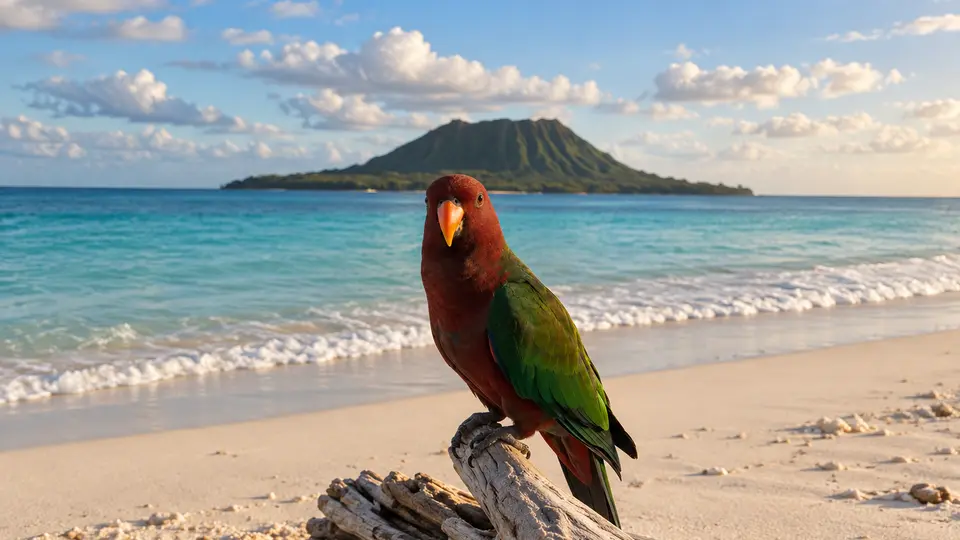
Maroon shining parrot in its natural habitat, AI illustration
Size42–45 cm longLifespanNot reliably establishedStatusLeast Concern

Maroon shining parrot: where and when to see them

Prosopeia tabuensis

Maroon shining parrot at a glance

The maroon shining parrot is a large, long-tailed parrot native to parts of Fiji. Rich maroon plumage contrasts with green wings and blue in the flight feathers and tail. Its island distribution is important: it should not be expected wherever visitors encounter forest in Fiji. Loud calls may reveal birds before their colors become visible, especially when they move between fruiting trees above a dense canopy.

Behaviour & reproduction

Size
42–45 cm long
Weight
Not reliably established
Lifespan
Not reliably established
Status
Least Concern

Birds occur in pairs or small groups, feeding in tree crowns and moving between patches of food. Their strong bills help them manipulate fruits and seeds, while climbing allows access to branch tips that may be awkward to reach in flight. They nest in tree cavities and depend on suitable mature trees. Calls carry through the forest, but a calling bird may remain concealed in foliage. Birds occur in pairs or small groups, feeding in tree crowns and moving between patches of food. Their strong bills help them manipulate fruits and seeds, while climbing allows access to branch tips that may be awkward to reach in flight. They nest in tree cavities and depend on suitable mature trees. Calls carry through the forest, but a calling bird may remain concealed in foliage. Their flight is strong and direct, often accompanied by loud calls. These parrots are quite arboreal, rarely descending to the ground.

Top wildlife locations

Fiji wildlife habitat

Fiji

Coastal forest margins on islands within its range, including Vanua Levu and Taveuni, provide plausible habitat. Inland forest excursions are often more useful; a Viti Levu stay alone is not a suitable expectation.

Adventure cruises in Fiji
Destinations describe the species' habitat, not guaranteed cruise stops. Some animals require an optional inland excursion or are found in restricted reserves.

Fun facts about the Maroon shining parrot

  • Its natural Fijian range includes Vanua Levu and Taveuni, rather than all major islands.
  • The long tail gives flying birds a distinctive silhouette above forest.
  • It uses tree cavities for nesting.
  • Its feet have two toes pointing forward and two backward, aiding climbing and food handling.

Best time to see the Maroon shining parrot

May through October generally offers relatively drier conditions for forest excursions in Fiji. These parrots are resident within their island range, and local fruiting influences encounters. The national travel season should not be treated as a documented peak in breeding or abundance. May through October generally offers relatively drier conditions for forest excursions in Fiji. These parrots are resident within their island range, and local fruiting influences encounters. The national travel season should not be treated as a documented peak in breeding or abundance. While no specific breeding season is universally documented, nesting activity appears to occur year-round, influenced by local food availability. Good viewing is possible throughout the year, with local guides often aware of current feeding sites.

Maroon shining parrot: season matrix by destination

Travel and observation windows vary by region. Highlighted months are an orientation for planning, not confirmed sightings or a guarantee of access.

Fiji

Relatively drier travel window only; island selection, local fruiting and access are more decisive than month.

JanFebMarAprMayJunJulAugSepOctNovDec
Cruise ships in Fiji

Where the Maroon shining parrot lives

It occupies forest, wooded edges and some secondary or cultivated landscapes with substantial tree cover on islands within its range, including Vanua Levu and Taveuni. Coastal forest can be suitable, although many accessible observation areas lie inland or on wooded slopes. It occupies forest, wooded edges and some secondary or cultivated landscapes with substantial tree cover on islands within its range, including Vanua Levu and Taveuni. Coastal forest can be suitable, although many accessible observation areas lie inland or on wooded slopes. This species shows a preference for low to mid-elevation forests, often near human settlements. They are generally absent from open grasslands or extensively cleared agricultural areas without significant tree stands.

What the Maroon shining parrot eats

Fruits, seeds, buds and other plant foods form the diet. Birds may visit cultivated fruit trees as well as native forest trees. Availability changes through the year, so feeding groups can shift between localities rather than remaining around one predictable lookout. Fruits, seeds, buds and other plant foods form the diet. Birds may visit cultivated fruit trees as well as native forest trees. Availability changes through the year, so feeding groups can shift between localities rather than remaining around one predictable lookout. Their diet includes wild figs, mangoes, and various native palm fruits. They play a role in seed dispersal for many native plant species.

Species at a glance

Common name
Maroon shining parrot
Scientific name
Prosopeia tabuensis
Animal group
Birds
Size
42–45 cm long
Weight
Not reliably established
Lifespan
Not reliably established
Status
Least Concern
Identification
Its maroon head and underparts distinguish it from the green, black-faced masked shining parrot of Viti Levu and the brighter red Kadavu shining parrot. Its maroon head and underparts distinguish it from the green, black-faced masked shining parrot of Viti Levu and the brighter red Kadavu shining parrot. The tail is often tipped with orange or yellow, particularly noticeable in flight. It has a robust red bill, and its bright plumage is distinct from other parrot species in its range.

Maroon shining parrot: frequently asked questions

Where can I see the Maroon shining parrot?
Fiji. Listen from authorized forest paths and scan exposed canopy branches. Avoid approaching nest cavities, using repeated playback or offering fruit. Strong bills make handling unsafe, and local landowner permission is important when following birds into village or plantation woodland. Listen from authorized forest paths and scan exposed canopy branches. Avoid approaching nest cavities, using repeated playback or offering fruit. Strong bills make handling unsafe, and local landowner permission is important when following birds into village or plantation woodland. Binoculars are essential for observing these often high-canopy birds. Early morning and late afternoon are generally the most active periods for feeding and vocalization.
When is the best time to see the Maroon shining parrot?
May through October generally offers relatively drier conditions for forest excursions in Fiji. These parrots are resident within their island range, and local fruiting influences encounters. The national travel season should not be treated as a documented peak in breeding or abundance. May through October generally offers relatively drier conditions for forest excursions in Fiji. These parrots are resident within their island range, and local fruiting influences encounters. The national travel season should not be treated as a documented peak in breeding or abundance. While no specific breeding season is universally documented, nesting activity appears to occur year-round, influenced by local food availability. Good viewing is possible throughout the year, with local guides often aware of current feeding sites.
How big does the Maroon shining parrot get?
42–45 cm long. Adult weight: Not reliably established. Size varies with age, sex and population.
How should I behave around the Maroon shining parrot?
Listen from authorized forest paths and scan exposed canopy branches. Avoid approaching nest cavities, using repeated playback or offering fruit. Strong bills make handling unsafe, and local landowner permission is important when following birds into village or plantation woodland. Listen from authorized forest paths and scan exposed canopy branches. Avoid approaching nest cavities, using repeated playback or offering fruit. Strong bills make handling unsafe, and local landowner permission is important when following birds into village or plantation woodland. Binoculars are essential for observing these often high-canopy birds. Early morning and late afternoon are generally the most active periods for feeding and vocalization.
What does the Maroon shining parrot eat?
Fruits, seeds, buds and other plant foods form the diet. Birds may visit cultivated fruit trees as well as native forest trees. Availability changes through the year, so feeding groups can shift between localities rather than remaining around one predictable lookout. Fruits, seeds, buds and other plant foods form the diet. Birds may visit cultivated fruit trees as well as native forest trees. Availability changes through the year, so feeding groups can shift between localities rather than remaining around one predictable lookout. Their diet includes wild figs, mangoes, and various native palm fruits. They play a role in seed dispersal for many native plant species.
Are wildlife sightings guaranteed on an adventure cruise?
No. Animals move freely and routes, weather, access restrictions and local conditions influence every outing. Confirm the actual itinerary and shore programme before booking.

Compare wildlife in the same destinations

Explore other birds recorded in these destinations. Similar surroundings do not mean the animals share the same habits or viewing season.

Species comparison by animal group and destination
Maroon shining parrotMaroon shining parrotBarking imperial pigeonBarking imperial pigeonBrown BoobyBrown Booby
Animal groupBirdsAnimal groupBirdsAnimal groupBirds
DestinationsFijiDestinationsFijiDestinationsCosta Rica, Cape Verde, Egypt, Fiji, Polynesia
All wildlife destinations
Plan your trip

Find your next wildlife adventure

Compare destinations, shore programmes and dates with the animals and habitats you would love to see.

  • Naturalist-led shore excursions
  • Responsible wildlife watching
  • Small expedition ships

Newsletter

Take Blue Rides with you

Adventure cruise offers, last-minute deals and trip inspiration.

Free, unsubscribe anytime. Details: Privacy Policy

Partner with Blue Rides

Affiliate Program

Recommend adventure cruises and earn commission on every confirmed booking.

Share. Track. Earn.