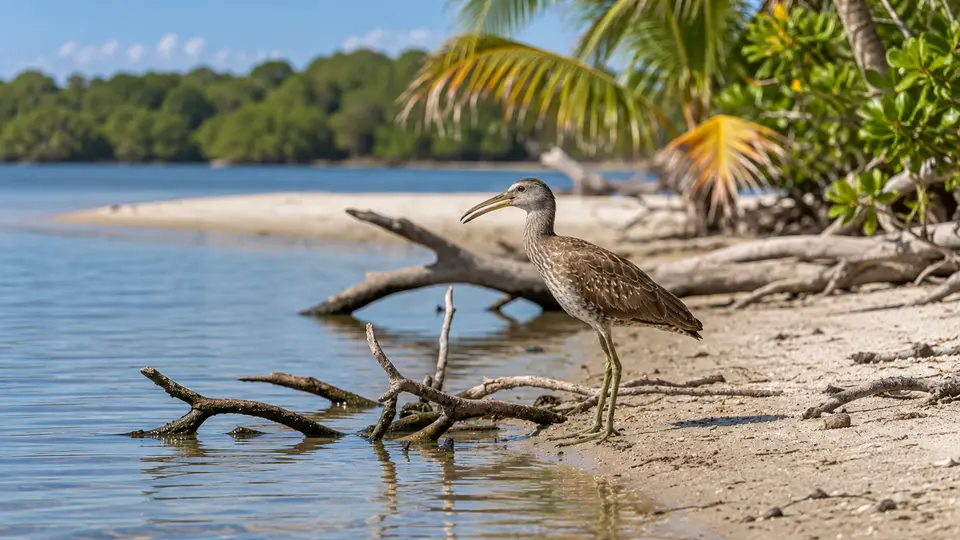
Limpkin in its natural habitat, AI illustration
Size64-73 cm longLifespanNot reliably establishedStatusLeast Concern

Limpkin: where and when to see them

Aramus guarauna

Limpkin at a glance

The limpkin is a long-legged wetland bird of the Americas, mottled brown and white and equipped with a slightly curved bill. It is the only living member of its family, occupying an evolutionary position near cranes and rails. Florida's populations are especially associated with apple snails. Its piercing calls carry far across marshes, often revealing a bird that is otherwise difficult to locate among dense waterside vegetation.

Behaviour & reproduction

Size
64-73 cm long
Weight
0.9-1.3 kg
Lifespan
Not reliably established
Status
Least Concern

Limpkins walk deliberately along shallow margins, probing or watching for snails before extracting them with precise bill movements. Individuals may defend feeding areas, while pairs use loud calls and displays during territorial interactions. Nests are platforms placed in marsh vegetation, shrubs or trees, depending on local conditions. Both parents care for the young, which leave the nest soon after hatching and initially depend on adults for food. They have a characteristic stiff-legged walk, often described as a 'limping' gait, which gave rise to their common name. Both parents contribute to incubating the eggs, typically 4-8, which are laid in a well-concealed nest structure.

Top wildlife locations

Florida wildlife habitat

Florida

Freshwater marsh boardwalks, lake margins and vegetated canals offer bank-side opportunities. Coastal visitors generally need a short inland wetland excursion; birds may be locally conspicuous but move as snail availability and water levels change.

Adventure cruises in Florida
Destinations describe the species' habitat, not guaranteed cruise stops. Some animals require an optional inland excursion or are found in restricted reserves.

Fun facts about the Limpkin

  • It is the sole living species in the family Aramidae.
  • Feeding sites may accumulate piles of emptied snail shells.
  • Its loud, wailing calls are frequently heard after dark.
  • Young birds leave the nest early but initially receive food from their parents.

Best time to see the Limpkin

Limpkins can be watched year-round in suitable Florida wetlands. November to April generally offers comfortable walking conditions and fewer thunderstorms, while local water levels influence feeding access. Nesting can be prolonged and variable, so the visitor season is not a breeding calendar. While resident year-round, increased activity during the late spring and summer months often makes them more conspicuous as they forage to feed young. Early morning and late afternoon are generally the most active periods for observation, regardless of the season.

Limpkin: season matrix by destination

Travel and observation windows vary by region. Highlighted months are an orientation for planning, not confirmed sightings or a guarantee of access.

Florida

These months favour comfortable wetland walks. Limpkins occur year-round in suitable habitat, and local water conditions matter more than a fixed viewing season.

JanFebMarAprMayJunJulAugSepOctNovDec
Cruise ships in Florida

Where the Limpkin lives

Freshwater marshes, lake edges, cypress swamps, canals and slow rivers provide suitable habitat, particularly where large aquatic snails are abundant. In Florida it also uses some suburban ponds. Saltwater beaches and exposed marine shorelines are not its usual setting. They often prefer areas with dense emergent vegetation or trees along the water's edge, offering cover and nesting sites. While primarily freshwater, they can occasionally be found in brackish waters where food sources are available.

What the Limpkin eats

Apple snails are the principal prey in much of its range, especially in Florida. Freshwater mussels and other small animals may supplement them. The bill is adapted for manipulating shells and separating a snail's body from its protective housing. Their specialized bill allows them to extract snails from their shells with a twisting motion, often leaving behind tell-tale piles of empty shells. In areas without abundant apple snails, they will readily consume other gastropods, bivalves, and aquatic insects.

Species at a glance

Common name
Limpkin
Scientific name
Aramus guarauna
Animal group
Birds
Size
64-73 cm long
Weight
0.9-1.3 kg
Lifespan
Not reliably established
Status
Least Concern
Identification
Its brown plumage heavily marked with white, long legs and slightly downcurved bill distinguish it from ibises, herons and the much larger sandhill crane. When flying, their long legs trail behind the body, and their rounded wings have a somewhat flapping, heron-like gait. The overall dull brown body contrasts with the bold white spots and streaks on the head, neck, and back.

Limpkin: frequently asked questions

Where can I see the Limpkin?
Florida. Use marsh boardwalks and pond-side paths, keeping away from feeding birds and accompanying chicks. Never offer snails or other food, and stay alert for alligators along the same freshwater margins used by limpkins. Their distinctive, loud wailing or screaming calls, often heard at dawn and dusk, can help locate them even when hidden by vegetation. Binoculars are highly recommended to observe their detailed feeding behaviors and plumage markings from a respectful distance.
When is the best time to see the Limpkin?
Limpkins can be watched year-round in suitable Florida wetlands. November to April generally offers comfortable walking conditions and fewer thunderstorms, while local water levels influence feeding access. Nesting can be prolonged and variable, so the visitor season is not a breeding calendar. While resident year-round, increased activity during the late spring and summer months often makes them more conspicuous as they forage to feed young. Early morning and late afternoon are generally the most active periods for observation, regardless of the season.
How big does the Limpkin get?
64-73 cm long. Adult weight: 0.9-1.3 kg. Size varies with age, sex and population.
How should I behave around the Limpkin?
Use marsh boardwalks and pond-side paths, keeping away from feeding birds and accompanying chicks. Never offer snails or other food, and stay alert for alligators along the same freshwater margins used by limpkins. Their distinctive, loud wailing or screaming calls, often heard at dawn and dusk, can help locate them even when hidden by vegetation. Binoculars are highly recommended to observe their detailed feeding behaviors and plumage markings from a respectful distance.
What does the Limpkin eat?
Apple snails are the principal prey in much of its range, especially in Florida. Freshwater mussels and other small animals may supplement them. The bill is adapted for manipulating shells and separating a snail's body from its protective housing. Their specialized bill allows them to extract snails from their shells with a twisting motion, often leaving behind tell-tale piles of empty shells. In areas without abundant apple snails, they will readily consume other gastropods, bivalves, and aquatic insects.
Are wildlife sightings guaranteed on an adventure cruise?
No. Animals move freely and routes, weather, access restrictions and local conditions influence every outing. Confirm the actual itinerary and shore programme before booking.

Compare wildlife in the same destinations

Explore other birds recorded in these destinations. Similar surroundings do not mean the animals share the same habits or viewing season.

Species comparison by animal group and destination
LimpkinLimpkinAnhingaAnhingaBald EagleBald Eagle
Animal groupBirdsAnimal groupBirdsAnimal groupBirds
DestinationsFloridaDestinationsFloridaDestinationsAlaska, Florida, New England
All wildlife destinations
Plan your trip

Find your next wildlife adventure

Compare destinations, shore programmes and dates with the animals and habitats you would love to see.

  • Naturalist-led shore excursions
  • Responsible wildlife watching
  • Small expedition ships

Newsletter

Take Blue Rides with you

Adventure cruise offers, last-minute deals and trip inspiration.

Free, unsubscribe anytime. Details: Privacy Policy

Partner with Blue Rides

Affiliate Program

Recommend adventure cruises and earn commission on every confirmed booking.

Share. Track. Earn.