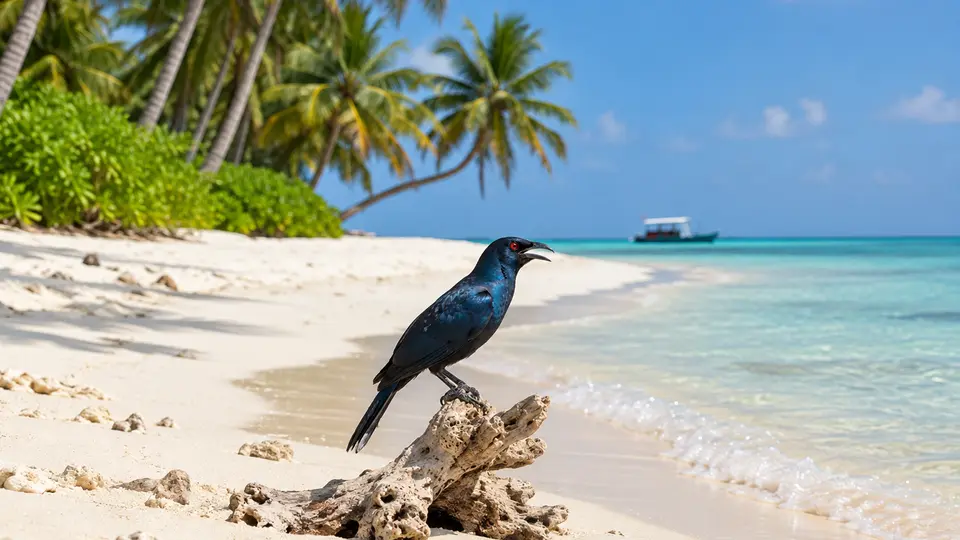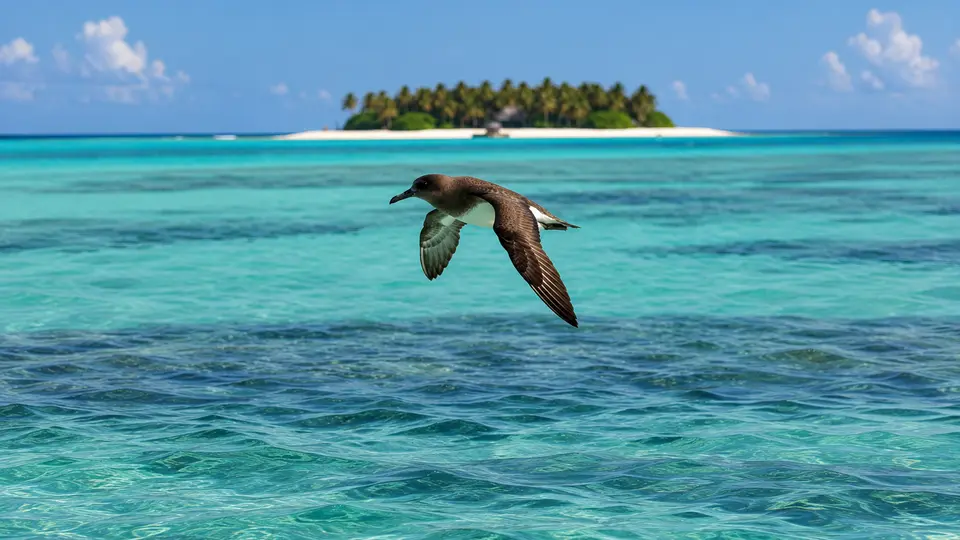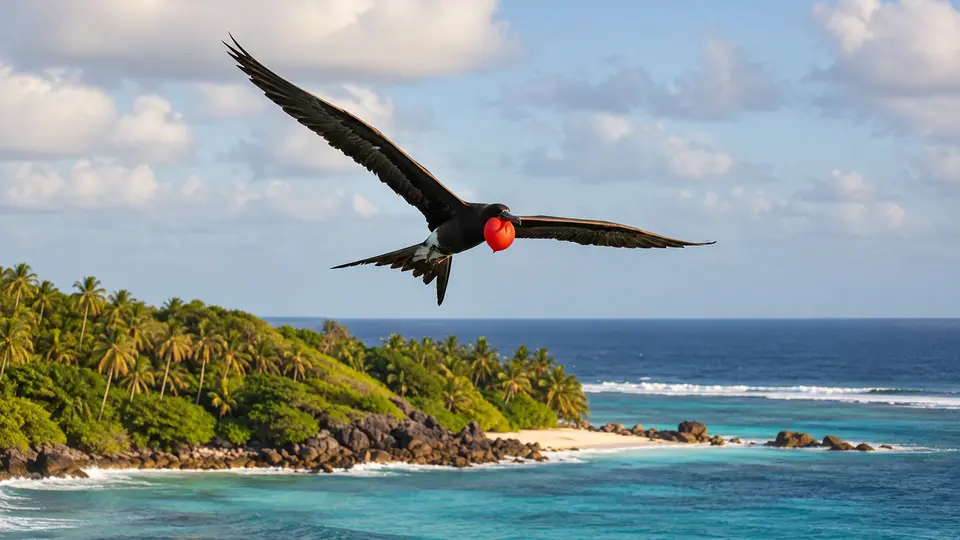
Lesser Frigatebird in its natural habitat, AI illustration
Size66-81 cm long; 1.55-1.93 m wingspanLifespanNot reliably establishedStatusLeast Concern

Lesser Frigatebird: where and when to see them

Fregata ariel

Lesser Frigatebird at a glance

The lesser frigatebird is the smallest frigatebird, yet its exceptionally long wings give it an imposing silhouette over tropical seas. A deeply forked tail and light body suit a life spent soaring rather than resting on the water. Males are mostly black, females have contrasting white underparts, and young birds carry pale heads. Breeding is concentrated on islands, while nonbreeding birds can travel widely through tropical ocean regions.

Behaviour & reproduction

Size
66-81 cm long; 1.55-1.93 m wingspan
Weight
625-955 g
Lifespan
Not reliably established
Status
Least Concern

Lesser frigatebirds ride thermals and coastal air currents, often circling high above islands before gliding out to feed. They seize food at the surface and sometimes chase other seabirds until those birds release a meal. Displaying males inflate a red throat pouch at the nest site. Parental investment is prolonged, and dependent young may continue soliciting food well after they have learned to fly. Courtship displays involve the male inflating his gular sac and calling loudly to attract a female overhead. They are agile fliers, capable of navigating strong winds and high-speed pursuits with remarkable ease.

Top wildlife locations

Seychelles wildlife habitat

Seychelles

Scan skies above outer-island coasts and offshore roosts from shore or deck. Lesser frigatebirds are localized, and important colony areas can be remote or restricted rather than accessible on ordinary island visits.

Adventure cruises in Seychelles
Indonesia wildlife habitat

Indonesia

Coastal headlands, fishing harbours and offshore-island skylines provide plausible viewpoints. Birds can occur widely but unevenly, while nesting and roosting islands may be remote, protected or inaccessible to casual visitors.

Adventure cruises in Indonesia
Maldives wildlife habitat

Maldives

Watch above reef-island shorelines and open channels from beaches or decks. Frigatebirds are irregular visitors in many areas, so sightings are opportunistic and identification should not assume a nearby breeding colony.

Adventure cruises in Maldives
Thailand wildlife habitat

Thailand

Andaman coastal headlands and offshore-island viewpoints offer the most plausible searches, including distant communal roost areas. Distribution is localized, and some roost islands are protected or inaccessible from standard visitor routes.

Adventure cruises in Thailand
Fiji wildlife habitat

Fiji

Scan above coastal villages, headlands and offshore islets, especially where seabirds gather. Occurrence varies among islands, and breeding or roosting sites may require permission or remain inaccessible to ordinary shore visitors.

Adventure cruises in Fiji

Destinations describe the species' habitat, not guaranteed cruise stops. Some animals require an optional inland excursion or are found in restricted reserves.

Fun facts about the Lesser Frigatebird

  • The species name ariel evokes an airy spirit.
  • Breeding males inflate a red gular pouch during display.
  • Its feet are small and poorly suited to walking.
  • White body markings differ substantially between males, females and juveniles.

Best time to see the Lesser Frigatebird

There is no single range-wide viewing season because colonies follow different breeding schedules and nonbreeders wander extensively. Dry-season coastal travel may improve visibility and comfort at some destinations, but local roost use and wind conditions are better guides than national tourism calendars. In the Seychelles, breeding often occurs between May and November, with chicks visible for many months afterward. In parts of Southeast Asia, breeding can be less synchronous, offering opportunities year-round in different locations.

Lesser Frigatebird: season matrix by destination

Travel and observation windows vary by region. Highlighted months are an orientation for planning, not confirmed sightings or a guarantee of access.

Seychelles

Island-specific occurrence and access differ substantially; a single dependable archipelago-wide shore-viewing season is unsupported.

JanFebMarAprMayJunJulAugSepOctNovDec
Cruise ships in Seychelles

Indonesia

Indonesia spans several weather regimes, and local movements and colony schedules prevent a defensible nationwide seasonal window.

JanFebMarAprMayJunJulAugSepOctNovDec
Cruise ships in Indonesia

Maldives

These generally drier travel months can suit coastal sky watching, but they do not indicate a confirmed peak in lesser frigatebird occurrence.

JanFebMarAprMayJunJulAugSepOctNovDec
Cruise ships in Maldives

Thailand

The Andaman dry-season travel window generally improves coastal access; local bird presence and roost activity still require current information.

JanFebMarAprMayJunJulAugSepOctNovDec
Cruise ships in Thailand

Fiji

These generally drier months suit coastal travel and observation, not a demonstrated nationwide breeding or abundance peak.

JanFebMarAprMayJunJulAugSepOctNovDec
Cruise ships in Fiji

Where the Lesser Frigatebird lives

Warm tropical seas and oceanic islands form its core habitat. Breeding and roosting sites commonly include low coastal trees, shrubs or mangroves. Birds range far from colonies, so a coastal sighting does not necessarily indicate nesting on the nearest island. They are highly pelagic, spending most of their lives soaring over open ocean, often thousands of kilometers from land. Breeding populations are found across the tropical Indian and Pacific Oceans.

What the Lesser Frigatebird eats

Flying fish and squid are important prey, along with other small marine animals taken close to the surface. Food stolen from terns, boobies and other seabirds supplements direct capture. Frigatebirds often exploit feeding activity that makes prey briefly accessible above water. They have relatively small, unwebbed feet, which makes them unable to land on water to fish, necessitating aerial foraging. They also frequently snatch food from the surface of the water without landing.

Species at a glance

Common name
Lesser Frigatebird
Scientific name
Fregata ariel
Animal group
Birds
Size
66-81 cm long; 1.55-1.93 m wingspan
Weight
625-955 g
Lifespan
Not reliably established
Status
Least Concern
Identification
Its smaller build and characteristic white flank or underwing-spur markings help separate it from great frigatebirds, although sex and age must be considered. Adult males are entirely black with a noticeable purple-green sheen, while females have a white breast and throat, often extending to the flanks. Juveniles are distinguished by a rufous head and neck, gradually fading to white.

Lesser Frigatebird: frequently asked questions

Where can I see the Lesser Frigatebird?
Seychelles, Indonesia, Maldives, Thailand, Fiji. Scan above headlands and offshore islets from shore or deck. Avoid entering roost trees or breeding vegetation, and use photographs to check identification because distant females and immature frigatebirds can be especially confusing. Their distinct 'M' shaped wing profile and long forked tail are often visible even at a distance. When observing from deck, pay attention to large feeding frenzies of tuna or other predators, as frigatebirds often congregate there.
When is the best time to see the Lesser Frigatebird?
There is no single range-wide viewing season because colonies follow different breeding schedules and nonbreeders wander extensively. Dry-season coastal travel may improve visibility and comfort at some destinations, but local roost use and wind conditions are better guides than national tourism calendars. In the Seychelles, breeding often occurs between May and November, with chicks visible for many months afterward. In parts of Southeast Asia, breeding can be less synchronous, offering opportunities year-round in different locations.
How big does the Lesser Frigatebird get?
66-81 cm long; 1.55-1.93 m wingspan. Adult weight: 625-955 g. Size varies with age, sex and population.
How should I behave around the Lesser Frigatebird?
Scan above headlands and offshore islets from shore or deck. Avoid entering roost trees or breeding vegetation, and use photographs to check identification because distant females and immature frigatebirds can be especially confusing. Their distinct 'M' shaped wing profile and long forked tail are often visible even at a distance. When observing from deck, pay attention to large feeding frenzies of tuna or other predators, as frigatebirds often congregate there.
What does the Lesser Frigatebird eat?
Flying fish and squid are important prey, along with other small marine animals taken close to the surface. Food stolen from terns, boobies and other seabirds supplements direct capture. Frigatebirds often exploit feeding activity that makes prey briefly accessible above water. They have relatively small, unwebbed feet, which makes them unable to land on water to fish, necessitating aerial foraging. They also frequently snatch food from the surface of the water without landing.
Are wildlife sightings guaranteed on an adventure cruise?
No. Animals move freely and routes, weather, access restrictions and local conditions influence every outing. Confirm the actual itinerary and shore programme before booking.

Compare wildlife in the same destinations

Explore other birds recorded in these destinations. Similar surroundings do not mean the animals share the same habits or viewing season.

Species comparison by animal group and destination
Lesser FrigatebirdLesser FrigatebirdAsian koelAsian koelAudubon's shearwaterAudubon's shearwater
Animal groupBirdsAnimal groupBirdsAnimal groupBirds
DestinationsSeychelles, Indonesia, Maldives, Thailand, FijiDestinationsMaldivesDestinationsMaldives
All wildlife destinations
Plan your trip

Find your next wildlife adventure

Compare destinations, shore programmes and dates with the animals and habitats you would love to see.

  • Naturalist-led shore excursions
  • Responsible wildlife watching
  • Small expedition ships

Newsletter

Take Blue Rides with you

Adventure cruise offers, last-minute deals and trip inspiration.

Free, unsubscribe anytime. Details: Privacy Policy

Partner with Blue Rides

Affiliate Program

Recommend adventure cruises and earn commission on every confirmed booking.

Share. Track. Earn.