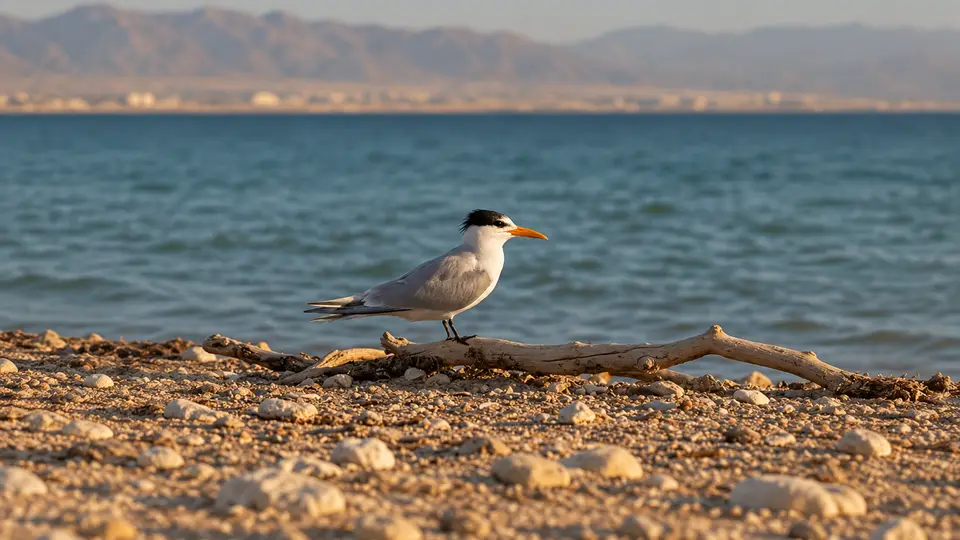
Lesser Crested Tern in its natural habitat

Lesser Crested TernThalasseus bengalensisWhere and when to see them

Lesser Crested Tern at a glance

The lesser crested tern is a streamlined coastal seabird with a bright orange bill, pale grey upperparts and a shaggy black breeding crest. Its distribution includes the Red Sea, Indian Ocean and parts of the Mediterranean. Colonies can contain hundreds or thousands of tightly spaced nests on low islands. These concentrations make the species conspicuous but also vulnerable to disturbance, egg collection and changes to small breeding islands.

Behaviour & reproduction

Size
35-43 cm long
Weight
180-240 g
Lifespan
Not reliably established
Status
Least Concern

Flocks commute between coastal feeding waters and communal roosts, often mixing with other terns. Birds hover briefly before plunging after fish and may follow predatory fish that drive shoals toward the surface. Courtship includes fish presentations, while both parents help care for the chick. Colonies are noisy and highly social, and older chicks may gather into groups before they can fly confidently. Courtship displays often involve spectacular aerial chases and elaborate fish offerings. After fledging, young birds remain dependent on their parents for food for several weeks.

Top wildlife locations

Egypt wildlife habitat

Egypt

Red Sea beaches, lagoon margins and harbour viewpoints offer plausible shore watching. Breeding islands may be protected or inaccessible, so use mainland viewpoints or distant deck views rather than seeking colony access.

Destinations describe the species' habitat, not guaranteed cruise stops. Some animals require an optional inland excursion or are found in restricted reserves.

Fun facts about the Lesser Crested Tern

  • The black crest becomes reduced outside the breeding season.
  • A courtship fish can help reinforce the pair bond.
  • Most pairs lay a single egg in a shallow ground scrape.
  • The species breeds in both the Red Sea region and parts of the Mediterranean.

Best time to see the Lesser Crested Tern

Along Egypt's Red Sea coast, spring and summer can offer opportunities to watch coastal movements and breeding activity from outside colonies. Migration adds variation in other months. Local island access and heat must be considered separately from the birds' seasonal presence. Peak breeding activity in the Egyptian Red Sea occurs from late spring through early summer, when large numbers gather at traditional colony sites. Winter months may see birds dispersing more widely along the coastline.

Lesser Crested Tern: season matrix by destination

Travel and observation windows vary by region. Highlighted months are an orientation for planning, not confirmed sightings or a guarantee of access.

Egypt

This broad coastal observation window overlaps regional breeding and movement periods; timing varies locally, and summer heat can limit comfortable shore visits.

JanFebMarAprMayJunJulAugSepOctNovDec
Cruise ships in Egypt

Where the Lesser Crested Tern lives

Lesser crested terns favour warm coastal seas, lagoons, estuaries and sheltered bays. They rest on sandbars, beaches and low rocky islands, usually nesting on open ground with little vegetation. Offshore breeding colonies may be protected or inaccessible to visitors. They are often found on sparsely vegetated islands in arid and semi-arid regions. These terns are highly colonial, forming dense nesting aggregations in suitable locations.

What the Lesser Crested Tern eats

Small schooling fish dominate the diet, especially species available near the sea surface. Crustaceans are also taken. Adults usually carry individual fish crosswise in the bill when provisioning a mate or chick, making feeding flights useful for distant observation. Lesser crested terns primarily forage in shallow, clear coastal waters. They often hunt cooperatively, concentrating fish shoals before diving.

Species at a glance

Common name
Lesser Crested Tern
Scientific name
Thalasseus bengalensis
Animal group
Birds
Size
35-43 cm long
Weight
180-240 g
Lifespan
Not reliably established
Status
Least Concern
Identification
Its orange bill and medium size separate it from the larger, yellow-billed greater crested tern and the usually black-billed Sandwich tern. Juveniles are distinguished by their mottled grey and white plumage and a darker bill that gradually turns orange. Its black cap extends from the bill to the nape, a key feature in all adult plumages.

Lesser Crested Tern: frequently asked questions

Where can I see the Lesser Crested Tern?
Egypt. Watch from public coastal viewpoints or the deck without approaching nesting islands. Keep clear of beach roosts and retreat if birds rise repeatedly; disturbance can expose eggs and chicks to intense heat. Binoculars or a spotting scope are essential for detailed observation from a distance, especially for distinguishing individuals within mixed flocks. Pay attention to their characteristic deep, sharp dives during foraging.
When is the best time to see the Lesser Crested Tern?
Along Egypt's Red Sea coast, spring and summer can offer opportunities to watch coastal movements and breeding activity from outside colonies. Migration adds variation in other months. Local island access and heat must be considered separately from the birds' seasonal presence. Peak breeding activity in the Egyptian Red Sea occurs from late spring through early summer, when large numbers gather at traditional colony sites. Winter months may see birds dispersing more widely along the coastline.
How big does the Lesser Crested Tern get?
35-43 cm long. Adult weight: 180-240 g. Size varies with age, sex and population.
How should I behave around the Lesser Crested Tern?
Watch from public coastal viewpoints or the deck without approaching nesting islands. Keep clear of beach roosts and retreat if birds rise repeatedly; disturbance can expose eggs and chicks to intense heat. Binoculars or a spotting scope are essential for detailed observation from a distance, especially for distinguishing individuals within mixed flocks. Pay attention to their characteristic deep, sharp dives during foraging.
What does the Lesser Crested Tern eat?
Small schooling fish dominate the diet, especially species available near the sea surface. Crustaceans are also taken. Adults usually carry individual fish crosswise in the bill when provisioning a mate or chick, making feeding flights useful for distant observation. Lesser crested terns primarily forage in shallow, clear coastal waters. They often hunt cooperatively, concentrating fish shoals before diving.
Are wildlife sightings guaranteed on an adventure cruise?
No. Animals move freely and routes, weather, access restrictions and local conditions influence every outing. Confirm the actual itinerary and shore program before booking.

Compare wildlife in the same destinations

Explore other birds recorded in these destinations. Similar surroundings do not mean the animals share the same habits or viewing season.

Species comparison by animal group and destination
Lesser Crested TernLesser Crested TernBrown BoobyBrown BoobyCrab-ploverCrab-plover
Animal groupBirdsAnimal groupBirdsAnimal groupBirds
DestinationsEgyptDestinationsCosta Rica, Cape Verde, Egypt, Fiji, PolynesiaDestinationsEgypt, Seychelles
All wildlife destinations
Plan your trip

Find your next wildlife adventure

Compare destinations, shore programs and dates with the animals and habitats you would love to see.

  • Naturalist-led shore excursions
  • Responsible wildlife watching
  • Small expedition ships