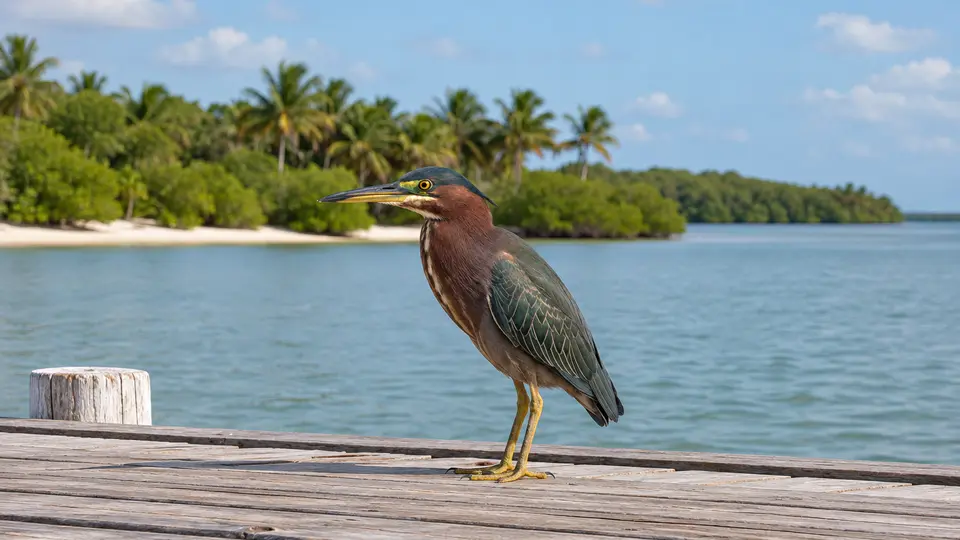
Green Heron in its natural habitat, AI illustration

Green HeronButorides virescensWhere and when to see them

Green Heron at a glance

The green heron is a small, compact American heron that often disappears against shaded wetland vegetation. Adults combine a dark greenish back with a chestnut neck and a sharp, straight bill. Florida supports resident birds as well as seasonal arrivals. Unlike large herons that commonly stand in open shallows, this species often hunts from low branches, roots or banks, making quiet attention to the water's edge more useful than broad scanning.

Behaviour & reproduction

Size
41–46 cm long
Weight
175–240 g
Lifespan
Not reliably established
Status
Least Concern

A green heron commonly waits motionless above shallow water, then extends its folded neck in a rapid strike. It also walks carefully along branches and muddy edges, changing position when prey remains scarce. Some individuals deliberately place bait on the surface to attract fish. Nesting usually occurs in shrubs or trees, singly or in loose groups. Disturbed birds may raise their crowns, flick their tails and depart with a sharp call. When alarmed or taking flight, the green heron often emits a distinctive, sharp 'skeow' call. Their flight pattern is characterized by slow, deliberate wing beats, often close to the water surface or through dense vegetation.

Top wildlife locations

Florida wildlife habitat

Florida

Mangrove boardwalks, sheltered coastal canals and pond margins provide accessible viewing habitat. No inland excursion is essential, although freshwater parks can be productive; dense vegetation often hides birds even at occupied sites.
Destinations describe the species' habitat, not guaranteed cruise stops. Some animals require an optional inland excursion or are found in restricted reserves.

Fun facts about the Green Heron

  • Some individuals use insects, feathers or other objects as fishing bait.
  • A folded neck makes the bird appear much shorter than it does while striking.
  • Its dark back can look almost black until light reveals the green sheen.
  • Both parents incubate eggs and feed the chicks.

Best time to see the Green Heron

Green herons can be watched in Florida throughout the year. Spring and summer bring breeding activity and additional migrants, while quieter winter wetlands still hold residents. Early morning or late afternoon often offers better activity and gentler light than the hottest midday hours. During the breeding season, green herons typically lay 2 to 6 eggs, which hatch after about 19 to 21 days. Outside of Florida, some northern populations migrate south for the winter, while Florida residents are generally year-round.

Green Heron: season matrix by destination

Travel and observation windows vary by region. Highlighted months are an orientation for planning, not confirmed sightings or a guarantee of access.

Florida

Residents make year-round watching plausible; migration, breeding and water levels influence local abundance.

JanFebMarAprMayJunJulAugSepOctNovDec
Cruise ships in Florida

Where the Green Heron lives

It uses mangroves, freshwater marsh margins, wooded ponds, canals and sheltered estuaries. Dense cover beside shallow water is particularly valuable. In Florida, natural wetlands and some urban waterways both provide habitat, provided there are secure perches, prey and suitable nesting vegetation nearby. This adaptable species is often found in both brackish and freshwater habitats throughout its range. It particularly favors areas with emergent vegetation like cattails or reeds, which provide excellent camouflage.

What the Green Heron eats

Small fish form the core of its diet, with crustaceans, aquatic insects, frogs and other small animals also taken. Hunting is usually close to cover rather than far out in open water. Prey is captured with a sudden bill thrust and swallowed whole. Green herons have an exceptionally long and flexible neck, allowing them to strike prey with surprising speed and reach from elevated perches. They are known to drop leaves or insects onto the water surface, observing and striking at fish drawn to the disturbance.

Species at a glance

Common name
Green Heron
Scientific name
Butorides virescens
Animal group
Birds
Size
41–46 cm long
Weight
175–240 g
Lifespan
Not reliably established
Status
Least Concern
Identification
Adults differ from night herons in their smaller size, chestnut neck and greenish back, while juveniles are slimmer and finer-billed than juvenile black-crowned night herons. The adult green heron's plumage appears dark overall at a distance, but closer views reveal rich chestnut on the neck and sides, and a glossy, dark greenish-blue cap and back. Their short, yellow legs and feet are also a good identifying feature, contrasting with their darker body.

Green Heron: frequently asked questions

Where can I see the Green Heron?
Florida. Pause at boardwalk edges and scan low roots before moving on. Do not use bait or approach concealed nests. Keep to designated paths near Florida waterways, where alligators and slippery banks present additional hazards. From a distance, look for their dark, hunched silhouette perched low over the water, often perfectly still. Patience is key when observing herons; a sudden movement can spook them, but sustained quiet observation often yields rewarding views of their hunting technique.
When is the best time to see the Green Heron?
Green herons can be watched in Florida throughout the year. Spring and summer bring breeding activity and additional migrants, while quieter winter wetlands still hold residents. Early morning or late afternoon often offers better activity and gentler light than the hottest midday hours. During the breeding season, green herons typically lay 2 to 6 eggs, which hatch after about 19 to 21 days. Outside of Florida, some northern populations migrate south for the winter, while Florida residents are generally year-round.
How big does the Green Heron get?
41–46 cm long. Adult weight: 175–240 g. Size varies with age, sex and population.
How should I behave around the Green Heron?
Pause at boardwalk edges and scan low roots before moving on. Do not use bait or approach concealed nests. Keep to designated paths near Florida waterways, where alligators and slippery banks present additional hazards. From a distance, look for their dark, hunched silhouette perched low over the water, often perfectly still. Patience is key when observing herons; a sudden movement can spook them, but sustained quiet observation often yields rewarding views of their hunting technique.
What does the Green Heron eat?
Small fish form the core of its diet, with crustaceans, aquatic insects, frogs and other small animals also taken. Hunting is usually close to cover rather than far out in open water. Prey is captured with a sudden bill thrust and swallowed whole. Green herons have an exceptionally long and flexible neck, allowing them to strike prey with surprising speed and reach from elevated perches. They are known to drop leaves or insects onto the water surface, observing and striking at fish drawn to the disturbance.
Are wildlife sightings guaranteed on an adventure cruise?
No. Animals move freely and routes, weather, access restrictions and local conditions influence every outing. Confirm the actual itinerary and shore program before booking.

Compare wildlife in the same destinations

Explore other birds recorded in these destinations. Similar surroundings do not mean the animals share the same habits or viewing season.

Species comparison by animal group and destination
Green HeronGreen HeronAnhingaAnhingaBald EagleBald Eagle
Animal groupBirdsAnimal groupBirdsAnimal groupBirds
DestinationsFloridaDestinationsFloridaDestinationsAlaska, Florida, New England
All wildlife destinations
Plan your trip

Find your next wildlife adventure

Compare destinations, shore programs and dates with the animals and habitats you would love to see.

  • Naturalist-led shore excursions
  • Responsible wildlife watching
  • Small expedition ships

Newsletter

Take Blue Rides with you

Adventure cruise offers, last-minute deals and trip inspiration.

Free, unsubscribe anytime. Details: Privacy Policy

Partner with Blue Rides

Affiliate Program

Recommend adventure cruises and earn commission on every confirmed booking.

Share. Track. Earn.

Your footage, our stage

Send us your videos or pictures.

Captured remarkable nature or wildlife on your journey? Share it with us, we may feature it on Blue Rides.