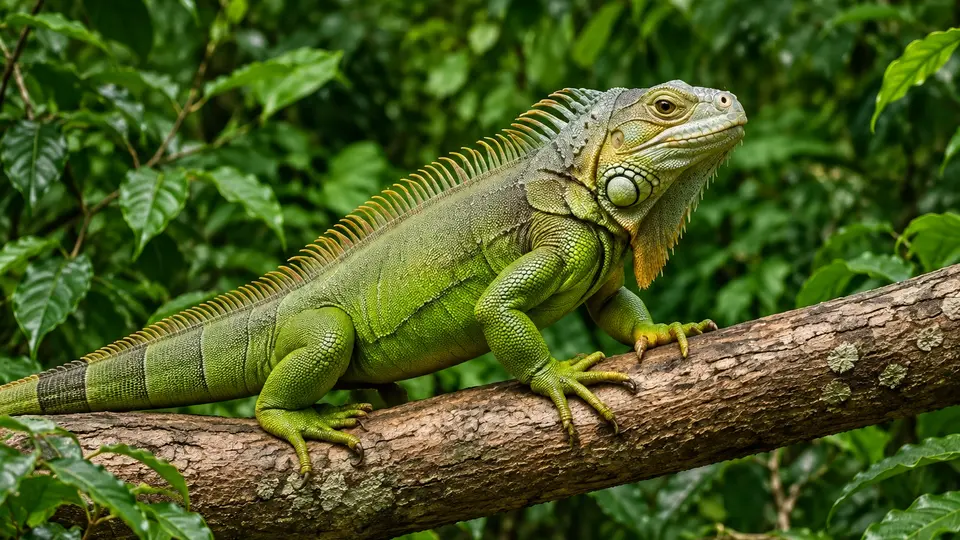
Green Iguana in its natural habitat, AI illustration

Green Iguana: where and when to see them

Iguana iguana

Green Iguana at a glance

The green iguana is a large, mostly plant-eating lizard native to tropical America, including Costa Rica. Its long tail, dorsal spines and hanging throat fan create a striking silhouette in riverside trees. Despite its name, adults may appear greyish, brown or orange rather than bright green. It is strongly associated with warm lowland habitats and frequently uses trees beside water, where foliage provides food, basking sites and escape routes.

Behaviour & reproduction

Size
1.2–1.8 m total length
Weight
2–5 kg
Lifespan
Not reliably established
Status
Least Concern

Green iguanas regulate body temperature by moving between sun and shade, often basking on exposed branches before feeding. Males use head movements, body posture and an expanded dewlap in territorial and courtship displays. When alarmed, an iguana may climb away, drop toward water or lash with its muscular tail if cornered. Females leave their usual tree cover to excavate nesting burrows, sometimes gathering where suitable sandy soil is limited. Courtship rituals involve head bobbing and dewlap displays from males, sometimes leading to competitive interactions for mating rights. When threatened, they can deliver a painful bite, and their whip-like tail is a powerful defense mechanism capable of breaking human skin.

Top wildlife locations

Costa Rica wildlife habitat

Costa Rica

Lowland riverbanks, mangrove margins and wooded coastal paths offer plausible views of basking animals. Inland excursions are optional, but some beaches favor spiny-tailed iguanas instead, so identification should be checked carefully.

Adventure cruises in Costa Rica

Destinations describe the species' habitat, not guaranteed cruise stops. Some animals require an optional inland excursion or are found in restricted reserves.

Fun facts about the Green Iguana

  • The dewlap functions in visual communication as well as contributing to its distinctive outline.
  • Much of an adult's total length consists of the tail.
  • Breeding males may become strongly orange in some populations.
  • Females lay their eggs in excavated underground chambers.

Best time to see the Green Iguana

Costa Rican lowland populations can be observed throughout the year. Sunny breaks encourage basking, while heavy rain may reduce visibility. The Pacific dry season often makes coastal travel easier, but Caribbean weather differs and neither pattern defines a nationwide iguana breeding calendar. While iguanas are present year-round, the dry season (December to April) often provides better viewing opportunities due to clearer weather and iguanas basking more prominently. However, nesting activities typically occur during the early part of the wet season, from May to June.

Green Iguana: season matrix by destination

Travel and observation windows vary by region. Highlighted months are an orientation for planning, not confirmed sightings or a guarantee of access.

Costa Rica

Year-round observation is possible; daily sunshine and regional rainfall are more useful predictors than a single national season.

JanFebMarAprMayJunJulAugSepOctNovDec
Cruise ships in Costa Rica

Where the Green Iguana lives

Typical habitat includes lowland forest edges, riparian woodland, mangroves and other warm landscapes with trees near water. Iguanas may also occupy gardens and disturbed areas where vegetation remains. Egg laying requires suitable ground, making riverbanks and sandy clearings important alongside the arboreal habitat adults use. They are semi-arboreal, spending much of their time in trees, but are also adept swimmers, often taking to water to escape predators. Young iguanas typically inhabit lower branches and dense vegetation for cover, while adults prefer higher canopies for basking and foraging.

What the Green Iguana eats

Adults primarily eat leaves, flowers and fruit, selecting seasonally available vegetation. Their digestive system relies on microbial fermentation to process fibrous food. Although occasional animal consumption is documented, they should be understood as predominantly herbivorous rather than treated as general-purpose scavengers. Juvenile iguanas consume more insects and spiders than adults, gradually transitioning to a largely herbivorous diet as they mature. This dietary shift is crucial for their growth and development, enabling them to process tougher plant matter.

Species at a glance

Common name
Green Iguana
Scientific name
Iguana iguana
Animal group
Reptiles
Size
1.2–1.8 m total length
Weight
2–5 kg
Lifespan
Not reliably established
Status
Least Concern
Identification
Compared with Costa Rica's black spiny-tailed iguana, it has a conspicuous large round scale below the ear and a long tail without strongly whorled rings of projecting spines. Beyond the large subtympanic scale, green iguanas in Costa Rica exhibit a prominent dorsal crest of soft spines running from the neck to the tail. Their coloration can vary from bright green to brownish gray, often with banding, depending on age, mood, and local environment.

Green Iguana: frequently asked questions

Where can I see the Green Iguana?
Costa Rica. Look upward from established riverside or coastal paths, keeping clear of branches directly beneath large animals. Never feed, grab or corner an iguana; sharp claws, teeth and powerful tail strikes can cause injuries. Scanning tree canopies with binoculars from a distance allows for detailed viewing without disturbing the animals. Pay attention to areas where branches overhang water, as iguanas frequently bask there and may drop into the water if startled.
When is the best time to see the Green Iguana?
Costa Rican lowland populations can be observed throughout the year. Sunny breaks encourage basking, while heavy rain may reduce visibility. The Pacific dry season often makes coastal travel easier, but Caribbean weather differs and neither pattern defines a nationwide iguana breeding calendar. While iguanas are present year-round, the dry season (December to April) often provides better viewing opportunities due to clearer weather and iguanas basking more prominently. However, nesting activities typically occur during the early part of the wet season, from May to June.
How big does the Green Iguana get?
1.2–1.8 m total length. Adult weight: 2–5 kg. Size varies with age, sex and population.
How should I behave around the Green Iguana?
Look upward from established riverside or coastal paths, keeping clear of branches directly beneath large animals. Never feed, grab or corner an iguana; sharp claws, teeth and powerful tail strikes can cause injuries. Scanning tree canopies with binoculars from a distance allows for detailed viewing without disturbing the animals. Pay attention to areas where branches overhang water, as iguanas frequently bask there and may drop into the water if startled.
What does the Green Iguana eat?
Adults primarily eat leaves, flowers and fruit, selecting seasonally available vegetation. Their digestive system relies on microbial fermentation to process fibrous food. Although occasional animal consumption is documented, they should be understood as predominantly herbivorous rather than treated as general-purpose scavengers. Juvenile iguanas consume more insects and spiders than adults, gradually transitioning to a largely herbivorous diet as they mature. This dietary shift is crucial for their growth and development, enabling them to process tougher plant matter.
Are wildlife sightings guaranteed on an adventure cruise?
No. Animals move freely and routes, weather, access restrictions and local conditions influence every outing. Confirm the actual itinerary and shore program before booking.

Compare wildlife in the same destinations

Explore other reptiles recorded in these destinations. Similar surroundings do not mean the animals share the same habits or viewing season.

Species comparison by animal group and destination
Green IguanaGreen IguanaAmerican CrocodileAmerican CrocodileCommon BasiliskCommon Basilisk
Animal groupReptilesAnimal groupReptilesAnimal groupReptiles
DestinationsCosta RicaDestinationsCosta Rica, FloridaDestinationsCosta Rica
All wildlife destinations
Plan your trip

Find your next wildlife adventure

Compare destinations, shore programs and dates with the animals and habitats you would love to see.

  • Naturalist-led shore excursions
  • Responsible wildlife watching
  • Small expedition ships

Newsletter

Take Blue Rides with you

Adventure cruise offers, last-minute deals and trip inspiration.

Free, unsubscribe anytime. Details: Privacy Policy

Partner with Blue Rides

Affiliate Program

Recommend adventure cruises and earn commission on every confirmed booking.

Share. Track. Earn.

Your footage, our stage

Send us your videos or pictures.

Captured beautiful landscapes or wildlife? Share your videos and pictures with us, we may feature them on Blue Rides.
