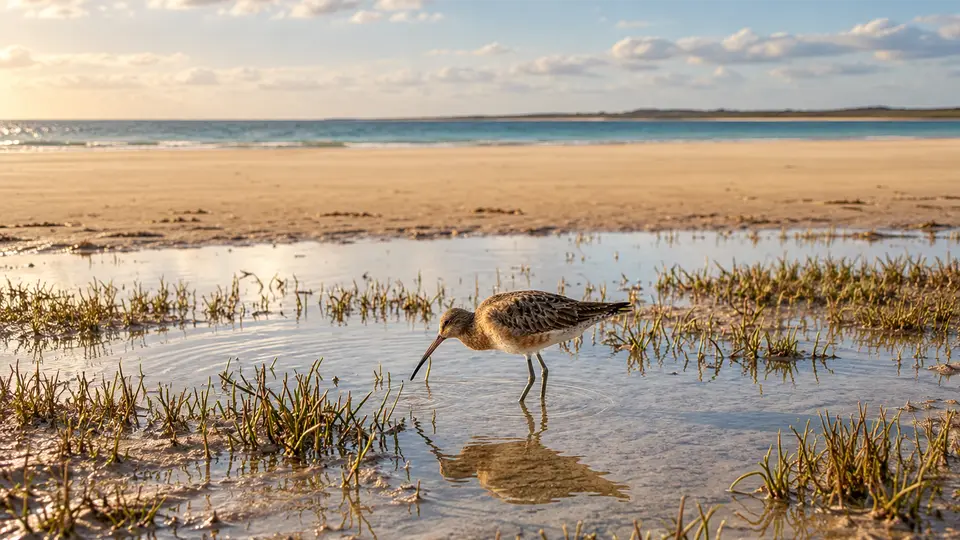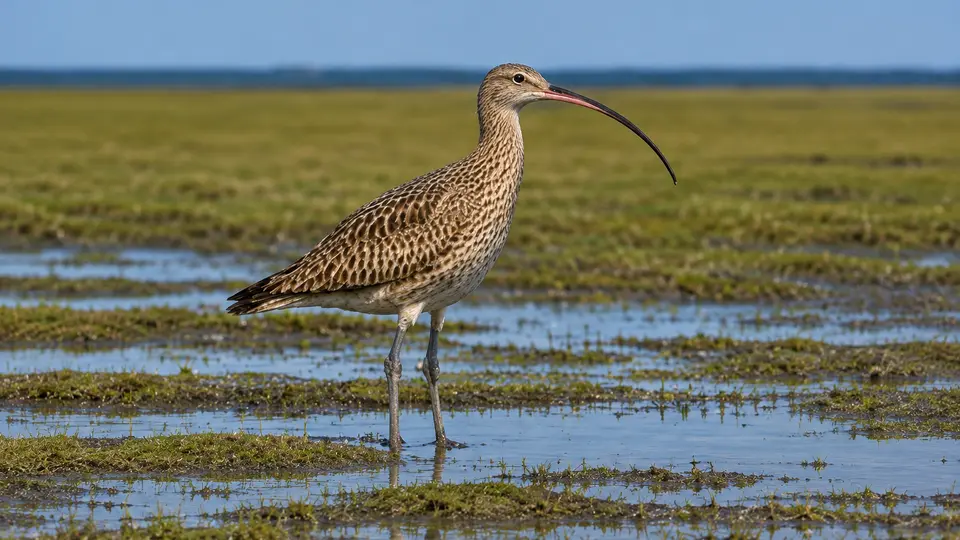
Eastern curlew in its natural habitat, AI illustration

Eastern curlew: where and when to see them

Numenius madagascariensis

Eastern curlew at a glance

The eastern curlew is the largest migratory shorebird regularly visiting Australia, recognizable by its extraordinarily long, downward-curving bill. It breeds in northeastern Asia and travels south along the East Asian-Australasian Flyway to coastal feeding grounds. Australia's estuaries support a major share of its nonbreeding population. Loss and degradation of intertidal habitat, especially at migration staging areas, have driven serious declines, making undisturbed feeding flats and secure high-tide roosts especially important.

Behaviour & reproduction

Size
53-66 cm long
Weight
600-1,300 g
Lifespan
Not reliably established
Status
Endangered

Eastern curlews spread across exposed mudflats as the tide falls, probing deeply and extracting prey with careful bill movements. They may wash muddy prey or manipulate a crab before swallowing it. Rising water pushes birds toward communal roosts on sandbanks, beaches or sheltered shorelines. They are wary and often flush well before a person approaches closely. Migration involves long flights punctuated by essential refuelling stops, while some immature birds remain in Australia through the northern breeding season. Eastern curlews spread across exposed mudflats as the tide falls, probing deeply and extracting prey with careful bill movements. They may wash muddy prey or manipulate a crab before swallowing it. Rising water pushes birds toward communal roosts on sandbanks, beaches or sheltered shorelines. They are wary and often flush well before a person approaches closely. Migration involves long flights punctuated by essential refuelling stops, while some immature birds remain in Australia through the northern breeding season. During migration, they can cover thousands of kilometers, often flying in V-formations. Post-breeding adults begin their southward migration to Australia from July to September.

Top wildlife locations

Australia wildlife habitat

Australia

Sheltered mainland estuaries and broad tidal bays provide suitable shore-viewing habitat, especially from existing hides or foreshore paths. Distribution is uneven, and disturbance-sensitive roosts may be closed or inaccessible to visitors.

Adventure cruises in Australia

Destinations describe the species' habitat, not guaranteed cruise stops. Some animals require an optional inland excursion or are found in restricted reserves.

Fun facts about the Eastern curlew

  • Females usually have noticeably longer bills than males.
  • Its breeding grounds and Australian feeding grounds lie in different hemispheres.
  • Some young birds postpone their first northward breeding migration.
  • A long bill lets it exploit deeply buried prey unavailable to shorter-billed shorebirds.

Best time to see the Eastern curlew

In much of coastal Australia, September through March offers the strongest seasonal overlap with nonbreeding eastern curlews. Arrival and departure dates vary by latitude, and a few birds remain year-round. Tide timing usually matters more for viewing than the time of day. In much of coastal Australia, September through March offers the strongest seasonal overlap with nonbreeding eastern curlews. Arrival and departure dates vary by latitude, and a few birds remain year-round. Tide timing usually matters more for viewing than the time of day. Peak numbers are typically observed during the austral summer months. Viewing opportunities are often best on a falling tide, as more mudflat is exposed.

Eastern curlew: season matrix by destination

Travel and observation windows vary by region. Highlighted months are an orientation for planning, not confirmed sightings or a guarantee of access.

Australia

This is the main nonbreeding observation window across much of Australia; local counts, tides and regional migration timing determine actual availability.

JanFebMarAprMayJunJulAugSepOctNovDec
Cruise ships in Australia

Where the Eastern curlew lives

Australian habitat consists mainly of sheltered estuaries, tidal mudflats, mangrove-fringed inlets and broad coastal embayments. Nearby undisturbed roosting ground is essential at high tide. Breeding habitat is very different, including wet meadows, bogs and open marshy landscapes in northeastern Asia. Australian habitat consists mainly of sheltered estuaries, tidal mudflats, mangrove-fringed inlets and broad coastal embayments. Nearby undisturbed roosting ground is essential at high tide. Breeding habitat is very different, including wet meadows, bogs and open marshy landscapes in northeastern Asia. This species is highly dependent on specific coastal wetland types, making them vulnerable to habitat degradation and loss. Critical habitat sites are often protected under international agreements due to their importance for migratory shorebirds.

What the Eastern curlew eats

Crabs are especially important on Australian nonbreeding grounds, alongside other crustaceans, marine worms and molluscs. The exceptionally long bill reaches prey buried beyond the reach of many smaller shorebirds. Females generally have longer bills, allowing some differences in feeding depth. Crabs are especially important on Australian nonbreeding grounds, alongside other crustaceans, marine worms and molluscs. The exceptionally long bill reaches prey buried beyond the reach of many smaller shorebirds. Females generally have longer bills, allowing some differences in feeding depth. They often target burrowing invertebrates like polychaete worms and yabbies. The curlew's specialized bill allows it to locate prey by touch even in murky substrates, a technique known as tactile foraging.

Species at a glance

Common name
Eastern curlew
Scientific name
Numenius madagascariensis
Animal group
Birds
Size
53-66 cm long
Weight
600-1,300 g
Lifespan
Not reliably established
Status
Endangered
Identification
Its huge size, exceptionally long bill and brown rump distinguish it from the smaller whimbrel and the usually white-rumped Eurasian curlew. Its huge size, exceptionally long bill and brown rump distinguish it from the smaller whimbrel and the usually white-rumped Eurasian curlew. Look for its distinctive downcurved bill, which can be up to 20 cm long. The overall plumage is mottled brown, providing excellent camouflage against muddy backgrounds. The absence of a prominent head stripe also helps differentiate it from Whimbrels.

Eastern curlew: frequently asked questions

Where can I see the Eastern curlew?
Australia. Use a telescope from an established shore viewpoint and keep well away from high-tide roosts. If birds stop feeding or walk away, retreat; repeated disturbance wastes energy needed for migration. Keep dogs away. Use a telescope from an established shore viewpoint and keep well away from high-tide roosts. If birds stop feeding or walk away, retreat; repeated disturbance wastes energy needed for migration. Keep dogs away. Maintaining a respectful distance is crucial for their survival, particularly for a critically endangered species. Binoculars are helpful for close-up views of plumage details and feeding behavior without causing stress.
When is the best time to see the Eastern curlew?
In much of coastal Australia, September through March offers the strongest seasonal overlap with nonbreeding eastern curlews. Arrival and departure dates vary by latitude, and a few birds remain year-round. Tide timing usually matters more for viewing than the time of day. In much of coastal Australia, September through March offers the strongest seasonal overlap with nonbreeding eastern curlews. Arrival and departure dates vary by latitude, and a few birds remain year-round. Tide timing usually matters more for viewing than the time of day. Peak numbers are typically observed during the austral summer months. Viewing opportunities are often best on a falling tide, as more mudflat is exposed.
How big does the Eastern curlew get?
53-66 cm long. Adult weight: 600-1,300 g. Size varies with age, sex and population.
How should I behave around the Eastern curlew?
Use a telescope from an established shore viewpoint and keep well away from high-tide roosts. If birds stop feeding or walk away, retreat; repeated disturbance wastes energy needed for migration. Keep dogs away. Use a telescope from an established shore viewpoint and keep well away from high-tide roosts. If birds stop feeding or walk away, retreat; repeated disturbance wastes energy needed for migration. Keep dogs away. Maintaining a respectful distance is crucial for their survival, particularly for a critically endangered species. Binoculars are helpful for close-up views of plumage details and feeding behavior without causing stress.
What does the Eastern curlew eat?
Crabs are especially important on Australian nonbreeding grounds, alongside other crustaceans, marine worms and molluscs. The exceptionally long bill reaches prey buried beyond the reach of many smaller shorebirds. Females generally have longer bills, allowing some differences in feeding depth. Crabs are especially important on Australian nonbreeding grounds, alongside other crustaceans, marine worms and molluscs. The exceptionally long bill reaches prey buried beyond the reach of many smaller shorebirds. Females generally have longer bills, allowing some differences in feeding depth. They often target burrowing invertebrates like polychaete worms and yabbies. The curlew's specialized bill allows it to locate prey by touch even in murky substrates, a technique known as tactile foraging.
Are wildlife sightings guaranteed on an adventure cruise?
No. Animals move freely and routes, weather, access restrictions and local conditions influence every outing. Confirm the actual itinerary and shore programme before booking.

Compare wildlife in the same destinations

Explore other birds recorded in these destinations. Similar surroundings do not mean the animals share the same habits or viewing season.

Species comparison by animal group and destination
Eastern curlewEastern curlewAustralian pelicanAustralian pelicanBar-tailed godwitBar-tailed godwit
Animal groupBirdsAnimal groupBirdsAnimal groupBirds
DestinationsAustraliaDestinationsAustraliaDestinationsAustralia, New Zealand
All wildlife destinations
Plan your trip

Find your next wildlife adventure

Compare destinations, shore programmes and dates with the animals and habitats you would love to see.

  • Naturalist-led shore excursions
  • Responsible wildlife watching
  • Small expedition ships

Newsletter

Take Blue Rides with you

Adventure cruise offers, last-minute deals and trip inspiration.

Free, unsubscribe anytime. Details: Privacy Policy

Partner with Blue Rides

Affiliate Program

Recommend adventure cruises and earn commission on every confirmed booking.

Share. Track. Earn.